- Your cart is empty
- Continue Shopping


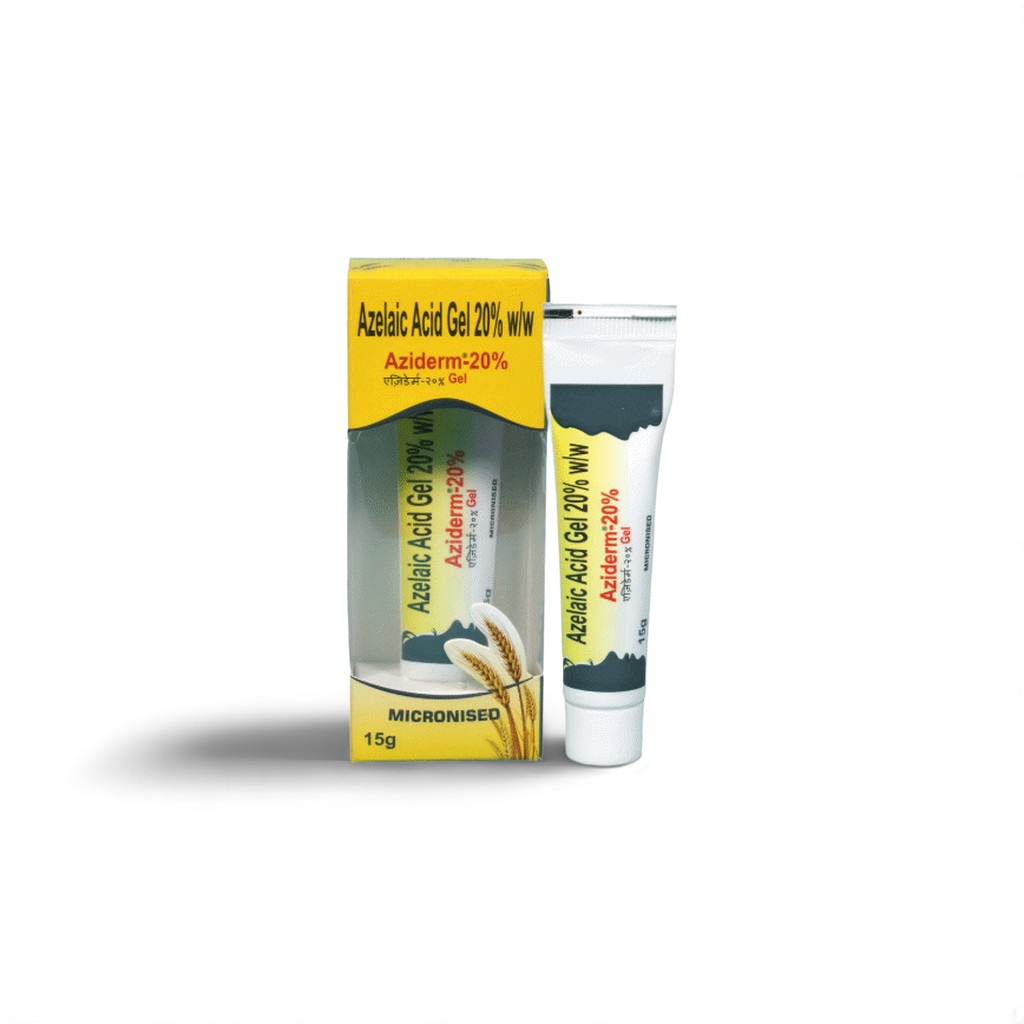
Price range: $14.00 through $58.00
✅ Active Ingredient Overview Table:
| 🔬 Active Ingredient (Generic Name): | Azelaic Acid |
|---|---|
| 💊 Indication: | Acne Vulgaris (Comedonal & Inflammatory Lesions), Rosacea, Post-Inflammatory Hyperpigmentation, Melasma |
| 🇺🇸 US Brand Equivalent: | Azelex (Galderma), Finacea (Finacea 15% Foam) |
| 🏭 Manufacturer: | Micro Labs Limited (Founded: 1973) |
| 📦 Packaging: | 15 g Tube |
| 🧪 Strength: | 20% w/w |
| 🚚 Delivery Time: | 6–15 days |
Aziderm 20% Gel delivers a higher concentration of azelaic acid to provide enhanced treatment for acne, rosacea, melasma, and post-inflammatory hyperpigmentation (PIH). Azelaic acid in a 20% formulation offers superior comedolytic, antibacterial, and anti-inflammatory effects compared to lower strengths. Beyond acne, 20% gel is clinically proven to reduce hyperpigmented lesions by inhibiting tyrosinase activity, making it effective for melasma and PIH in diverse skin types.
Acne patients may experience persistent papules, pustules, and dark spots even after inflammation subsides. Aziderm 20% works by normalizing keratinocyte differentiation, reducing follicular blockage, and inhibiting Propionibacterium acnes, while also decreasing reactive oxygen species and inflammatory cytokines. The double-strength gel accelerates lesion clearance and pigment fading, improving skin clarity and patient confidence.
Rosacea sufferers benefit from azelaic acid’s ability to reduce erythema and papulopustular lesions without the irritation often associated with topical antibiotics. For melasma and PIH, Aziderm 20% inhibits melanin synthesis and reduces melanocyte proliferation, leading to gradual lightening of hyperpigmented spots over 8–16 weeks.
| Attribute | Detail |
|---|---|
| Chemical Formula | C9H16O4 |
| Molecular Weight | 188.22 g/mol |
| Mode of Action | Inhibits tyrosinase → reduces melanin synthesis; normalizes keratinocyte proliferation; bacteriostatic against P. acnes; anti-inflammatory |
| Local Activity | Decreases reactive oxygen species; modulates inflammatory mediators |
| Condition | Application |
|---|---|
| Acne Vulgaris | • Cleanse and dry affected areas. |
| • Apply a thin layer of 20% gel twice daily (morning and evening). | |
| • Continue for at least 12 weeks for clinical improvement. | |
| Rosacea | • Apply a pea-sized amount to inflamed and erythematous areas twice daily. |
| • Monitor for increased sensitivity; continue up to 16 weeks. | |
| Post-Inflammatory Hyperpigmentation (PIH) & Melasma | • Apply to pigment-affected areas twice daily. |
| • Use daily SPF 30+ sunscreen; continue for 16–24 weeks. |
Avoid contact with eyes, mouth, and mucous membranes. Use non-comedogenic moisturizer to minimize dryness.
Common:
Serious (rare):
Advise patients to perform a patch test before full-face application. Start with once-daily use if sensitivity occurs, then increase to twice daily. Discontinue if severe irritation develops.
Store Aziderm 20% Gel at 20–25°C in its original tube. Protect from light and high humidity. Keep out of reach of children.
Micro Labs’ Aziderm 20% Gel offers a potent, cost-effective option. Ensure compliance with local prescribing guidelines.
“Azelaic acid 20% gel provides enhanced efficacy for stubborn acne, rosacea, and hyperpigmentation. Its multi-targeted action, including tyrosinase inhibition, makes it a valuable option for patients with mixed lesions.”
| Active | Azelaic Acid |
|---|---|
| Tube's | 1, 3, 6 |