
- Your cart is empty
- Continue Shopping

First Blood Transfusion to a Human: 1667 Sensation and Court Case | Medical History
-
Dr. Tina Sugandh
- Posted on
🏥 Medical History • Blood Transfusion • Jean-Baptiste Denis • 1667
The First Blood Transfusion to a Human: A Scientific Sensation and a Court Case
📍 June 15, 1667 • Paris, France • Louis XIV’s physician • 6 min read
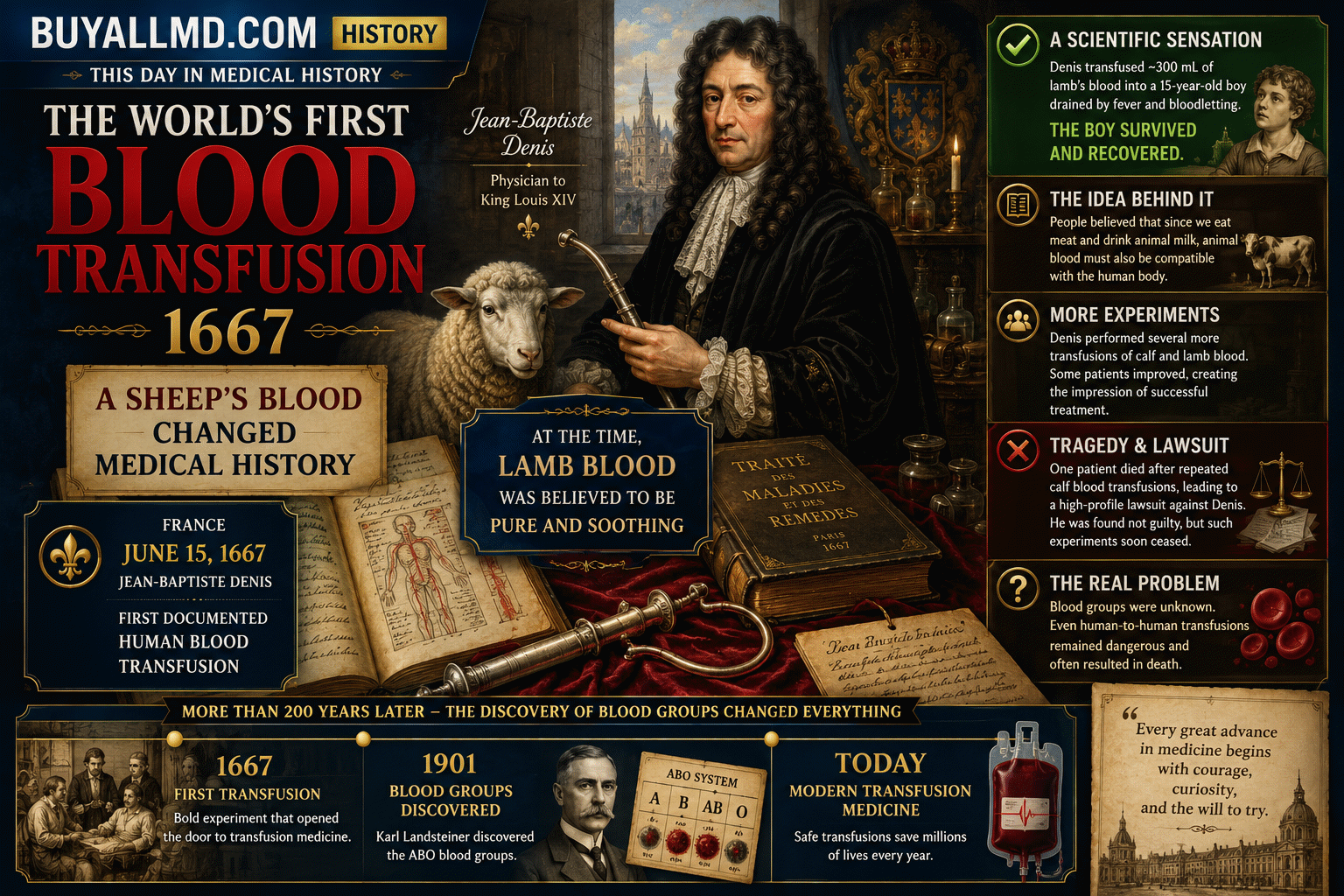
🏥 On June 15, 1667, French physician Jean-Baptiste Denis transfused approximately 300 ml of lamb blood into a 15-year-old boy — the first documented blood transfusion to a human.
On June 15, 1667, French physician Jean-Baptiste Denis — personal physician to King Louis XIV — performed the first documented blood transfusion to a human. The patient was a 15-year-old boy, weakened by numerous bloodlettings due to fever. Denis transfused approximately 300 milliliters of lamb blood through a silver cannula. The boy survived and recovered, instantly making the experiment a sensation in European scientific circles.
📜 The Historical Context: Bloodletting and Animal Blood
In the 17th century, bloodletting was a standard medical practice for treating a wide range of ailments, including fever. The boy had undergone numerous bloodlettings, which had left him severely weakened. Denis saw transfusion as a way to restore the lost blood.
Denis’s logic was based on the beliefs of his time: lamb’s blood was considered “pure” and “calming”, and since people ate meat and drank animal milk, animal blood was assumed to be compatible with the human body.
💡 The procedure: Blood was drawn from a lamb’s carotid artery and transferred through a silver cannula into the boy’s vein. The amount was approximately 300 ml — roughly the volume of a modern blood donation.
🩸 June 15, 1667: The Procedure
On that day, Denis transfused approximately 300 ml of lamb’s blood into the boy’s veins. The patient survived and showed signs of improvement, which Denis attributed to the transfusion.
This success made Denis a celebrity in scientific circles across Europe. He performed several more transfusions using blood from calves and lambs on different patients. Some patients indeed felt better — likely because the small volumes of transfused blood reduced the risk of severe complications, creating the impression of successful treatment.
⚖️ The Downfall: A Patient Dies and a Court Case Follows
Denis’s later experiments ended in tragedy. One patient died after multiple transfusions of calf blood, leading to a high-profile court case against Denis. Although he was acquitted and found not guilty, the scandal effectively ended xenotransfusion (animal-to-human blood transfusion) experiments for over a century.
Denis was eventually cleared of blame, and the court ruled that the death was due to poisoning by other substances. However, the case had already caused enough controversy to halt further experimentation for decades.
💡 The irony: Even after Denis’s acquittal, the French Parliament prohibited blood transfusions without prior approval from the Faculty of Medicine. Similar bans were enacted in England and Rome. Human-to-human blood transfusions also remained dangerous and often fatal for over 200 years.
🔬 Why Did Transfusions Fail? The Science Behind the Deaths
We now know that Denis’s transfusions failed because of immune incompatibility:
- Xenotransfusion (animal-to-human): Human immune systems attack animal blood cells, causing severe, often fatal reactions.
- Human-to-human transfusions (without blood typing): Without knowledge of blood groups (A, B, AB, O), incompatible transfusions caused hemolytic reactions, kidney failure, and death.
It wasn’t until 1900 that Karl Landsteiner discovered the ABO blood group system, explaining why many early transfusions failed. Landsteiner’s discovery earned him the Nobel Prize in Physiology or Medicine in 1930 and laid the foundation for modern transfusion medicine.
📅 A Brief Timeline of Transfusion Medicine
1667 — First human transfusion (Denis, lamb blood)
1818 — First human-to-human transfusion (James Blundell, UK)
1900 — Karl Landsteiner discovers ABO blood groups
1907 — First transfusion using cross-matching
1939-1940 — Rh factor discovered
1940s-1950s — Modern blood banking begins
🏛️ Denis’s Legacy
Despite his fall from favor, Denis’s contribution to medical history is significant. He was the first to document a human blood transfusion and to advocate for the procedure as a legitimate treatment. While the science of his time could not explain the failures, his work — along with that of later pioneers — eventually led to the life-saving practice of modern transfusion medicine.
✅ Key Takeaways
- First documented human blood transfusion: June 15, 1667
- Performed by Jean-Baptiste Denis (physician to Louis XIV)
- Patient: 15-year-old boy, 300 ml of lamb’s blood
- Patient survived — but later transfusions led to patient deaths
- Successful transfusion was sheer luck (small volume, compatible by chance)
- Denis was acquitted, but the scandal halted xenotransfusion for over 100 years
⚠️ The Science Behind the Failures
- Animal blood is incompatible with human immune systems
- ABO blood groups were unknown until 1900
- Without cross-matching, transfusions were a fatal gamble
- It took over 200 years to make transfusions safe
🔬 Historical References & External Resources
- NCBI PMC — The history of blood transfusion
- PubMed — Jean-Baptiste Denis and the first blood transfusion
- Wikipedia — Jean-Baptiste Denis
- BBC — The history of blood transfusions
⚠️ Historical & Medical Disclaimer: This article provides educational information about the history of blood transfusion. Modern transfusions are safe and life-saving procedures performed under strict medical protocols. Do not attempt any medical procedures based on historical accounts. This information is for educational purposes only.
© 2026 BuyAllMD.com — Evidence-Based Medical History & Research News
