
- Your cart is empty
- Continue Shopping
What You Need to Know About Liver Cysts
-
Dr. Tina Sugandh
- Posted on
🩺 Hepatology • Liver Cysts • Polycystic Liver Disease • Echinococcosis
Liver Cysts: Three Different Diseases Under One Diagnosis
📍 Hepatology & Gastroenterology • Anatomy • 6 min read
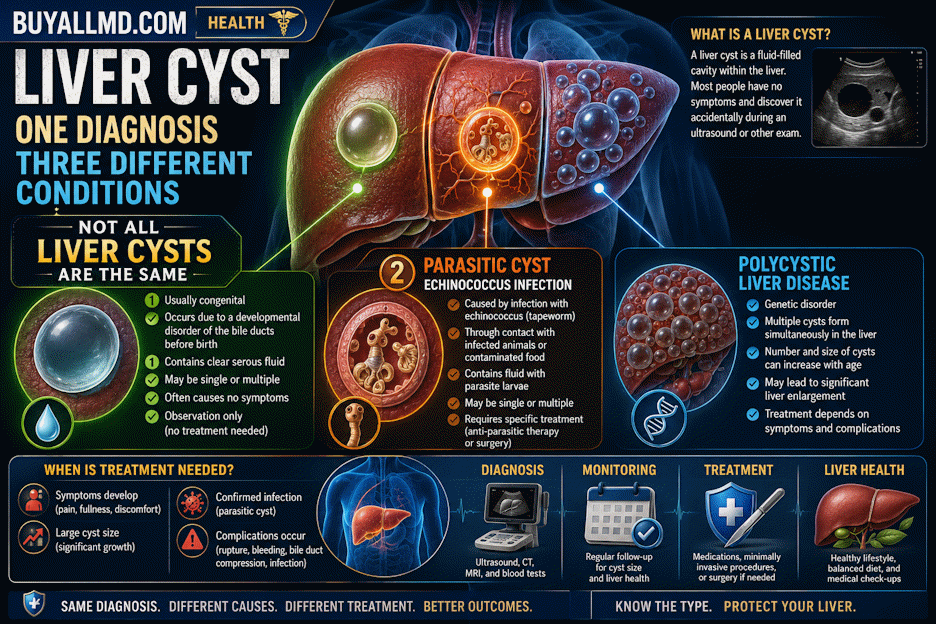
🩺 Liver cysts come in three main types: simple cysts (serous fluid), parasitic cysts (echinococcosis), and polycystic liver disease (multiple cysts).
A liver cyst is a fluid-filled cavity within the liver. Most people discover them incidentally during an ultrasound or other examination — they often cause no symptoms for years. Several types of liver cysts exist, each differing in origin, contents, and treatment approach.
💧 Simple Liver Cyst
The most common type. Usually congenital, arising from abnormal development of the bile ducts before birth. It contains clear serous fluid and can be either solitary or multiple. In most cases, it causes no symptoms.
📌 Key features: Congenital, clear fluid, usually asymptomatic
📊 Prevalence: ~2-5% of the population (often found incidentally)
🩺 Management: Observation only — no treatment needed unless symptomatic
🪱 Parasitic Cyst (Echinococcosis)
Occurs when infected with Echinococcus tapeworms — through contact with infected animals or contaminated food. Inside the cyst is fluid containing parasite larvae. These cysts can be solitary or multiple and require specific medical treatment.
⚠️ Cause: Echinococcus infection (E. granulosus or E. multilocularis)
⚠️ Transmission: Contact with infected animals (sheep, dogs, foxes) or contaminated food
⚠️ Treatment: Requires specific therapy — usually albendazole and/or surgical removal
🫁 Polycystic Liver Disease
A genetic condition in which numerous cysts form simultaneously in the liver. The number and size of cysts can increase with age. In some cases, this can lead to significant enlargement of the liver and, in rare instances, liver failure.
🧬 Cause: Genetic (often associated with polycystic kidney disease)
📈 Progression: Cysts increase in number and size with age
🩺 Management: Depends on cyst number, size, and symptoms — observation or intervention as needed
💡 Key takeaway: “Liver cyst” is not one single condition. The approach to management depends entirely on the type — simple, parasitic, or polycystic.
📋 Treatment and Management: Type-Dependent Approach
💧 Simple Cyst (Asymptomatic)
No treatment — observation and monitoring only. Regular ultrasound follow-up may be recommended.
💧 Simple Cyst (Symptomatic)
May require aspiration, sclerotherapy, or surgical removal if causing pain, compression, or complications.
🪱 Parasitic Cyst
Must be treated. Therapy includes albendazole (anti-parasitic medication) and often surgical removal to prevent complications.
🫁 Polycystic Liver Disease
Management depends on severity — from observation to medical therapy (somatostatin analogs) to surgical intervention (fenestration, resection, or in severe cases, transplantation).
📊 Comparison of Liver Cyst Types
| Feature | Simple Cyst | Parasitic Cyst | Polycystic Disease |
|---|---|---|---|
| Cause | Congenital (bile duct malformation) | Echinococcus infection | Genetic |
| Contents | Clear serous fluid | Fluid + parasite larvae | Serous fluid (multiple cysts) |
| Treatment | Observation (asymptomatic) or aspiration/surgery (symptomatic) | Albendazole + surgery | Observation, medication, or surgery |
| Prognosis | Excellent (benign) | Good with treatment | Variable — can progress |
⚠️ When to consult a hepatologist or gastroenterologist:
- Incidental finding of a liver cyst on imaging
- Upper abdominal pain, fullness, or early satiety
- History of travel to endemic areas (parasitic cyst risk)
- Family history of polycystic kidney or liver disease
- New or worsening symptoms
✅ Key Takeaways
- Liver cyst is a broad term covering three different conditions
- Simple cyst: Most common, congenital, usually benign
- Parasitic cyst: Caused by Echinococcus — requires specific treatment
- Polycystic disease: Genetic, multiple cysts, can progress
- Management depends on type, symptoms, and severity
⚠️ Important Caveats
- Most liver cysts are incidental findings and benign
- Rare complications: rupture, infection, compression, hemorrhage
- Parasitic cysts require urgent specialist management
- Polycystic disease may progress — regular follow-up is essential
🔬 Scientific References & External Resources
- PubMed — Liver cyst classification
- PubMed — Echinococcosis treatment guidelines
- PubMed — Polycystic liver disease management
- NCBI — Liver cysts overview
- WHO — Echinococcosis (parasitic cysts)
⚠️ Medical Disclaimer: This article provides educational information about liver cysts. It is not a substitute for professional medical advice, diagnosis, or treatment. If you have been told you have a liver cyst or are experiencing symptoms, consult a qualified healthcare provider for proper evaluation and management. This information is for educational purposes only.
© 2026 BuyAllMD.com — Evidence-Based Health & Medical Education News
