
- Your cart is empty
- Continue Shopping
Mechanism That Allows Tumors to Hide From the Immune System
-
Dr. Tina Sugandh
- Posted on
🧬 Immunology • Cancer Research • Immunotherapy • Oncology
Scientists Find Mechanism That Allows Tumors to Hide From the Immune System
📋 Chiba University • Thymus • Plasmacytoid Dendritic Cells • CCR9 • Science Advances • 7 min read
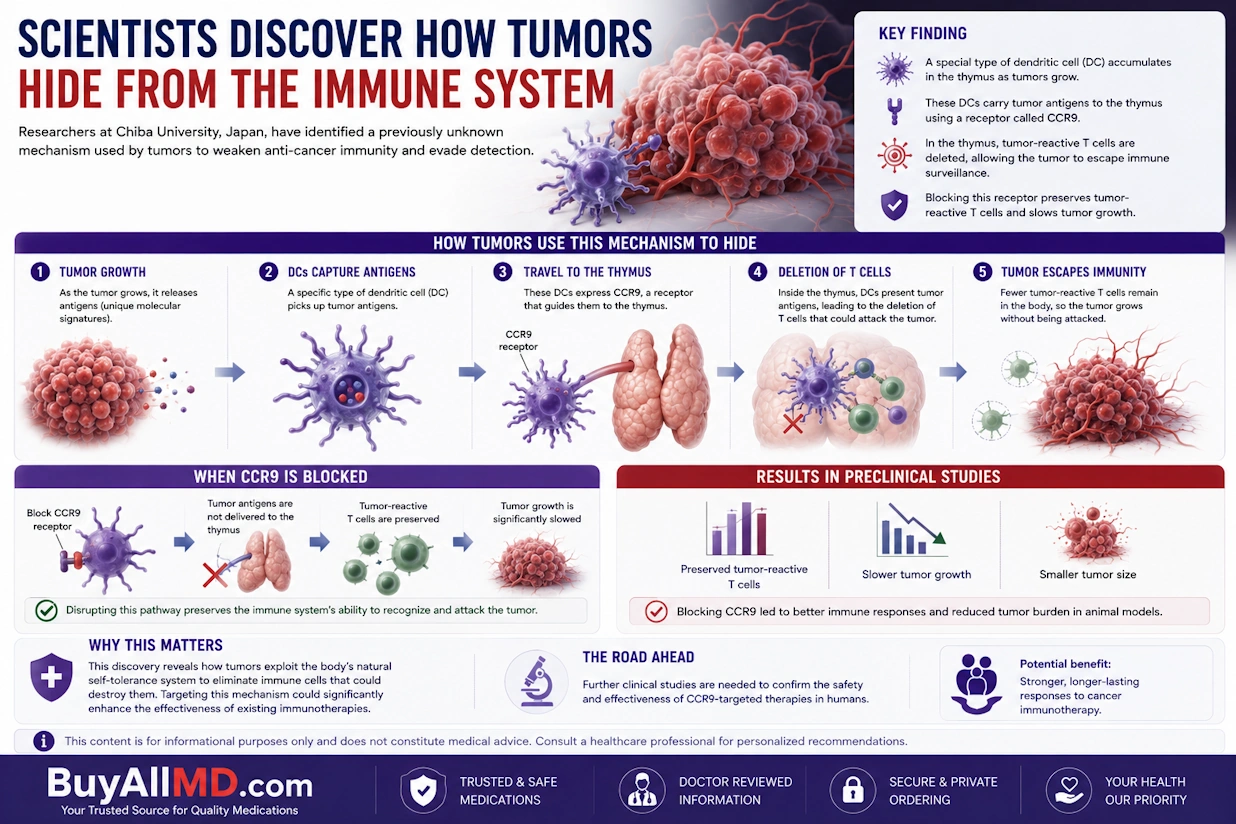
🧬 Researchers have discovered that tumors can hijack the body’s immune tolerance machinery — using the thymus to “train” the immune system to tolerate cancer instead of attacking it.
🧬 The Discovery — A Previously Unknown Immune Evasion Pathway
In Japan, scientists from Chiba University have discovered a previously unknown mechanism by which tumors weaken anti-cancer immunity. As tumors grow, a specific type of immune cell — plasmacytoid dendritic cells (pDCs) — increasingly accumulates in the thymus, the organ that normally “trains” immune cells to recognize foreign threats.
The study, published in Science Advances, reveals that tumors can hijack the physiological machinery of central tolerance — the body’s system for preventing autoimmune disease — to induce systemic immune unresponsiveness against themselves.
🔬
First Discovery
Previously unknown immune evasion pathway
🧬
Thymus Manipulation
Tumors hijack central tolerance
🎯
CCR9 Target
New therapeutic target identified
💡 Key Insight: “Our findings suggest that tumors can hijack the physiological machinery of central tolerance to induce systemic immune unresponsiveness against themselves,” said Professor Motoko Y. Kimura, who led the study.
🔬 How Tumors Manipulate the Thymus
The researchers found that as tumors grow, they recruit plasmacytoid dendritic cells (pDCs) that transport tumor antigens to the thymus. There, they trigger the elimination of developing T cells capable of recognizing the tumor.
Two distinct pDC populations contribute to this immune evasion:
1️⃣
CDP-pDCs — Antigen Transporters
These cells capture tumor antigens in the periphery and migrate to the thymus via CCR9. They present these antigens to developing T cells, causing the thymus to eliminate tumor-reactive T cells.
2️⃣
CLP-pDCs — Immune Suppressors
These cells accumulate in the thymus and release type I interferon (IFN-α), altering the thymic environment and suppressing the production of new T cells.
📌 Key Mechanism: “Tumors can hijack the physiological machinery of central tolerance to induce systemic immune unresponsiveness against themselves,” the researchers explained.
🧬 CCR9 — The Key to Tumor Evasion
The pDCs reach the thymus through a receptor called CCR9 on their surface. This chemokine receptor directs these immune cells to the thymus, where they carry tumor antigens and trigger immune tolerance.
🔑
CCR9 Deficiency
When the function of CCR9 was disrupted, tumor-reactive T cells were preserved, and tumor growth was significantly slowed.
📉
Smaller Tumors
Mice lacking CCR9 developed significantly smaller tumors and maintained more cancer-fighting CD8+ T cells.
🎯
Therapeutic Target
“CCR9 is a potential therapeutic target in cancer immunotherapy,” said first author Dr. Yangsong Wang.
💡 Key Finding: “By blocking the migration of tumor antigen-carrying pDCs from tumors to the thymus, it may be possible to enhance anti-tumor immunity and improve responses to existing treatments such as immune checkpoint inhibitors,” said Dr. Wang.
💊 Implications for Cancer Immunotherapy
Immune checkpoint inhibitors have transformed cancer treatment over the past decade, but many patients either fail to respond or eventually develop resistance. The researchers believe that preventing tumors from establishing immune tolerance in the thymus could make these therapies more effective.
🔄
Enhanced Checkpoint Inhibitors
Blocking CCR9 could improve responses to immune checkpoint inhibitors by preventing tumors from establishing systemic tolerance.
🧬
New Combination Therapies
Future therapies could combine existing immune-activating treatments with drugs that block this newly identified thymic tolerance pathway.
🦠
Beyond Cancer
The findings may also have implications for chronic infections that persist in the body and might exploit similar thymic tolerance pathways.
🔬 The Experimental Evidence — Key Findings
| Observation | Finding |
|---|---|
| pDC Accumulation | pDCs accumulated in the thymus within 14 days of tumor implantation and persisted as tumors grew. |
| CCR9 Dependence | pDC migration to the thymus was CCR9-dependent — genetic removal of CCR9 largely blocked this process. |
| Two pDC Populations | Two distinct pDC populations contribute: CDP-pDCs (antigen transporters) and CLP-pDCs (immune suppressors). |
| Tumor Growth | CCR9-deficient mice developed significantly smaller tumors and maintained tumor-specific CD8+ T cells. |
👨🔬 Expert Perspective
“Our findings reveal a previously unrecognized mechanism of tumor immune evasion through manipulating thymic function. By blocking the migration of tumor antigen-carrying pDCs from tumors to the thymus, it may be possible to enhance anti-tumor immunity and improve responses to existing treatments such as immune checkpoint inhibitors.”
— Dr. Yangsong Wang, First Author
“Our findings suggest that tumors can hijack the physiological machinery of central tolerance to induce systemic immune unresponsiveness against themselves. The study identifies CCR9 as a potential therapeutic target in cancer immunotherapy.”
— Professor Motoko Y. Kimura, Lead Researcher
❓ Frequently Asked Questions
What did the Chiba University study discover?
Researchers discovered that tumors can manipulate the thymus — the organ that trains immune cells — to teach the immune system to tolerate cancer instead of attacking it. This is achieved through the accumulation of plasmacytoid dendritic cells (pDCs) that carry tumor antigens to the thymus and eliminate tumor-reactive T cells.
What is the role of CCR9 in this process?
CCR9 is a chemokine receptor that directs pDCs to the thymus. When CCR9 function was disrupted, pDCs could not migrate to the thymus, tumor-reactive T cells were preserved, and tumor growth was significantly slowed.
What are the two types of pDCs involved?
CDP-derived pDCs capture tumor antigens and present them in the thymus, leading to the deletion of tumor-reactive T cells. CLP-derived pDCs release type I interferon (IFN-α), altering the thymic environment and suppressing the production of new T cells.
How could this discovery improve cancer immunotherapy?
By blocking the migration of tumor antigen-carrying pDCs to the thymus, it may be possible to enhance anti-tumor immunity and improve responses to existing immune checkpoint inhibitors. This could be especially valuable for patients who currently fail to respond to immunotherapy.
Could this mechanism also apply to other diseases?
Yes. The researchers note that chronic or dormant infections that persist in the body for long periods could potentially exploit similar thymic tolerance pathways to evade immune responses.
📚 References & Resources
- Science Advances — Original Study
- PubMed — Study Abstract
- EurekAlert! — Research News
- The Week — Coverage
- Chiba University — Official Site
⚠️ Medical Disclaimer
This content is for informational and educational purposes only. The research findings discussed are preliminary and based on animal studies. They have not yet been tested in humans and are not currently available as a treatment. This information does not constitute medical advice. Always consult a qualified healthcare professional for personalized health guidance, especially if you have concerns about cancer, immunotherapy, or other medical conditions.
© 2026 BuyAllMD.com — Evidence-Based Immunology & Cancer Research News
