
- Your cart is empty
- Continue Shopping
AI in Surgery — Musk’s 3-Year Prediction
-
Dr. Tina Sugandh
- Posted on
🤖 AI & Robotics • Healthcare Innovation • Bioethics • Future of Medicine
Musk Claims Robot Surgeons Will Surpass the World’s Best Doctors Within Three Years
📋 Tesla Optimus • Moonshots Podcast • Surgery Automation • AI in Healthcare • 6 min read
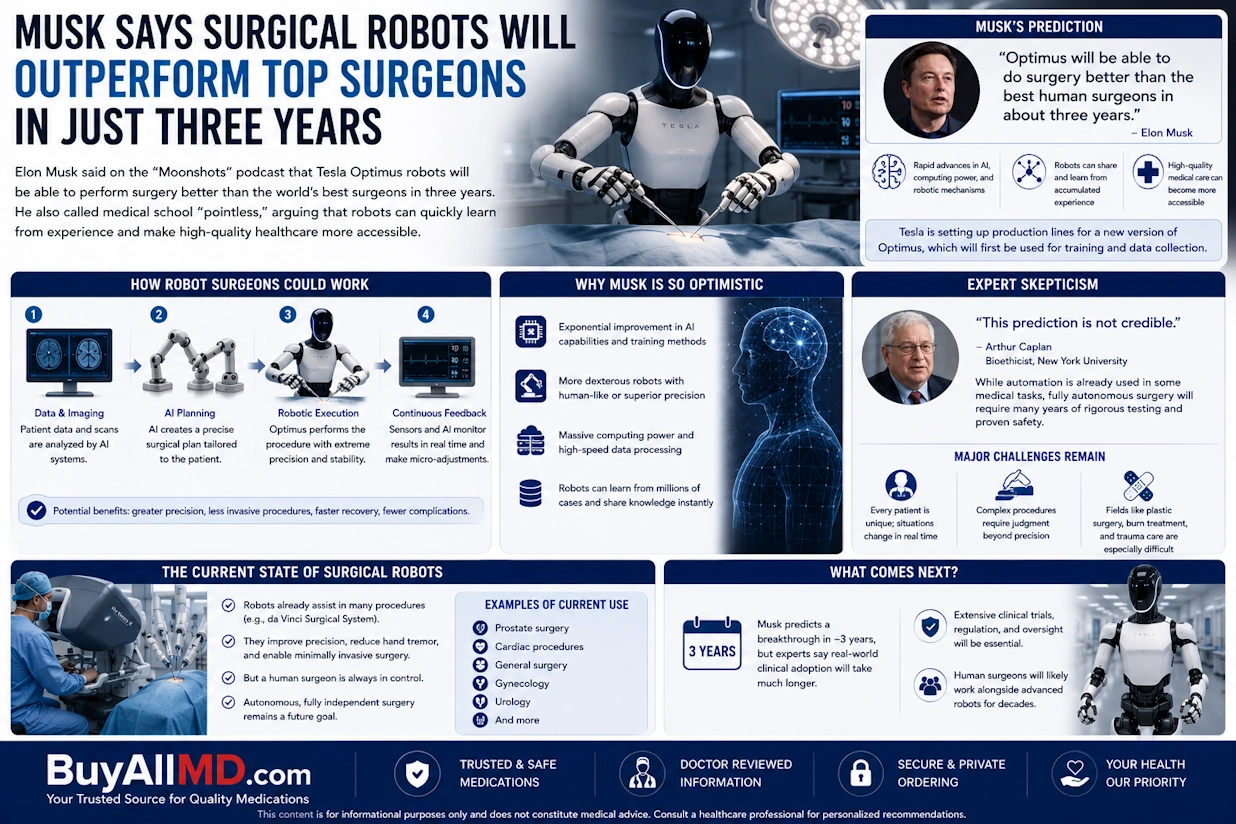
🤖 Elon Musk has made a bold prediction: Tesla’s Optimus humanoid robot will outperform the world’s best surgeons within three years — a claim met with both excitement and skepticism.
🤖 Musk’s Bold Prediction — The End of Human Surgeons?
Elon Musk, CEO of Tesla and SpaceX, made a striking prediction on the Moonshots podcast hosted by physician and engineer Peter Diamandis. He claimed that Tesla’s humanoid robot Optimus will surpass the world’s best human surgeons within three years.
According to Musk, the number of robots capable of performing surgeries at the highest level will eventually exceed the total number of human surgeons currently in the world. He argued that medical school is becoming “pointless” because robots will soon be able to rapidly learn and replicate surgical expertise. By 2030, he predicted, there will be more Optimus robots performing excellent surgery than the total number of surgeons on Earth.
🤖
3-Year Timeline
Optimus to surpass human surgeons
💊
Medical School “Pointless”
Musk’s controversial take on medical education
⚡
Three Exponential Factors
Software, chip performance, mechanical precision
💡 Key Claim: Musk believes that the combination of advancing AI, computing power, and robotics precision will create a breakthrough that makes human surgeons obsolete within a few years.
🧠 Musk’s Argument — Why Robots Will Win
Musk’s argument rests on several observations about the limitations of human surgeons and the advantages of automation:
🕐
Training Takes Too Long
Becoming a good doctor requires over a decade of training, while medical knowledge evolves faster than any individual can absorb.
😴
Human Limitations
Humans are prone to fatigue, errors, and limited attention — robots do not tire, forget, or make mistakes.
🔄
Scalable Expertise
Machines can share experiences and replicate best practices endlessly once trained — making expertise infinitely scalable.
🏭 Tesla’s Plans — From Production Line to Operating Room
Tesla has set an ambitious timeline for the Optimus robot. The company announced the industrial launch of the Optimus Gen 3 for the first quarter of 2026, with mass commercial production planned for the end of 2027.
Tesla’s goal is to produce 1 million Optimus units per year. The robot is designed for sub-millimeter precision and is intended for use in logistics, manufacturing, and eventually healthcare — including surgery.
📅
Gen 3 Launch
Q1 2026 — Industrial launch of Optimus Gen 3.
🌍
Mass Production
End of 2027 — Worldwide commercial rollout.
🏭
Scale Target
1 million units per year — making Optimus a product of mass consumption.
📌 Key Detail: Optimus is currently being used by Tesla for training and data collection on their own production lines. The robot’s ability to pick up and manipulate objects like eggs without breaking them is considered a non-trivial step toward surgical applications.
👨⚕️ Expert Skepticism — “Not Credible”
Many medical experts have strongly pushed back against Musk’s prediction. Arthur Caplan, a bioethics professor at NYU Grossman School of Medicine, called the timeline “not credible.” He emphasized that even modern surgical robots are developing quite slowly.
❌
Surgery Is an “Art”
“In many fields, surgery remains an art that requires human intuition, clinical judgment, ethics, and legal responsibility — elements that AI cannot yet fully replace.”
🧬
Individual Variation
“The individual differences in the human body are immense, and this complexity is difficult to adapt through standardized programming.”
⏱️
Regulatory Hurdles
“Clinical validation and regulatory approval alone would stretch any aggressive timeline. Even if Optimus progresses quickly, the bar for surgical work is not a simple extension of warehouse dexterity.”
⚠️ Critical Warning: “If vehicles still cannot fully drive themselves in complex urban environments, then the automation of surgical procedures, which is more difficult and has a lower tolerance for error, would require even more time.” — Arthur Caplan, NYU Bioethicist
📊 Expert Perspectives — The Skeptics vs. The Visionaries
| Expert | Perspective | Key Concern |
|---|---|---|
| Arthur Caplan (NYU Bioethicist) | Skeptical | Timeline “not credible”; surgery is an “art” requiring human intuition |
| Will Walden (Podcast Host) | Cautious | “We all know Elon Musk time” — regulatory approval could take a decade |
| Arthur Caplan (NYU Bioethicist) | Skeptical | “Even modern surgical robots are developing quite slowly” |
🧩 The Challenges — Why 3 Years Is Unlikely
⚖️
Regulatory Approval
A robot that acts with broad autonomy would face a higher standard, stepwise validation, and multi-year trials that match specific indications.
🧬
Surgical Complexity
Surgical tasks couple fine motion with millisecond-level reactions to living tissue and changing vitals. Plastic surgery, burns, and trauma remain particularly complex.
🤖
Dexterity Gap
“The thing can barely pick up an egg right now. Can it handle a tool like a scalpel? Can it pick up a scalpel and manipulate it, roll it in its fingers, and also use it to precisely cut into a person’s body?”
💬 Expert Voices — What the Critics Are Saying
“Musk’s statements are ‘not credible.’ In many fields, surgery remains an ‘art’ that requires human intuition. The individual differences in the human body are immense, and this complexity is difficult to adapt through standardized programming.”
— Arthur Caplan, Professor of Bioethics, NYU Grossman School of Medicine
“Even if Optimus progresses quickly, the bar for surgical work is not a simple extension of warehouse dexterity. Surgical tasks couple fine motion with millisecond-level reactions to living tissue and changing vitals. A robot that acts with broad autonomy would face a higher standard, stepwise validation, and multi-year trials.”
— Will Walden, Podcast Host (Elon Musk Podcast)
❓ Frequently Asked Questions
What did Elon Musk say about robot surgeons?
Musk claimed that Tesla’s Optimus humanoid robot will surpass the world’s best human surgeons within three years. He argued that medical school is becoming “pointless” and that robots will soon be able to rapidly learn and replicate surgical expertise.
What is the Optimus robot?
Optimus is a humanoid robot developed by Tesla. It is designed for general-purpose tasks including logistics, manufacturing, and potentially surgery. The Gen 3 version is planned for launch in Q1 2026, with mass production by end of 2027.
What do experts say about Musk’s prediction?
Medical experts, including bioethicist Arthur Caplan from NYU, have strongly pushed back, calling the timeline “not credible.” They point to the complexity of surgery, the need for human intuition, and the significant regulatory hurdles that would take years to overcome.
When will Optimus be available for surgery?
Tesla plans to launch Optimus Gen 3 in Q1 2026 for industrial use, with mass production by end of 2027. However, clinical surgical applications would require additional years of testing, validation, and regulatory approval — making Musk’s 3-year timeline highly unlikely according to experts.
Is medical school becoming “pointless”?
Musk made this controversial statement, but experts strongly disagree. Even if robots eventually assist in surgery, clinical judgment, ethics, patient communication, and complex decision-making remain uniquely human skills that AI cannot yet fully replace.
📚 References & Resources
- Aju Press — Musk May Be Wrong on Doctors
- AIbase — Musk’s Shocking Comments
- Vietnam.vn — Robot Surgeons Prediction
- Autoplus — Optimus Gen 3 in Operating Rooms
- Podscan.fm — Can Optimus Perform Surgery?
⚠️ Medical Disclaimer
This content is for informational and educational purposes only. The statements made by Elon Musk are speculative predictions and do not constitute medical advice. Tesla’s Optimus robot has not yet been tested or approved for any clinical or surgical application. Always consult a qualified healthcare professional for personalized health guidance.
© 2026 BuyAllMD.com — Evidence-Based Health & Technology News
