
- Your cart is empty
- Continue Shopping
Gut Bacteria
-
Dr. Tina Sugandh
- Posted on
🧬 Oncology • Immunotherapy • Synthetic Biology • Microbiome
Scientists Engineer Gut Bacteria to Fight Pancreatic Cancer
📋 University of Chicago • Bifidobacterium longum • Interleukin-2 • Bugs as Drugs • 6 min read
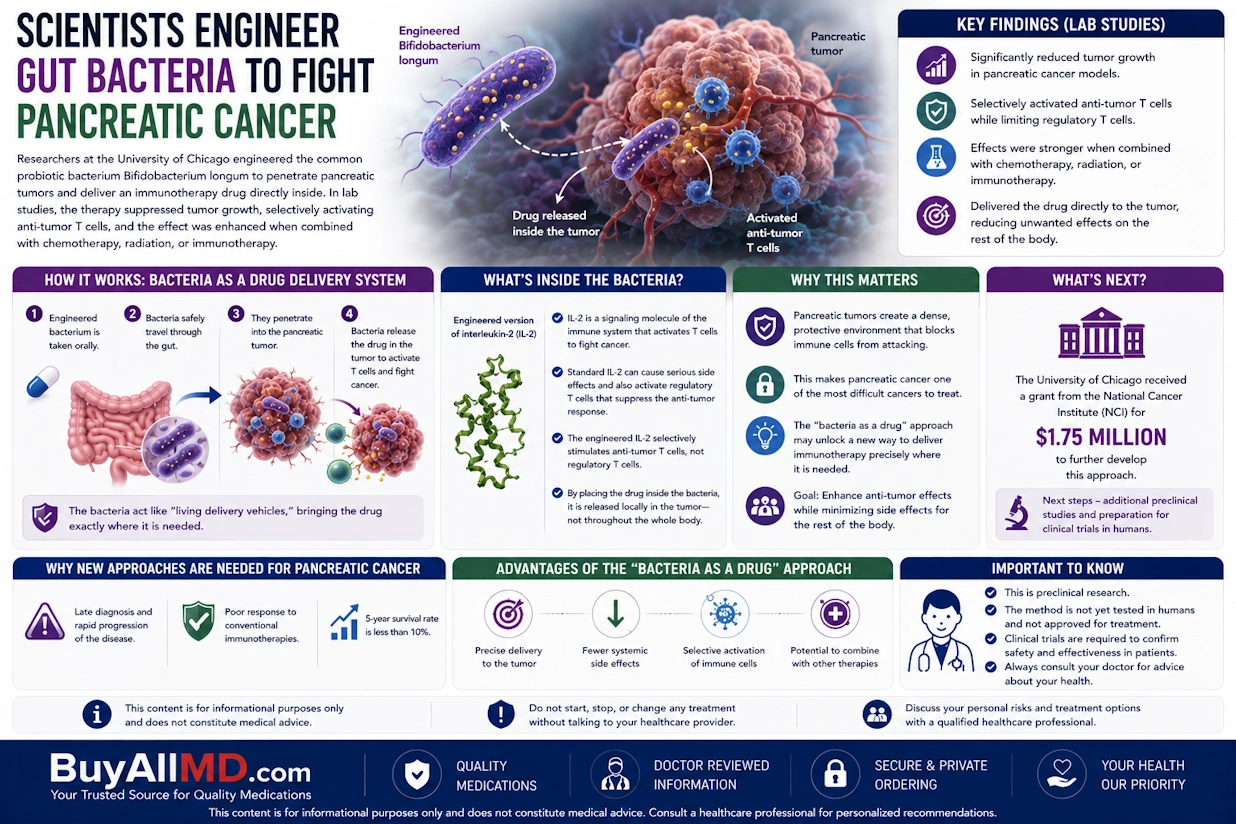
🧬 Researchers at the University of Chicago have engineered a probiotic bacterium to deliver immunotherapy directly inside pancreatic tumors — a promising “bugs as drugs” strategy.
🧬 The Discovery — Engineering Bacteria to Fight Cancer
In the United States, scientists from the University of Chicago have modified Bifidobacterium longum — a common probiotic bacterium found in the gut — to penetrate pancreatic tumors and deliver an immunotherapeutic drug directly inside them. In laboratory studies, the therapy suppressed tumor growth by selectively activating anti-tumor T cells, and the effect was enhanced when combined with chemotherapy, radiotherapy, or immunotherapy.
The study, published in Science Advances, offers a potentially powerful approach for improving treatment response in pancreatic cancer — one of the most difficult-to-treat malignancies.
🧬
B. longum
Engineered probiotic bacterium
🧪
SumIL-2
Engineered IL-2 variant
💰
$1.75M Grant
From the National Cancer Institute
💡 Key Finding: “BifidoSumIL-2 not only works by itself — it works with radiotherapy, chemotherapy and immunotherapy,” said Dr. Ralph Weichselbaum, lead researcher.
🔬 How the Therapy Works — The “Bugs as Drugs” Strategy
The therapy, called BifidoSumIL-2, is designed to release a modified form of interleukin-2 (IL-2) inside tumors. IL-2 is a powerful immune molecule that activates T cells, which help the body fight cancer. However, traditional IL-2 therapy can cause harmful side effects and may also activate immune cells that suppress the antitumor response.
1️⃣
Engineered Bacteria
B. longum is modified to carry SumIL-2 — an engineered IL-2 variant that preferentially activates cancer-fighting T cells.
2️⃣
Tumor Targeting
B. longum is an obligate anaerobe — it thrives in low-oxygen environments like solid tumors, but is cleared from oxygen-rich healthy tissues.
3️⃣
Local Drug Delivery
The bacteria act as microscopic drug factories, releasing SumIL-2 only at the tumor site — limiting side effects elsewhere in the body.
📌 Key Insight: “Bifidobacterium is not the easiest organism to work with — it’s anaerobic, it grows slowly, and the genetic tools for manipulating it are much more limited compared to model bacteria like E. coli. A lot of the work was just figuring out how to reliably engineer it,” said Dr. Mark Mimee.
🩺 The Challenge — Pancreatic Cancer’s “Cold” Microenvironment
Pancreatic tumors are particularly difficult to treat because they create a “cold” tumor microenvironment that prevents the body’s natural immune cells from mounting a strong attack. This immunosuppressive environment is one of the main reasons why pancreatic cancer remains one of the deadliest malignancies.
🛡️
Immunosuppressive Barrier
Pancreatic tumors create a protective shield that blocks immune cell attack, making standard immunotherapies largely ineffective.
🧬
Low Response Rates
Pancreatic ductal adenocarcinoma (PDAC) remains largely unresponsive to immune checkpoint inhibitors.
📊
Unmet Medical Need
“A big unmet medical need has been pancreatic cancer, and so that was going to be our mountain to climb,” said Dr. Ralph Weichselbaum.
📊 Key Findings — Preclinical Results
| Finding | Result |
|---|---|
| Tumor Suppression | BifidoSumIL-2 significantly suppressed tumor growth in both subcutaneous and orthotopic PDAC models. |
| Immune Activation | Selectively activated cancer-fighting CD8+ T cells while limiting regulatory T cell activation. |
| Tumor Microenvironment | Improved Teff/Treg ratio — reshaping the tumor’s immune landscape. |
| Combination Effects | Enhanced tumor control when combined with chemotherapy, radiation, or anti-PD-L1 immunotherapy. |
💡 Key Data: “This combination potential is one of the study’s most important findings,” said Dr. Weichselbaum. “BifidoSumIL-2 not only works by itself — it works with radiotherapy, chemotherapy and immunotherapy.”
🧬 SumIL-2 — An Engineered IL-2 Variant
The therapy is based on a modified version of interleukin-2 (IL-2), a signaling molecule of the immune system that activates T cells to fight cancer. Traditional IL-2 therapy can cause serious side effects and may unintentionally activate regulatory T cells that suppress the anti-tumor response.
To overcome this, the team created SumIL-2 — an engineered version of IL-2 designed to selectively stimulate anti-tumor T cells while limiting activation of regulatory T cells. By placing SumIL-2 inside B. longum, the therapy is released directly inside tumors rather than throughout the body.
🔬 Next Steps — From Lab to Clinic
Although the results are promising, BifidoSumIL-2 has not yet been tested in humans. Future studies will need to evaluate:
🛡️
Long-Term Safety
Evaluating safety, possible off-target effects, and durability of the immune response.
💊
Delivery Method
Whether the bacteria can be delivered orally rather than by injection.
🧬
Combination Strategies
Combining with newer pancreatic cancer therapies, including KRAS inhibitors.
💡 Funding: The University of Chicago received a $1.75 million grant from the National Cancer Institute to further develop this approach.
❓ Frequently Asked Questions
What did the University of Chicago study discover?
Researchers engineered Bifidobacterium longum — a gut probiotic — to deliver an engineered form of interleukin-2 (SumIL-2) directly into pancreatic tumors. The therapy suppressed tumor growth and was enhanced when combined with standard cancer treatments.
Why is pancreatic cancer so difficult to treat?
Pancreatic tumors create a “cold” tumor microenvironment that prevents immune cells from attacking the cancer. This immunosuppressive barrier makes standard immunotherapies largely ineffective.
What is Bifidobacterium longum and why was it chosen?
B. longum is a probiotic bacterium naturally found in the gut. It is an obligate anaerobe, meaning it thrives in low-oxygen environments — a common feature of solid tumors. This allows it to target tumors while being cleared from healthy tissues.
How does SumIL-2 differ from traditional IL-2 therapy?
Traditional IL-2 therapy can cause serious side effects and may activate regulatory T cells that suppress the anti-tumor response. SumIL-2 is engineered to selectively activate cancer-fighting T cells while limiting these effects.
Is this treatment available to patients now?
No. BifidoSumIL-2 has not yet been tested in humans. It is currently in preclinical development. Further studies are needed to evaluate safety, dosing, and efficacy before human trials can begin.
📚 References & Resources
- University of Chicago — News Release
- EurekAlert! — Bugs as Drugs Strategy
- PubMed — BifidoSumIL-2 Study Abstract
- UChicago Medicine — Cancer Research
- NCI — Pancreatic Cancer Information
⚠️ Medical Disclaimer
This content is for informational and educational purposes only. The research findings discussed are preliminary and based on preclinical studies — they have not yet been tested in humans and are not currently available as a treatment. This information does not constitute medical advice. Always consult a qualified healthcare professional for personalized health guidance, especially if you have concerns about cancer or any other medical condition.
© 2026 AusPharmX.com — Evidence-Based Oncology & Immunotherapy News
