- Your cart is empty
- Continue Shopping



Price range: $70.00 through $170.00
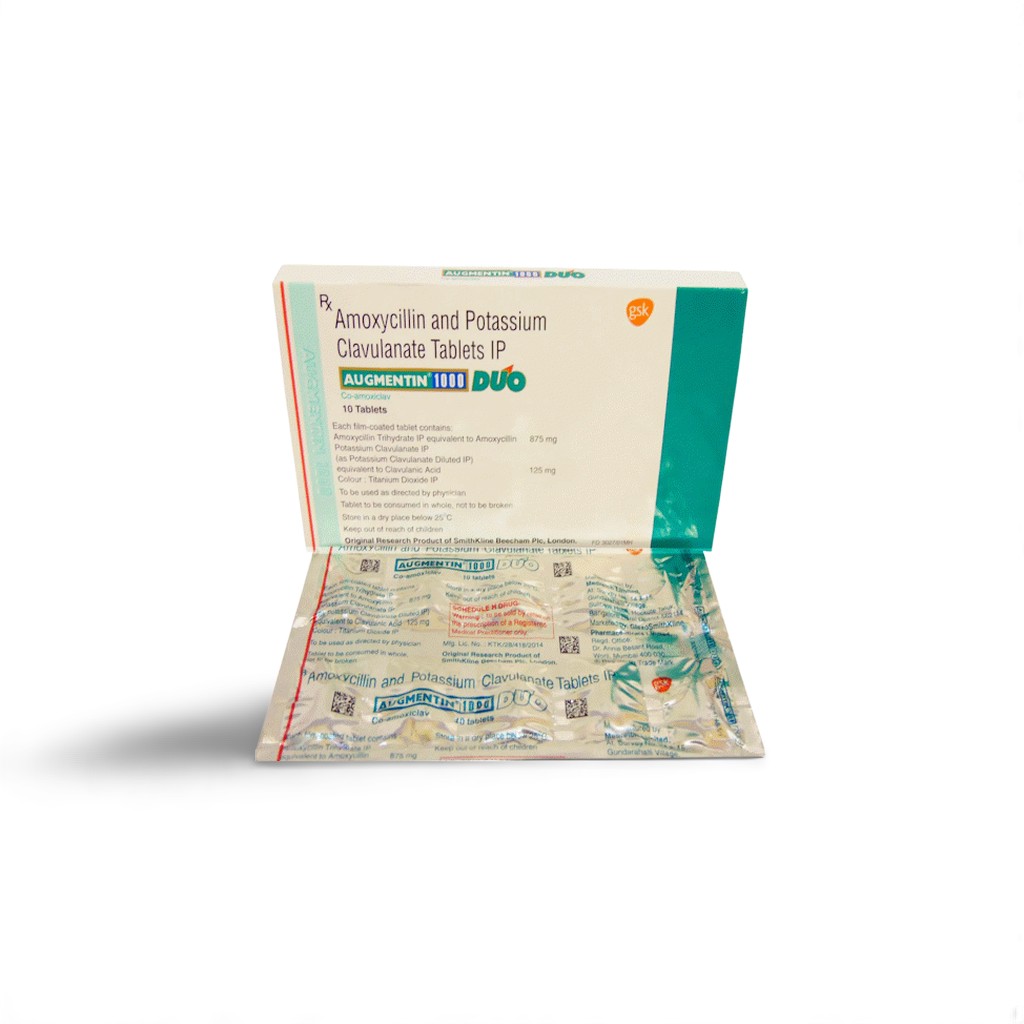
✅ Active Ingredient Overview Table:
| 🔬 Active Ingredients: | Amoxicillin 875 mg + Clavulanic Acid 125 mg |
|---|---|
| 💊 Indication: | Bacterial Infections (Respiratory, Skin, ENT, Urinary) |
| 🇺🇸 US Brand Equivalent: | Augmentin |
| 🏭 Manufacturer: | GlaxoSmithKline Pharmaceuticals Ltd (Founded: 2000) |
| 📦 Packaging: | 10 Tablets per Strip |
| 🧪 Strength: | 1000 mg (875/125 mg) |
| 🚚 Delivery Time: | 6–15 days |
Augmentin Duo 1000 mg is a high-strength combination antibiotic that pairs Amoxicillin, a broad-spectrum penicillin, with Clavulanic Acid, a potent β-lactamase inhibitor. By protecting Amoxicillin from enzymatic degradation, Clavulanic Acid extends the antibiotic’s activity against β-lactamase–producing bacteria, including resistant strains of Staphylococcus aureus, Haemophilus influenzae, Moraxella catarrhalis, and various anaerobes. This makes Augmentin Duo 1000 mg ideal for serious or resistant infections such as complicated sinusitis, community-acquired pneumonia, diabetic foot infections, and severe urinary tract infections.
Unlike standard-dose formulations, Augmentin Duo 1000 mg delivers a higher Amoxicillin component for maximal bactericidal effect in moderate-to-severe infections. Additionally, the ratio of Amoxicillin to Clavulanic Acid has been optimized to balance efficacy with tolerability, minimizing gastrointestinal side effects while ensuring broad-spectrum coverage. Patients with refractory or hospital-substituted infections often benefit from this high-dose regimen, paired with clinical monitoring and appropriate duration.
| Component | Mechanism |
|---|---|
| Amoxicillin 875 mg | • Binds to penicillin-binding proteins (PBPs) → inhibits bacterial cell wall synthesis → bactericidal activity. |
| Clavulanic Acid 125 mg | • Irreversibly inhibits β-lactamase enzymes produced by resistant bacteria → protects Amoxicillin from degradation → restores activity against β-lactamase–producers. |
| Pharmacokinetics | • Absorption: ~75–80% oral bioavailability; minimal effect of food. |
| • Distribution: High tissue penetration, including middle ear, sinuses, lung, and bone. | |
| • Metabolism & Excretion: Excreted primarily unchanged in urine; Clavulanic Acid partially metabolized in liver. | |
| • Half-Life: Amoxicillin: ~1 hour; Clavulanic Acid: ~1 hour. |
| Condition | Recommended Regimen |
|---|---|
| Severe Sinusitis (Adults) | 1000 mg twice daily for 10–14 days (may extend to 21 days based on clinical response). |
| Community-Acquired Pneumonia (Moderate-to-Severe) | 1000 mg three times daily for 7–10 days (adjust based on severity and patient factors). |
| Diabetic Foot Infection (Mild-to-Moderate) | 1000 mg twice daily for 7–14 days (alongside wound care and glycemic control). |
| Complicated Urinary Tract Infection (UTI) | 1000 mg twice daily for 7 days (adjust for renal impairment; extend to 10–14 days if needed). |
| Skin & Soft Tissue Infections (Moderate-to-Severe) | 1000 mg twice daily for 7–10 days (e.g., cellulitis, abscesses requiring broad-spectrum coverage). |
| Intra-Abdominal Infections (with Metronidazole) | 1000 mg twice daily plus Metronidazole 500 mg three times daily for 5–7 days. |
Common Side Effects (≥1%):
Less Common:
Serious (Rare):
Precautions:
Store Augmentin Duo 1000 mg tablets at 20–25°C (68–77°F). Protect from moisture and excessive heat. Keep tablets in original strip until use. Discard any expired tablets. Keep out of reach of children.
Augmentin Duo 1000 mg serves patients with serious infections, but regional availability and brand naming may vary.
Importing Augmentin Duo from India:
International patients may opt to import GSK’s Augmentin Duo 1000 mg from India for cost savings. Ensure a valid prescription, verify regulatory compliance (FDA, TGA, MHRA approvals or import permits), and confirm authenticity through batch certificates to avoid counterfeit medicines.
“Augmentin Duo 1000 mg provides an enhanced Amoxicillin dose, crucial for tackling resistant or deep-seated bacterial infections. Prescribers must emphasize adherence, monitor renal function, and watch for gastrointestinal side effects.”
| Active | Amoxicillin/Clavulanic acid |
|---|---|
| Tablet/s | 30, 60, 90 |