
- Your cart is empty
- Continue Shopping
A Small Organ With a Big Role in the Body
-
Dr. Tina Sugandh
- Posted on
🩸 Human Anatomy • Spleen • Immune System
The Spleen: A Small Organ With a Big Role in the Body
📍 Human Anatomy • Blood Filtration • Immune Function • 6 min read
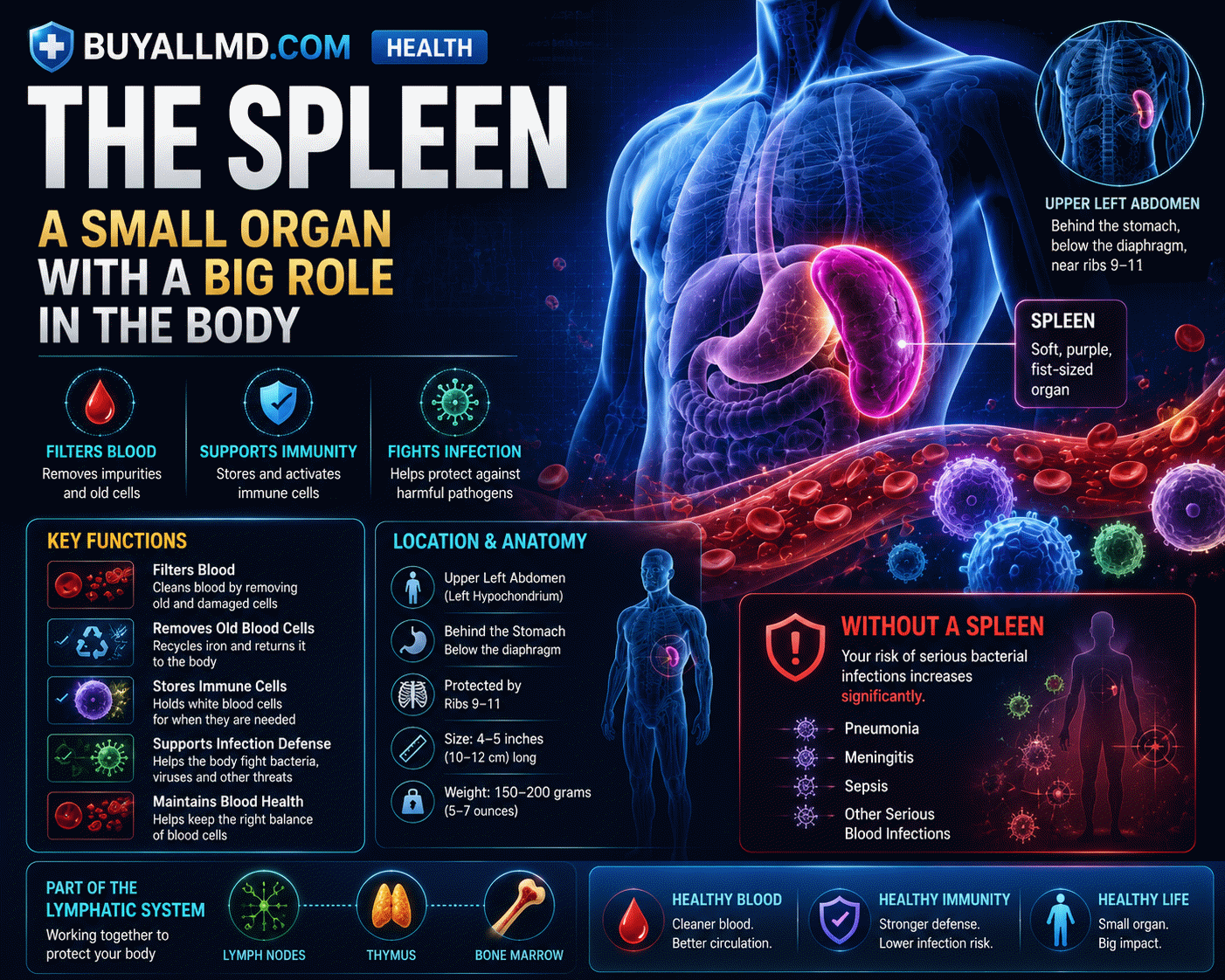
🩸 The spleen (left side, behind the stomach) filters about 200 mL of blood per minute — removing old red blood cells, recycling iron, and storing infection-fighting white blood cells.
The spleen — a fist-sized organ tucked behind the stomach on the left side of the abdomen — is often overlooked. Yet it performs multiple vital functions: filtering blood, supporting the immune system, and helping maintain the normal composition of blood cells. Without it, the body becomes more vulnerable to certain infections. Despite its modest size, the spleen plays an outsized role in blood health and immune defense.
📍 Location & Anatomy: Where Is the Spleen?
The spleen is a soft, purple, fist-sized organ located in the upper left part of the abdomen (left hypochondrium), just behind the stomach and below the diaphragm. It sits near the 9th, 10th, and 11th ribs — which provide some protection against injury.
In healthy adults, the spleen is about 4-5 inches (10-12 cm) long and weighs approximately 150-200 grams (5-7 ounces). It is part of the lymphatic system along with the lymph nodes and thymus. Despite its modest size, it plays an outsized role in maintaining blood health and immune defense.
💡 Did you know? The spleen receives one of the highest blood flow rates per gram of tissue in the body — about 200 mL of blood passes through it every minute. That’s roughly 300 liters of blood filtered daily.
🩸 Blood Filtration: The Spleen’s Primary Job
🔴 Removing Old Red Blood Cells
Red blood cells (erythrocytes) have a lifespan of about 120 days. The spleen identifies and removes old, damaged, or misshapen RBCs from circulation — a process called “culling.” About 1-2% of RBCs are removed daily.
♻️ Iron Recycling
When RBCs are broken down, the spleen extracts iron (Fe²⁺) from hemoglobin. This iron is then transported back to the bone marrow — where it is reused to produce new red blood cells (erythropoiesis).
🩸 Blood Reserve
The spleen acts as a reservoir for blood. In emergencies (e.g., significant blood loss), the spleen can contract and release up to 200-300 mL of blood back into circulation.
🛡️ Immune Function: The Spleen as a Defender
🦠 White Blood Cell Storage
- Stores monocytes and lymphocytes — types of white blood cells
- When infection is detected, these cells are released into the bloodstream
- Contains about 25-30% of the body’s total lymphocytes
🔬 Antibody Production
- Specialized areas of the spleen (white pulp) produce antibodies
- Particularly effective against encapsulated bacteria (Streptococcus pneumoniae, Haemophilus influenzae, Neisseria meningitidis)
- Removing the spleen increases risk of sepsis from these bacteria
🏃 Why Does Your Side Hurt When Running? (The Side Stitch)
Many runners experience a sharp, stabbing pain in the left upper abdomen (or right side) during intense exercise — commonly called a “side stitch” or exercise-related transient abdominal pain (ETAP). The spleen plays a role in this phenomenon:
- During exercise, the body directs blood away from internal organs (splanchnic vasoconstriction)
- The spleen responds by contracting and releasing stored blood into circulation — providing extra oxygen-carrying capacity to working muscles
- This contraction can cause irritation of the diaphragm and surrounding tissues, leading to the classic stitch pain
While uncomfortable, a side stitch is usually harmless. It tends to occur more often in beginner runners, during high-intensity intervals, or when exercising soon after eating.
⚠️ Enlarged Spleen (Splenomegaly): A Sign of Underlying Disease
An enlarged spleen (splenomegaly) is not a disease itself — it is a sign of an underlying condition. Common causes include:
🦠 Infections
Mononucleosis (EBV), bacterial endocarditis, malaria, TB
Mononucleosis (EBV), bacterial endocarditis, malaria, TB
🩸 Blood disorders
Leukemia, lymphoma, hemolytic anemia, myelofibrosis
Leukemia, lymphoma, hemolytic anemia, myelofibrosis
🫁 Liver diseases
Cirrhosis, portal hypertension
Cirrhosis, portal hypertension
🧬 Metabolic disorders
Gaucher disease, amyloidosis, Niemann-Pick disease
Gaucher disease, amyloidosis, Niemann-Pick disease
Symptoms of an enlarged spleen include a feeling of fullness without eating (due to the spleen pressing on the stomach), left upper abdominal pain, and pain in the left shoulder (referred pain). If you experience these symptoms, consult a doctor — an enlarged spleen can rupture easily with trauma.
⚕️ Life Without a Spleen: Splenectomy
While the spleen performs critical functions, the human body can survive without it. Splenectomy (surgical removal of the spleen) may be necessary for trauma (ruptured spleen), certain blood disorders, or cancer. However, the absence of the spleen comes with important consequences:
- Increased risk of infection — particularly from encapsulated bacteria (S. pneumoniae, H. influenzae, N. meningitidis)
- Overwhelming post-splenectomy infection (OPSI) — rare but life-threatening sepsis that can develop within hours
- Recommended vaccination — patients should receive vaccines against pneumococcus, meningococcus, and Haemophilus influenzae type b (Hib)
- Daily antibiotics — sometimes prescribed for children or immunocompromised individuals
- Lifelong vigilance — seek immediate medical attention for fever or signs of infection
Despite these risks, most people without a spleen live normal lives with appropriate preventive measures.
✅ Key Functions of the Spleen
- Filters ~200 mL of blood per minute
- Removes old/damaged red blood cells (120-day lifespan)
- Recycles iron back to bone marrow
- Stores white blood cells (monocytes, lymphocytes)
- Produces antibodies against encapsulated bacteria
- Acts as a blood reservoir (200-300 mL reserve)
⚠️ When to Be Concerned
- Enlarged spleen (splenomegaly) → underlying disease
- Left upper abdominal pain, early satiety, referred left shoulder pain
- History of mononucleosis → risk of splenic rupture
- After splenectomy → fever requires emergency evaluation
- Side stitch during running (usually harmless)
🔬 Scientific References & External Resources
- NCBI StatPearls — Spleen Anatomy
- PubMed — Spleen function research
- PubMed — Splenomegaly causes
- PubMed — Overwhelming post-splenectomy infection (OPSI)
- Wikipedia — Spleen
⚠️ Medical Disclaimer: This article is for educational and informational purposes only and does not constitute medical advice. The spleen is a vital organ, and any symptoms such as left upper abdominal pain, early satiety, unexplained fever, or history of recent trauma should be evaluated by a qualified healthcare provider. Individuals who have undergone splenectomy should follow their physician’s recommendations regarding vaccinations and fever management. Never ignore persistent or severe abdominal pain. This information is not intended to diagnose, treat, cure, or prevent any disease.
© 2026 BuyAllMD.com — Evidence-Based Health & Anatomy Education
