
- Your cart is empty
- Continue Shopping
Sirolimus (Rapamycin) for SLE: Phase 3 SIRIUS Trial Shows Efficacy | EULAR 2026
-
Dr. Tina Sugandh
- Posted on
🩺 Rheumatology • SLE • Clinical Trial • EULAR 2026
Randomized Trial Supports Sirolimus as Add-On Therapy for Systemic Lupus Erythematosus
📍 Peking Union Medical College Hospital • EULAR 2026 • Phase 3 SIRIUS Trial • 7 min read
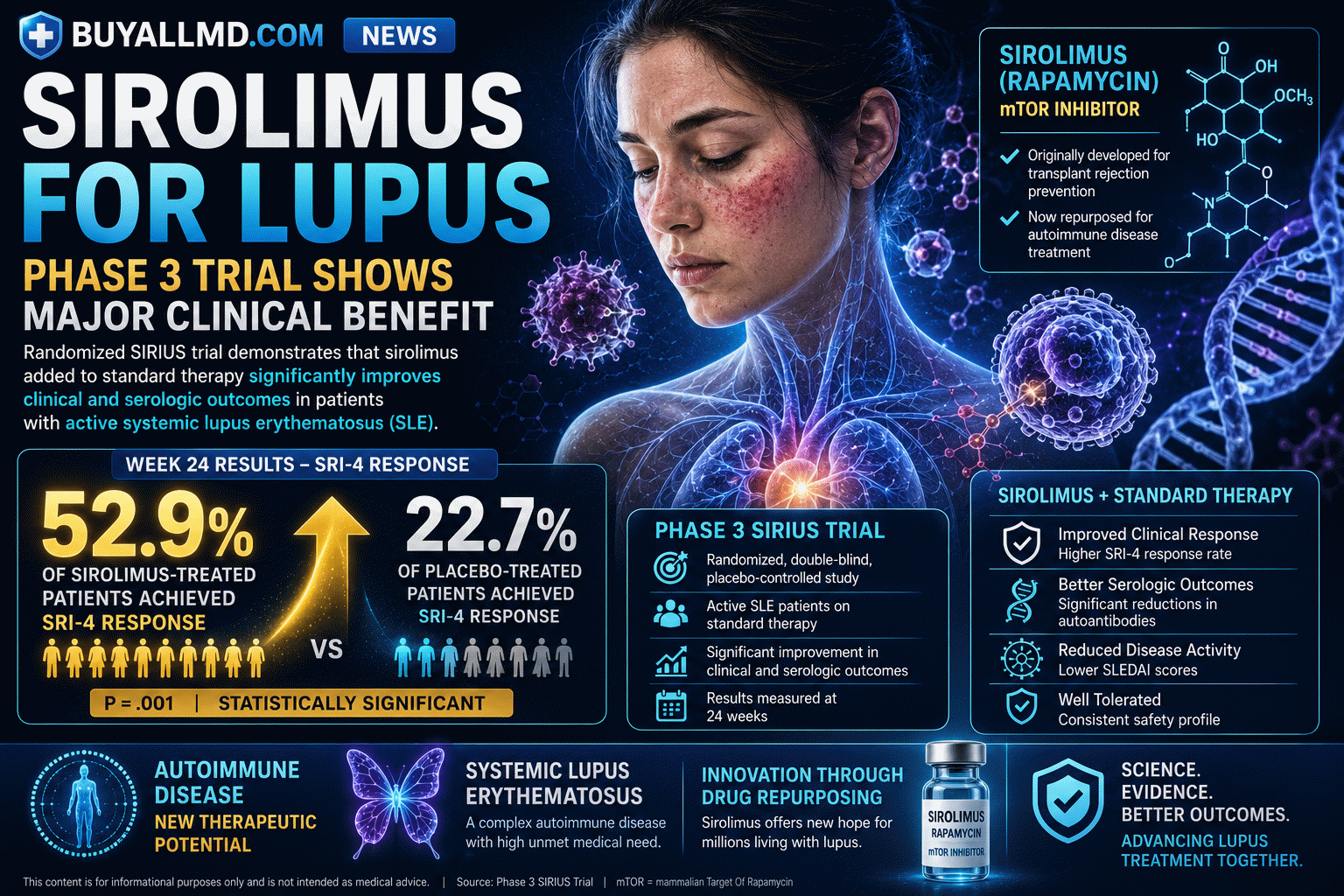
🔬 Sirolimus (rapamycin) — an established transplant rejection drug — significantly improved disease activity in active SLE patients when added to standard therapy in the Phase 3 SIRIUS trial (EULAR 2026).
Phase 3 SIRIUS trial results show that sirolimus (rapamycin) added to standard therapy significantly improves clinical and serologic outcomes in active systemic lupus erythematosus (SLE). At 24 weeks, 52.9% of sirolimus-treated patients achieved SRI-4 response vs 22.7% with placebo (P = .001). The mTOR inhibitor, already established for transplant rejection prevention, was successfully repurposed for lupus in this multicenter, double-blind, randomized controlled trial conducted at six centers in China.
📋 SIRIUS Trial Design: Phase 3 Randomized Controlled Study
The SIRIUS trial (presented as a late-breaking clinical abstract at the European Alliance of Associations for Rheumatology (EULAR) 2026 Annual Meeting in London) was a multicenter, randomized, double-blind, placebo-controlled Phase 3 study conducted at six centers in China.
- Inclusion criteria: Adults with active SLE (SLEDAI-2K score ≥4 despite standard treatment) plus serologic activity (anti-dsDNA >10 IU/mL and/or complement C3 ≤0.90 g/L)
- Intervention: Sirolimus 1.5 mg/day or matching placebo added to stable background therapy for 24 weeks, followed by crossover
- Primary endpoint: SLE Responder Index (SRI)-4 response at week 24
- Patient population: Mean age ~35 years, 94% women, mean time from diagnosis ~8.5 years
💡 Key context: Despite treatment at baseline with glucocorticoids (83%), antimalarials (86%), and immunosuppressants (MMF 56%), mean SLEDAI-2K scores were 10.0 — indicating significant unmet need.
📊 Primary and Secondary Endpoint Results
🎯 Primary Endpoint: SRI-4 Response
At 24 weeks: 52.9% (sirolimus) vs 22.7% (placebo) — P = .001
At 12 weeks: 48.6% vs 20.0% — P < .001
At 4 weeks: 27.1% vs 18.7% — P = .224 (early trend)
📉 Disease Activity (SLEDAI-2K)
Mean change from baseline to week 24:
-4.7 (sirolimus) vs -1.0 (placebo) — P < .001
🧪 Serologic Markers
Complement C3: +0.26 vs +0.02 g/L (P < .001)
Complement C4: +0.08 vs +0.01 g/L (P < .001)
Anti-dsDNA: -89.3 vs +51.1 IU/mL (P < .001)
📈 Additional Secondary Endpoints Favoring Sirolimus
🎯 Other Response Rates
- BICLA response: 60.0% vs 32.2%
- SRI-5 response: 40.0% vs 17.3%
- SRI-6 response: 40.0% vs 16.0%
- PGA change: -0.38 vs -0.18 (P = .009)
🩺 Clinical Remission & LLDAS
- LLDAS (Lupus Low Disease Activity State): 24.3% vs 10.7%
- Clinical remission: 14.3% vs 4.0%
- SLE-DAS change: -2.84 vs -0.75
⚠️ Safety Profile: Known and Manageable
Most frequent adverse events (sirolimus vs placebo):
- Hypertriglyceridemia: 60.3% vs 26.4%
- Hypercholesterolemia: 42.7% vs 9.8%
- Leukopenia: 38.2% vs 20.3%
- Neutropenia: 30.9% vs 8.1%
- Menstrual irregularities: 17.1% vs 0%
Serious adverse events: Sirolimus 4.3% vs placebo 1.3% — deaths: 1 in each group (neither treatment-related). Infections occurred in ~25% of each group.
🧬 Why Sirolimus? The mTOR Pathway in SLE Pathogenesis
Sirolimus (also known as rapamycin) is a well-established mTOR (mammalian target of rapamycin) inhibitor used for decades to prevent organ transplant rejection. Its mechanism of action in SLE is supported by evidence that the mTOR signaling pathway is “extensively” involved in lupus pathogenesis:
- mTOR hyperactivation is observed in T cells, B cells, and dendritic cells from SLE patients
- mTOR inhibition restores regulatory T cell (Treg) function and suppresses autoreactive lymphocytes
- Reduces autoantibody production and inflammatory cytokine release
Previous proof-of-concept studies (Lancet 2018, meta-analysis 2020) suggested sirolimus might be beneficial in SLE. The SIRIUS trial now provides Phase 3 randomized evidence supporting its efficacy as an add-on therapy.
💬 Expert Commentary: Implications for Clinical Practice
Commenting on the findings, Dr. Md Yuzaiful Md Yusof (Associate Professor, Leeds Institute of Rheumatic and Musculoskeletal Medicine, UK) — who was not involved in the study — noted:
- “These are important Phase 3 randomized trial results showing rapid efficacy and a large effect size of 30% between sirolimus and placebo at week 24.”
- “The low placebo response rate strengthens the findings.”
- “Other key secondary efficacy endpoints favored sirolimus too, with no major safety signals.”
Potential place in therapy: Dr. Md Yusof suggested sirolimus could be used in patients with active moderate-to-severe nonrenal disease who failed one conventional immunosuppressant — prior to biologics, as well as those with T-cell driven features (mucocutaneous disease, arthritis, serositis, cytopenia).
✅ Key Takeaways
- Phase 3 SIRIUS trial shows sirolimus effective as add-on therapy for active SLE
- SRI-4 response 52.9% vs 22.7% placebo at 24 weeks (P = .001)
- Significant improvements in SLEDAI-2K, serologic markers (C3/C4, anti-dsDNA)
- Well-tolerated with expected mTOR inhibitor side effects (lipid elevations, cytopenias)
- Represents a repurposed, oral, low-cost option for SLE
⚠️ Important Considerations
- Conducted solely in China — global generalizability pending
- Lipid monitoring required (hypertriglyceridemia 60%, hypercholesterolemia 43%)
- Cytopenias (leukopenia 38%, neutropenia 31%) require blood count monitoring
- Not yet approved for SLE — remains investigational for this indication
- Position relative to biologics (belimumab, anifrolumab) unclear
🔬 Scientific References & External Resources
- EULAR 2026 Late-breaking abstract: Li M, et al. “Sirolimus as add-on therapy for active systemic lupus erythematosus: a randomized, double-blind, placebo-controlled phase 3 trial (SIRIUS).” Presented June 10, 2026.
- PubMed — Sirolimus in SLE (including Lancet 2018 and 2020 meta-analysis)
- PubMed — mTOR pathway in SLE pathogenesis
- EULAR (European Alliance of Associations for Rheumatology) — Official meeting website
- ClinicalTrials.gov — Search for ongoing SLE studies
⚠️ Medical & Safety Disclaimer: This article summarizes a Phase 3 clinical trial presented at the EULAR 2026 Annual Meeting. Sirolimus is currently FDA-approved for the prevention of organ transplant rejection, but it is not yet approved for the treatment of systemic lupus erythematosus (SLE). The use of sirolimus for SLE remains investigational. mTOR inhibitors have well-established side effects including hyperlipidemia, cytopenias, oral ulcers, and increased infection risk. Any off-label use should only be considered under the supervision of a qualified rheumatologist with appropriate monitoring. This information is for educational and research purposes only and does not constitute medical advice.
© 2026 BuyAllMD.com — Evidence-Based Medical Research News
