
- Your cart is empty
- Continue Shopping
Crab Sticks: Why They’re Not the Best Choice Among Seafood | Surimi Nutrition
-
Dr. Tina Sugandh
- Posted on
🍣 Food Science • Nutrition • Processed Food • Surimi
Crab Sticks: Why They’re Not the Best Choice Among Seafood
📍 Food Science & Nutrition • Ultra-Processed Seafood Alternative • 5 min read
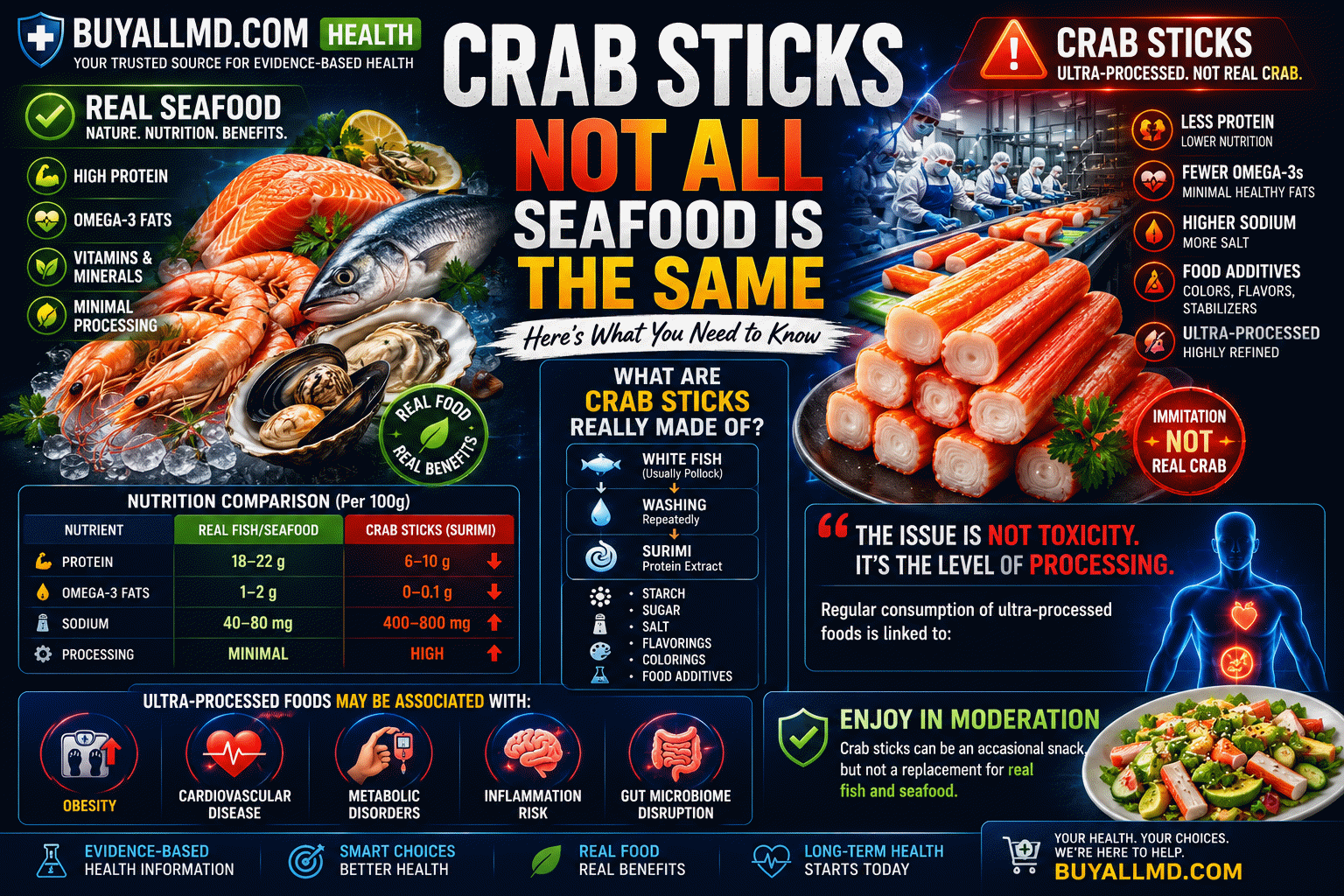
🍣 Surimi — the base of crab sticks — is made by washing white fish fillets repeatedly until a neutral protein mass is formed, then adding starch, sugar, salt, flavorings, and colorings.
Despite their name, most crab sticks contain no actual crab. The video above shows the production process of surimi — the base of crab sticks. White fish fillets are repeatedly washed until a neutral protein mass is obtained. Starch, sugar, salt, flavorings, and colorings are then added to mimic the taste, texture, and appearance of crab meat. Compared to fish and real seafood, crab sticks generally contain less protein and healthy fats (including omega-3) but more salt and various food additives.
🔬 What Is Surimi? The Truth Behind Crab Sticks
Surimi is a Japanese word meaning “ground meat.” In the context of seafood, it refers to a paste made from white-fleshed fish (such as pollock, hake, or cod) that has been minced, washed repeatedly to remove fat and unwanted proteins, and mixed with cryoprotectants (sugar and sorbitol) to prevent protein denaturation during freezing.
The resulting product is a neutral-tasting, odorless protein base that can be flavored and shaped into various products — most famously crab sticks (also known as imitation crab or kamaboko).
⚙️ How Crab Sticks Are Made
🐟 Step 1: Fish Filleting
White-fleshed fish (usually Alaska pollock) is filleted, skinned, and deboned.
💧 Step 2: Washing and Leaching
The minced fish is washed with cold water multiple times. This removes water-soluble proteins, fat, and odor compounds — leaving behind a flavorless, white protein mass.
🧂 Step 3: Mixing and Seasoning
The surimi is mixed with starch, sugar, salt, egg whites, and flavorings. Red and orange colorings are added to create the crab-like appearance.
🔥 Step 4: Cooking and Shaping
The mixture is spread into thin sheets, cooked, flavored with crab extract, and shaped into sticks with artificial red coloring on the outside.
💡 Key fact: Most crab sticks are made from Alaska pollock — one of the most abundant and sustainable fish species. However, the processing removes many of the nutritional benefits of the original fish, including omega-3 fatty acids.
📊 Nutritional Comparison: Crab Sticks vs. Real Seafood
| Nutrient (per 100g) | Crab Sticks | Real Crab | Salmon (wild) |
|---|---|---|---|
| Protein | ~8g | ~19g | ~22g |
| Omega-3 (EPA/DHA) | ~0.05g | ~0.3g | ~2.0g |
| Sodium | ~700mg | ~300mg | ~60mg |
| Carbohydrates | ~15g | ~0g | ~0g |
| Food Additives | High (starch, sugar, colorings) | None | None |
⚠️ The Real Problem: Ultra-Processed Foods
The main issue with crab sticks is not toxicity or any single ingredient — it’s the high degree of processing that makes them an ultra-processed food.
Regular consumption of ultra-processed foods is linked to:
- Increased risk of obesity
- Higher rates of cardiovascular disease
- Metabolic disorders (insulin resistance, type 2 diabetes)
- Potential for hypertension (due to high sodium content)
- Lower overall nutrient density compared to whole foods
✅ Should You Eat Crab Sticks?
✅ Occasional Consumption
Crab sticks are fine as a rare treat — in sushi rolls, salads, or as a snack. They are not toxic or dangerous in moderation.
❌ Not a Seafood Substitute
Crab sticks should not be considered a replacement for real seafood. They lack the protein, omega-3 fats, and overall nutritional profile of fish and shellfish.
🐟 Healthier Seafood Alternatives
🐟 Wild salmon — rich in omega-3
🦐 Shrimp — high protein, low fat
🦪 Oysters — high in zinc and iron
🐟 Sardines — calcium and omega-3 powerhouse
🦀 Real crab — high protein, low additives
✅ Key Takeaways
- Crab sticks contain no actual crab — they are made from surimi (processed fish protein)
- They are lower in protein and omega-3 than real seafood
- They are higher in sodium, starch, and additives
- They are an ultra-processed food, not a health food
- Best viewed as a occasional treat, not a seafood substitute
⚠️ Important Caveats
- Not toxic — safe to eat in moderation
- May contain allergens (fish, egg, wheat, shellfish flavorings)
- High sodium — a concern for those with hypertension
- Not suitable for those avoiding ultra-processed foods
🔬 Scientific References & External Resources
- PubMed — Ultra-processed foods and health outcomes
- PubMed — Surimi nutritional composition
- Harvard Health — Ultra-processed foods and heart disease
- Wikipedia — Surimi production process
⚠️ Nutrition & Health Disclaimer: This article provides educational information about surimi and crab sticks. It is not dietary or medical advice. Individuals with allergies, hypertension, or specific dietary needs should consult a healthcare professional or registered dietitian. This information is for educational purposes only.
© 2026 BuyAllMD.com — Evidence-Based Food & Nutrition Science News
