
- Your cart is empty
- Continue Shopping
Chlamydia Vaccine Breakthrough: Key Protein Structure Deciphered
-
Dr. Tina Sugandh
- Posted on
🧬 Vaccine Research • Chlamydia • Cryo-EM • UT Southwestern
Breakthrough in Chlamydia Vaccine: Structure of Key Bacterial Protein Deciphered
📍 UT Southwestern Medical Center • University of California, Irvine • Nature Communications • 6 min read
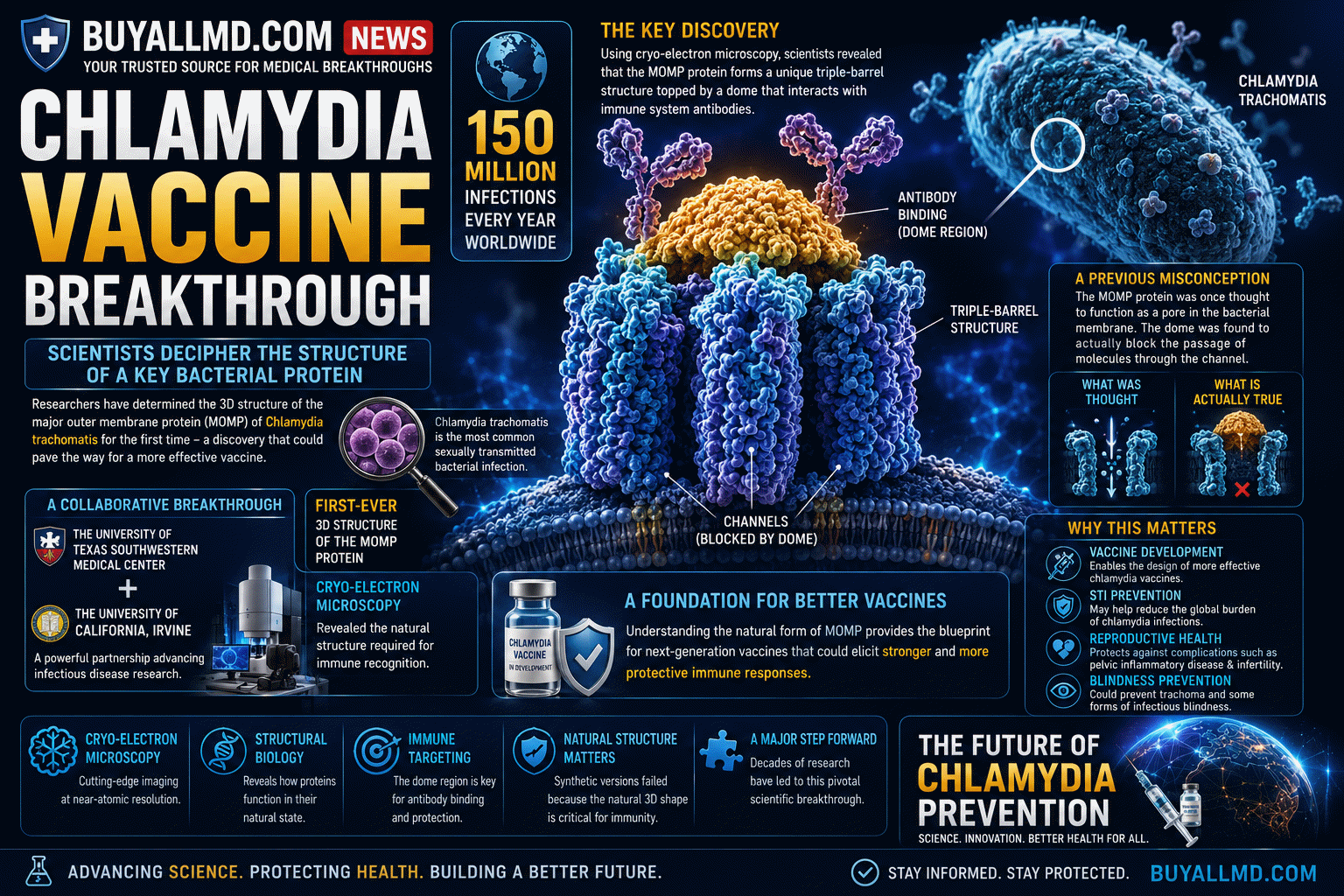
🧬 Cryo-EM imaging revealed the unusual three-dimensional structure of MOMP — three barrel-shaped units topped with an “antigenic cap” that interacts with antibodies[citation:1].
Scientists at UT Southwestern Medical Center and the University of California, Irvine have for the first time determined the three-dimensional structure of the major outer membrane protein (MOMP) of Chlamydia trachomatis — the bacterium responsible for the world’s most common bacterial sexually transmitted infection[citation:1]. This breakthrough, published in Nature Communications, could finally unlock the door to a long-sought vaccine against chlamydia[citation:1].
🌍 The Chlamydia Crisis: A Silent Epidemic
Chlamydia remains the most commonly reported sexually transmitted infection in the United States and worldwide[citation:1][citation:5]. According to the CDC, an estimated 150 million people globally were infected with C. trachomatis in 2023[citation:1]. The infection is frequently asymptomatic — many people can transmit the infection without knowing they have it — yet it can lead to serious long-term complications:
- In women: pelvic inflammatory disease (PID), scarring of the fallopian tubes, infertility, and increased risk of ectopic pregnancy[citation:5]
- In men: epididymitis and, rarely, urethral strictures[citation:5]
- In both sexes: reactive arthritis and increased risk of HIV transmission[citation:5]
C. trachomatis has several strains (serovars) that cause a variety of conditions, including urogenital infections, blindness (trachoma), and lymphatic disease[citation:1].
💡 Key insight: “Although chlamydia can be successfully treated with antibiotics, a safe and effective chlamydia vaccine could help prevent infections that often go undiagnosed.” — Dr. Dominika Borek, Professor of Biophysics and Biochemistry at UT Southwestern[citation:1]
🔬 The Breakthrough: Deciphering MOMP’s Structure
For decades, vaccine development efforts have focused on the major outer membrane protein (MOMP), found on the exterior of the bacterium’s infectious stage (elementary bodies)[citation:1]. However, vaccines using denatured or recombinant MOMP have consistently failed, suggesting that the native three-dimensional structure is essential for triggering an effective immune response[citation:1].
Using cryo-electron microscopy (cryo-EM) at UT Southwestern’s Cryo-Electron Microscopy Facility, researchers imaged MOMP from a chlamydia species that infects mice (Chlamydia muridarum)[citation:1]. The team produced images of the protein both alone and bound to a fragment of a mouse anti-chlamydia antibody.
🧬 What They Found: An Unusual Structure
The team’s findings revealed that MOMP has an unusual structure unlike any protein seen before[citation:1]:
🏺 Three Barrel-Shaped Units
MOMP is composed of three barrel-shaped units arranged in a triple structure[citation:1].
⛺ Topped With an “Antigenic Cap”
The structure is topped with a dome-shaped “antigenic cap” that interacts with immune system antibodies[citation:1]. This cap also displays the protein’s “variable domains” — the part of the protein that differs between serotypes and influences which types of cells the bacteria can adhere to[citation:1].
🚫 Not a Pore — A Stopper
Researchers had previously assumed that MOMP served as a molecular pore in the bacterial membrane[citation:1]. However, the structure shows that the base of the protein acts as a stopper, while the antigenic cap serves as a lid, effectively blocking any molecules from passing through[citation:1]. This corrects a decades-old misconception.
💉 Vaccine Implications: A Blueprint for Protection
The cryo-EM imaging of MOMP’s three-dimensional structure now provides a blueprint to guide vaccine development[citation:1]. Because previous attempts using denatured or recombinant MOMP lacked this native structure, they failed to generate protective immunity[citation:1].
By targeting the native form of MOMP, researchers hope to design antigens that more closely mimic the protein’s actual shape, potentially triggering a much more robust and protective immune response[citation:1].
💡 Why this matters: “This study provides a structural framework that could aid in the design of more effective vaccine antigens.” — Dr. Dominika Borek[citation:1]
👁️ Beyond STIs: Preventing Blindness and Protecting Koalas
Chlamydia doesn’t just cause sexually transmitted infections. The bacteria also cause:
- Trachoma — the world’s leading infectious cause of blindness[citation:5]
- Conjunctivitis in newborns — passed from infected mothers during delivery[citation:5]
- Lymphogranuloma venereum (LGV) — a more invasive form of the disease[citation:1]
Animals can also be infected by other chlamydia species. For example, koalas are endangered due to prevalent Chlamydia pecorum infections[citation:1]. A successful vaccine could therefore have broad implications for both human and animal health.
🔮 What’s Next?
The research team’s findings lay the groundwork for the next phase of vaccine development. The structural data provides a rational basis for designing vaccine antigens that:
- Present MOMP’s antigenic cap in its native conformation
- Stimulate antibodies that recognize multiple serovars
- Potentially confer cross-protection against different strains and infection types
✅ Key Takeaways
- First-ever 3D structure of Chlamydia MOMP determined using cryo-EM
- Unusual triple-barrel structure topped with an “antigenic cap” that interacts with antibodies
- Corrects decades-old misconception that MOMP functions as a membrane pore
- Provides structural blueprint for developing a more effective chlamydia vaccine
- Could potentially prevent both genital infections and blindness (trachoma)
⚠️ Important Caveats
- Vaccine development still in early stages
- Human trials not yet initiated
- Native MOMP production at scale remains a challenge
- Cross-protection against all serovars requires further study
🔬 Scientific References & External Resources
- UT Southwestern — Findings could boost efforts to develop chlamydia vaccine
- UC Tech Transfer — Tertiary Structure of Chlamydia MOMP
- Merck Manual — Chlamydia Infections
- PubMed — MOMP structure research
⚠️ Medical & Research Disclaimer: This article summarizes published research from UT Southwestern Medical Center and UC Irvine. The MOMP structural data is a significant scientific advance, but vaccine development is still in early preclinical stages. A chlamydia vaccine is not yet available for clinical use. This information is for educational and research purposes only and does not constitute medical advice.
© 2026 BuyAllMD.com — Evidence-Based Vaccine & Infectious Disease Research News
