
- Your cart is empty
- Continue Shopping
Why Women Suffer Longer Cognitive
-
Dr. Tina Sugandh
- Posted on
🧠 Concussion Research • Neuroscience • Sex Differences • Perelman School of Medicine
Study: Why Women Suffer Longer Cognitive Effects After Concussion
📍 Perelman School of Medicine • University of Pennsylvania • 6 min read
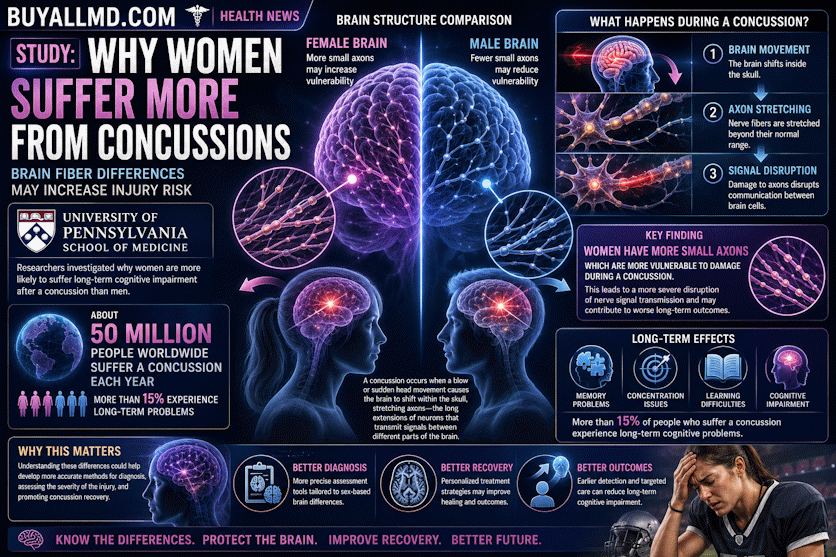
🧠 Concussion stretches and damages axons (nerve fibers). Women have, on average, more small axons — which appear more vulnerable to injury.
Scientists at the Perelman School of Medicine at the University of Pennsylvania have investigated why women are more likely to suffer prolonged cognitive impairment after concussion than men. The results suggest that differences in the structure of brain nerve fibers may make women’s brains more vulnerable to injury during trauma.
⚡ What Happens During a Concussion?
A concussion occurs when a blow or sudden movement of the head causes the brain to shift inside the skull, stretching axons — the long projections of neurons that transmit signals between different parts of the brain. This stretching damages the axons, impairing neural communication.
The researchers discovered that women, on average, have more small axons than men. These smaller axons appear to be more vulnerable to damage during concussion, leading to more pronounced disruption of neural signal transmission.
💡 Key insight: “Women have more small axons than men, and these small axons appear more vulnerable to injury during concussion, which may explain why women are more likely to experience prolonged cognitive symptoms.” — Dr. Douglas Smith, senior author
🔬 The Study: What the Researchers Found
The research team examined post-mortem brain tissue samples and used advanced imaging techniques to compare axonal structure between male and female brains. Key findings:
- Axonal size distribution differs: Women have a higher proportion of small-diameter axons.
- Small axons are more vulnerable: These thinner axons are more easily stretched and damaged during traumatic impact.
- Greater signal disruption: Damage to small axons causes more significant disruption of neural communication, contributing to longer-lasting cognitive symptoms.
📊 The Global Impact of Concussion
🌍
50 million
People worldwide suffer a concussion each year
⚠️
15%+
Experience long-term problems with memory, concentration, and learning
🏥 Why This Matters for Diagnosis and Recovery
The study’s findings have significant clinical implications. Understanding the structural differences between male and female brains could help:
- Improve diagnostic accuracy: Current concussion assessment tools may not account for sex-based differences in vulnerability
- Personalize treatment: Recovery protocols could be tailored based on biological sex
- Inform return-to-play decisions: Recognizing that women may need longer recovery periods could reduce re-injury risk
- Guide future research: Understanding the mechanisms of vulnerability could lead to neuroprotective strategies
💡 Clinical relevance: Current concussion guidelines treat all patients similarly, but these findings suggest that sex-specific approaches may be needed for more effective diagnosis and recovery.
📊 Sex Differences in Concussion: Key Findings
| Factor | Women | Men |
|---|---|---|
| Axonal size | More small axons | Fewer small axons |
| Vulnerability to injury | Higher (small axons more vulnerable) | Lower |
| Cognitive recovery time | Often longer | Often shorter |
| Symptom persistence | More likely to experience prolonged symptoms | Less likely to experience prolonged symptoms |
✅ Key Takeaways
- Women have more small axons in the brain — these are more vulnerable to concussion damage
- This may explain why women often experience longer cognitive recovery after concussion
- Concussion affects 50 million people worldwide annually
- Over 15% face long-term memory, concentration, and learning problems
- Findings could lead to sex-specific diagnostic and treatment approaches
⚠️ Important Caveats
- Individual variation exists — not all women are equally vulnerable
- Further research needed to confirm mechanisms and develop interventions
- Current concussion protocols apply to all patients regardless of sex
- This is one factor among many (hormonal, biomechanical, etc.)
🔬 Scientific References & External Resources
- PubMed — Concussion sex differences research
- NIH — Concussion overview
- CDC — Concussion and TBI
- MedlinePlus — Concussion
⚠️ Medical Disclaimer: This article provides educational information about concussion research. It is not a substitute for professional medical advice, diagnosis, or treatment. If you or someone you know has sustained a concussion, seek immediate medical attention. This information is for educational purposes only.
© 2026 BuyAllMD.com — Evidence-Based Neuroscience & Medical Research News
