
- Your cart is empty
- Continue Shopping
Glucosamine Linked to 25% Higher Alzheimer’s Risk
-
Dr. Tina Sugandh
- Posted on
🧠 Neurology • Alzheimer’s • Glucosamine • University of Florida
Study: Glucosamine Linked to Risk of Alzheimer’s Disease
📍 University of Florida • AI-Powered Analysis • 6 min read
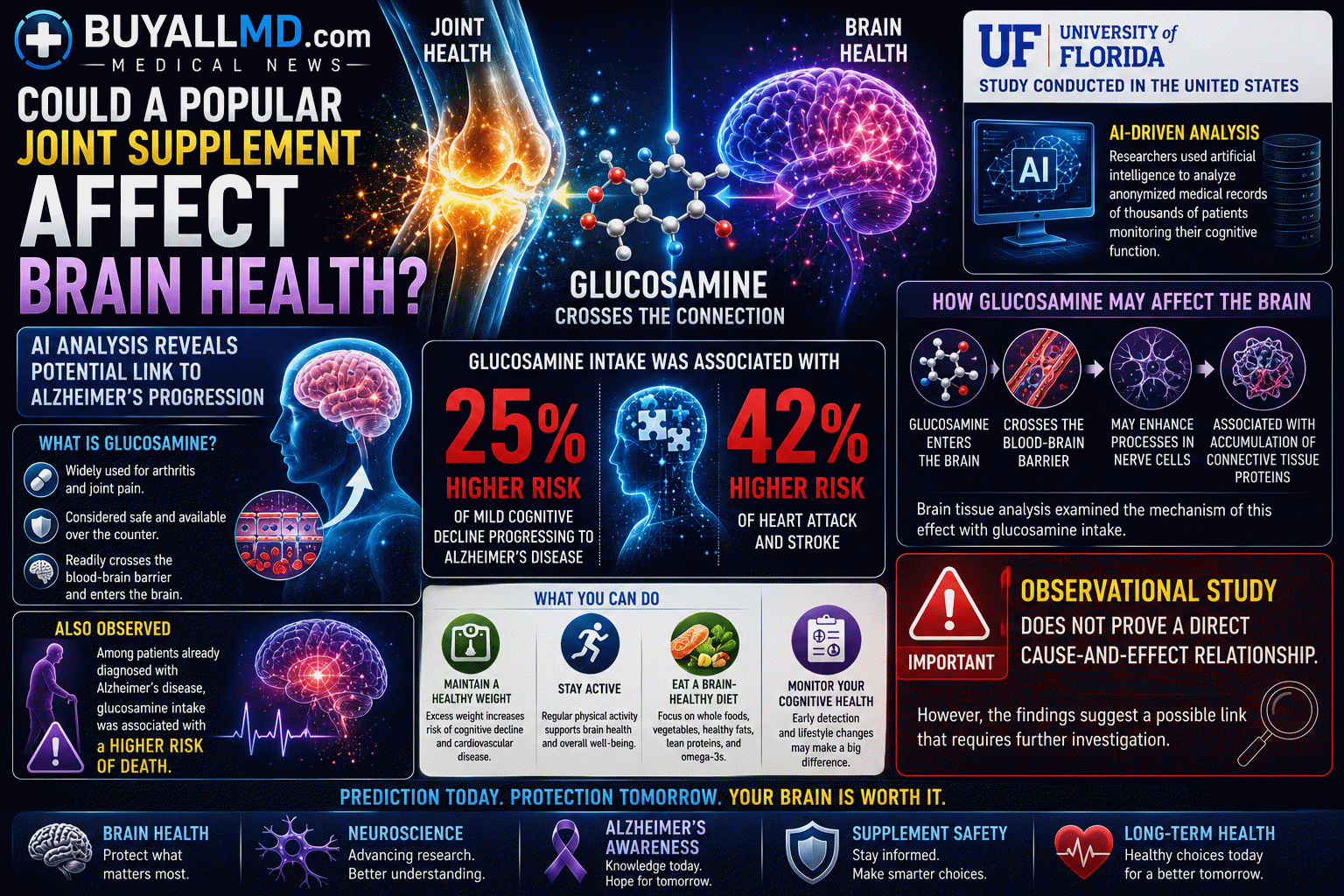
🧠 AI-powered analysis of medical records found glucosamine use was associated with a 25% increased risk of progression from mild cognitive impairment to Alzheimer’s disease.
Scientists at the University of Florida, using artificial intelligence, analyzed anonymized medical records of tens of thousands of patients with cognitive decline. The results showed that glucosamine use was associated with a 25% increased risk of progression from mild cognitive impairment to Alzheimer’s disease.
💊 What Is Glucosamine?
Glucosamine is a naturally occurring compound found in cartilage. It is widely used as a dietary supplement for the treatment of osteoarthritis and joint pain. It is considered safe and is available over-the-counter in most countries.
Common forms include glucosamine sulfate, glucosamine hydrochloride, and N-acetylglucosamine. It is often taken together with chondroitin sulfate for joint health.
💡 Key context: Glucosamine is one of the most commonly used dietary supplements in the United States, particularly among older adults — the same population at highest risk for Alzheimer’s disease.
🔬 The Study: AI Analysis of Medical Records
The University of Florida research team used artificial intelligence to analyze large-scale, anonymized medical data. Key aspects of the study include:
- Population: Tens of thousands of patients with mild cognitive impairment
- Method: AI-driven analysis of electronic health records
- Outcome measured: Progression from mild cognitive impairment to Alzheimer’s disease
- Key finding: Glucosamine use associated with a 25% increased risk of progression
⚠️ Important: This is an observational study. It does not prove that glucosamine causes Alzheimer’s disease — only that there is an association that requires further investigation.
🧬 How Glucosamine May Affect the Brain
The study suggests several possible mechanisms by which glucosamine could influence Alzheimer’s risk:
🧠
Crosses the Blood-Brain Barrier
Glucosamine easily crosses into the brain, where it may accumulate
🧬
Toxic Protein Accumulation
May enhance processes linked to amyloid-beta and tau protein accumulation
🔄
Brain Tissue Confirmation
Brain tissue analysis supported the link between glucosamine and these mechanisms
📊 Additional Finding: Higher Mortality Risk in Alzheimer’s Patients
The study also found that among patients already diagnosed with Alzheimer’s disease, glucosamine use was associated with a higher risk of death. This adds another layer of concern regarding the supplement’s safety in vulnerable populations.
⚠️ Expert Caution: What This Means for Patients
The study authors emphasize several important points:
- Observational study only — causation is not established
- Further research is needed to confirm and understand the mechanism
- Patients should not stop taking glucosamine based on this study alone
- Anyone concerned should consult their healthcare provider
- This study highlights the importance of ongoing monitoring of supplement safety
⚠️ Clinical Recommendation:
- Do not discontinue prescribed or recommended glucosamine without medical advice
- Discuss any concerns with a healthcare provider
- Consider alternative joint health options if there is significant concern
📈 The Bigger Picture: Supplement Safety and Alzheimer’s
This research adds to a growing body of evidence about the potential neurocognitive effects of widely used supplements. Key considerations:
- Many supplements have not been rigorously studied for long-term brain effects
- Older adults are the largest consumers of both glucosamine and medications for cognitive decline
- AI-driven analysis of medical records is emerging as a powerful research tool
- This study underscores the need for post-market surveillance of widely used supplements
✅ Key Takeaways
- Glucosamine use associated with 25% increased risk of progression from MCI to Alzheimer’s
- Glucosamine crosses the blood-brain barrier
- May promote toxic protein accumulation in the brain
- Observational study — causation not proven
- Further research is urgently needed
⚠️ Important Caveats
- Observational study — not causation
- Do not stop glucosamine without consulting a doctor
- More research needed to confirm the link
- Study population may not generalize to all groups
- Alternative explanations not ruled out
🔬 Scientific References & External Resources
- University of Florida — Lead research institution
- PubMed — Glucosamine and Alzheimer’s research
- Alzheimer’s Association — Patient and caregiver resources
- NIH — Alzheimer’s disease information
- NIH — Glucosamine fact sheet
⚠️ Medical & Research Disclaimer: This article summarizes observational research from the University of Florida and is for educational purposes only. The study does not prove that glucosamine causes Alzheimer’s disease. Do not discontinue any medication or supplement without consulting a qualified healthcare provider. This information does not constitute medical advice.
© 2026 BuyAllMD.com — Evidence-Based Neurology & Medical Research News
