
- Your cart is empty
- Continue Shopping

How to Start Brachiation Training Safely
-
Dr. Tina Sugandh
- Posted on
💪 Functional Fitness • Evolutionary Health • Strength Training
Brachiation: The Forgotten Skill That Could Be Good for Your Health
📋 University at Buffalo • Grip Strength • Shoulder Mobility • 5 min read
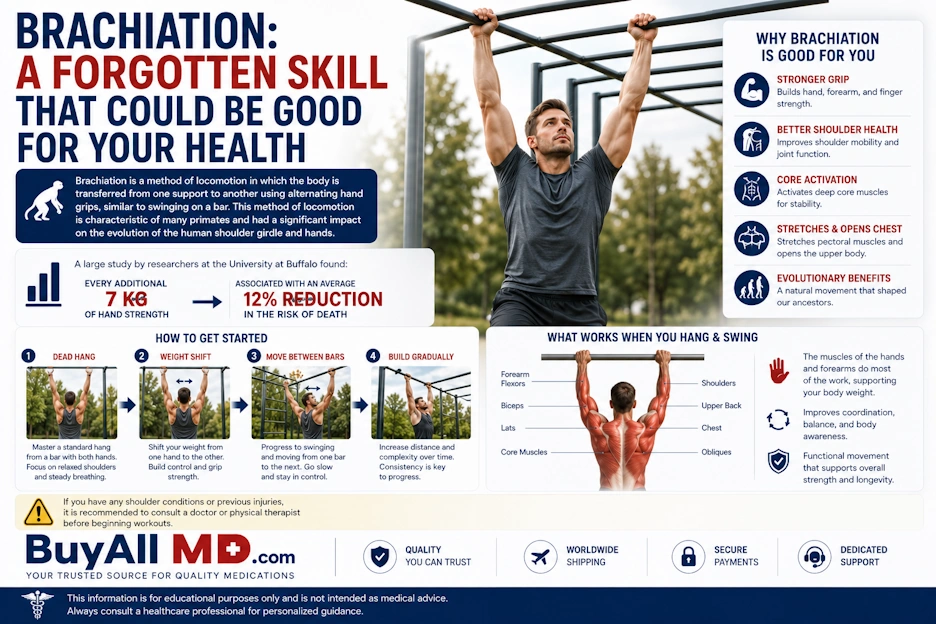
🧫 Brachiation — swinging from bar to bar — is a forgotten skill that may offer significant health benefits.
💪 What Is Brachiation?
Brachiation is a mode of locomotion in which the body is transferred from one support to another using alternating hand grips — similar to swinging across monkey bars. This form of movement is characteristic of many primates and has significantly influenced the evolution of the human shoulder girdle and hands.
Today, this type of loading has almost completely disappeared from daily life, yet it may offer valuable health benefits.
🦧
Primate Locomotion Swinging from support to support
🧬
Evolutionary Impact Shaped human shoulders and hands
🏋️
Full Body Load Bodyweight suspension and swinging
💡 Key Insight: During hanging and swinging, the hands and forearms do the primary work of supporting the body’s weight — a movement pattern that has largely disappeared from modern life.
📊 Grip Strength and Longevity — The Research
According to a large-scale study by researchers at the University at Buffalo, every additional 7 kg (15.4 lbs) of grip strength was associated with an average 12% reduction in mortality risk.
This finding highlights the importance of grip strength as a biomarker of overall health and longevity — and brachiation is one of the most effective ways to develop it.
7 kg
Grip Strength Increase Associated with 12% lower mortality risk
12%
Mortality Risk Reduction Per 7 kg increase in grip strength
💡 Key Finding: Grip strength is a powerful predictor of all-cause mortality — and brachiation is an excellent way to build it.
✅ Health Benefits of Brachiation
💪
Grip Strength Development
Builds hand and forearm strength — associated with lower mortality risk
🔄
Shoulder Mobility
Improves range of motion in the shoulder girdle
🧘
Core Activation
Engages abdominal and back muscles
🧘
Chest Stretch
Stretches tight pectoral muscles
📋 How to Start — A Progressive Approach
1️⃣
Basic Hang
Start with a simple two-handed hang on the bar. Hold for 10-30 seconds.
2️⃣
Weight Shifting
Shift weight from one hand to the other while hanging.
3️⃣
Swinging
Progress to swinging between bars once you’ve mastered the basics.
📌 Important: The first sessions should be done without rushing or sudden movements. Progress gradually and listen to your body.
⚠️ Precautions and Contraindications
⚠️ Important: For individuals with shoulder joint conditions or a history of shoulder injuries, it is strongly recommended to consult a doctor or physical therapist before starting brachiation training.
- 🦴 Rotator cuff injuries
- 🦴 Shoulder impingement or bursitis
- 🦴 Arthritis of the shoulder or hands
- 🦴 Previous shoulder dislocations
💡 Pro Tip: Start with active hangs (shoulders engaged, not passively hanging) to protect the shoulder joint while building strength.
❓ Frequently Asked Questions
What is brachiation?
Brachiation is a form of locomotion where the body swings from one support to another using alternating hand grips — like swinging across monkey bars.
Why is grip strength important?
Research shows that grip strength is a powerful predictor of all-cause mortality. Every 7 kg increase in grip strength is associated with a 12% reduction in mortality risk.
How do I start brachiation training?
Start with a basic two-handed hang, then progress to shifting weight from one hand to the other, and finally to swinging between bars. Progress gradually and avoid sudden movements.
Is brachiation safe for everyone?
Brachiation places significant stress on the shoulders and hands. If you have shoulder joint conditions or a history of shoulder injuries, consult a doctor or physical therapist first.
What muscles does brachiation work?
Brachiation primarily works the hands, forearms, shoulders, and core. It also stretches the chest muscles and improves overall shoulder mobility.
📚 References & Resources
- University at Buffalo — Research
- PubMed — Grip Strength & Mortality Research
- WHO — Physical Activity Guidelines
⚠️ Medical Disclaimer
This content is for informational and educational purposes only. Brachiation training involves significant physical demands on the shoulders and hands. Always consult a qualified healthcare professional before starting a new exercise program, especially if you have pre-existing conditions or injuries.
© 2026 BuyAllMD.com — Evidence-Based Health & Fitness Information
