
- Your cart is empty
- Continue Shopping
Refined Sunflower Oil: Production and Health Risks
-
Dr. Tina Sugandh
- Posted on
🌻 Nutrition Science • Food Processing • Healthy Eating
Sunflower Oil: What Lies Behind Its Production Process
📋 Refined Oil • Oxidation • Health Implications • 5 min read
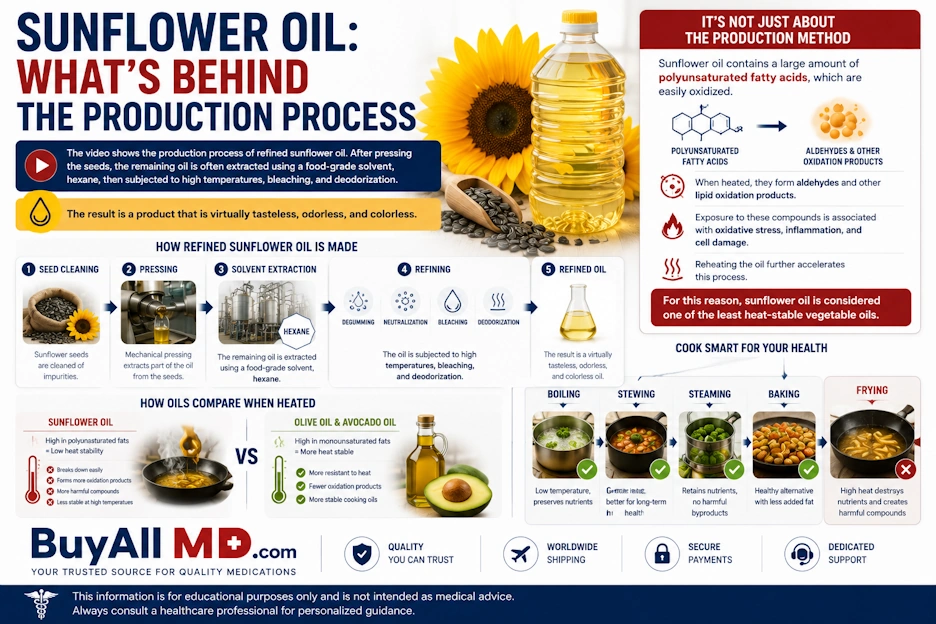
🧫 Image shows the production process of refined sunflower oil — from seed pressing to chemical extraction and deodorization.
🌻 The Production Process — What Happens Behind the Scenes
The video demonstrates the production process of refined sunflower oil. After pressing the seeds, the remaining oil is often extracted using a food-grade solvent — hexane — then subjected to high temperatures, bleaching, and deodorization. The result is a product that has virtually no taste, smell, or color of its own.
This intensive processing creates a neutral oil that is cheap to produce and has a long shelf life, but the methods used raise questions about its nutritional value and health implications.
🔬
Solvent Extraction Hexane used to extract oil
🌡️
High Temperatures Heat, bleaching, deodorization
⬜
Neutral Product No taste, smell, or color
💡 Key Insight: Refined sunflower oil is heavily processed — stripped of natural flavors, colors, and many beneficial compounds found in unrefined oils.
🧬 Why Composition Matters — The Fatty Acid Profile
However, not only the production method matters — the composition of the oil itself is equally important. Sunflower oil contains a high proportion of polyunsaturated fatty acids, which are easily oxidized.
When heated, these fatty acids form aldehydes and other lipid oxidation products. Exposure to these compounds is associated with the development of oxidative stress, inflammatory processes, and cellular damage.
🔬
Easily Oxidized
Polyunsaturated fats break down under heat
⚠️
Forms Aldehydes
Harmful compounds linked to oxidative stress
🔥
Worsens with Reheating
Repeated heating accelerates oxidation
⚠️ Health Concern: Repeated heating of sunflower oil further accelerates oxidation, increasing the formation of harmful compounds.
📊 Oil Stability Comparison
| Oil Type | Heat Stability | Primary Fats | Best Used For |
|---|---|---|---|
| Sunflower Oil | Low | Polyunsaturated | Low-heat uses, dressings |
| Olive Oil | High | Monounsaturated | Sautéing, roasting, dressings |
| Avocado Oil | High | Monounsaturated | High-heat cooking, frying |
| Coconut Oil | High | Saturated | Baking, frying |
💡 Key Point: Olive oil and avocado oil are more stable at high temperatures due to their high monounsaturated fat content and produce fewer oxidation products.
🍳 Healthier Cooking Options
Even with more stable oils, frying doesn’t become entirely safe. For better health and longevity, the following cooking methods are preferred:
💧
Boiling Preserves nutrients, no added fat
🍲
Stewing Low-temperature, gentle cooking
♨️
Steaming Retains nutrients, no oil needed
🔥
Baking Even heat, minimal oil needed
✅ Recommendation: For health and longevity, boiling, stewing, steaming, and baking are preferable to frying, regardless of the oil used.
❓ Frequently Asked Questions
Is sunflower oil healthy?
Sunflower oil is high in polyunsaturated fats, which are beneficial in their natural state. However, refined sunflower oil is heavily processed and forms harmful compounds when heated, making it less suitable for high-temperature cooking.
Why is sunflower oil considered unstable?
Sunflower oil contains a high proportion of polyunsaturated fats, which are easily oxidized when exposed to heat, light, and air. This oxidation produces aldehydes and other harmful compounds linked to inflammation and cellular damage.
What oils are best for cooking?
Olive oil and avocado oil are more stable at high temperatures due to their high monounsaturated fat content. They produce fewer oxidation products when heated compared to sunflower oil.
Is frying with any oil safe?
Even with more stable oils, frying isn’t entirely safe. For better health, boiling, stewing, steaming, and baking are preferred over frying.
What is refined sunflower oil?
Refined sunflower oil is produced through solvent extraction (hexane), heating, bleaching, and deodorization. This process creates a neutral oil with no taste, smell, or color, but strips away many of the natural beneficial compounds.
📚 References & Resources
- WHO — Healthy Diet Fact Sheet
- American Heart Association — Healthy Cooking Oils
- PubMed — Sunflower Oil Oxidation Research
- FDA — Food Ingredients & Packaging
⚠️ Disclaimer
This content is for informational and educational purposes only. It does not constitute medical or dietary advice. Always consult a qualified healthcare professional or registered dietitian for personalized nutrition guidance.
© 2026 AusPharmX.com — Evidence-Based Nutrition & Health Information
