
- Your cart is empty
- Continue Shopping
Long COVID Causes Dopamine
-
Dr. Tina Sugandh
- Posted on
🧠 Neuroscience • Long COVID • Dopamine • PET Imaging • Mental Health
Scientists Find First Direct Evidence of Dopamine System Damage in Long COVID
📋 CAMH Canada • PET Imaging • Striatum • Motivation • Memory • 7 min read
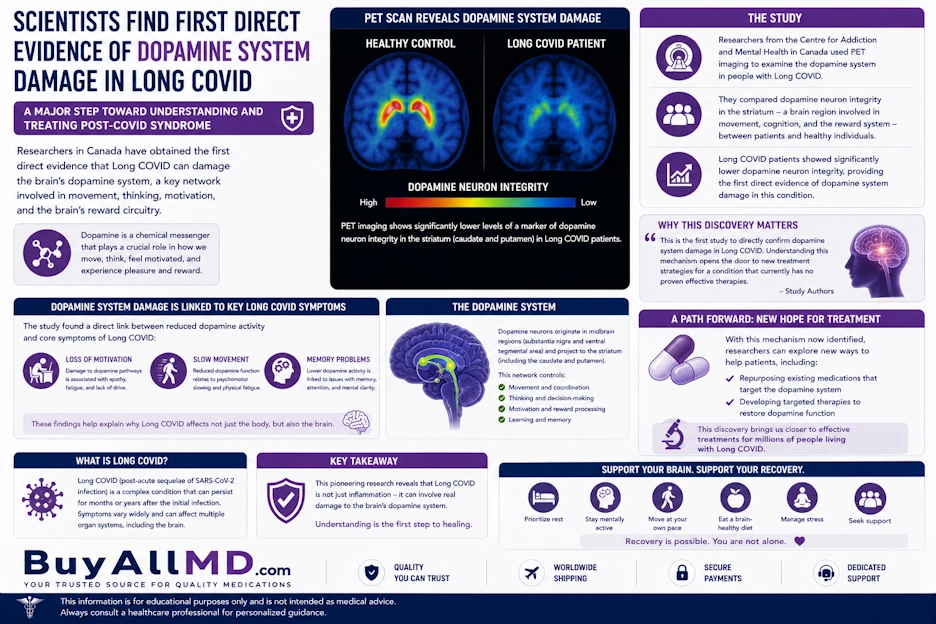
🧠 For the first time, researchers have directly demonstrated dopamine system damage in Long COVID patients — linking it to loss of motivation, motor slowing, and memory impairment.
🧠 The Discovery — Direct Evidence of Dopamine Damage
In Canada, scientists from the Centre for Addiction and Mental Health (CAMH) used PET brain imaging to study the state of the dopamine system in patients with Long COVID. They discovered significantly lower levels of a marker for dopamine neuron integrity in the striatum — a brain region involved in movement, cognition, and reward processing — compared to healthy individuals.
This is the first study to directly confirm dopamine system damage in these patients. Previous research had primarily focused on brain inflammation as the main driver of Long COVID symptoms, but this finding reveals a more specific mechanism.
🧠
First Direct Evidence
Dopamine system damage confirmed
📊
PET Imaging
Advanced brain scanning technology
💊
Treatment Hope
Existing drugs may be repurposed
💡 Key Finding: Reduced dopamine neuron integrity in the striatum was directly correlated with loss of motivation, motor slowing, and memory impairments — three hallmark symptoms of Long COVID.
🧬 What Is the Dopamine System and Why Does It Matter?
Dopamine is a neurotransmitter — a chemical messenger that plays a critical role in multiple brain functions:
🎯
Motivation & Reward
Dopamine is central to the brain’s reward system — it drives motivation, goal-directed behavior, and the feeling of pleasure.
🏃
Movement
Dopamine is essential for smooth, coordinated movement. Its deficiency is the hallmark of Parkinson’s disease.
🧠
Cognition & Memory
Dopamine modulates working memory, attention, and executive function — the mental processes that help us plan and focus.
📌 Why This Matters: When the dopamine system is damaged, patients experience reduced motivation, slowed movements, and cognitive difficulties — exactly what many Long COVID patients report.
📊 Dopamine Damage and Long COVID Symptoms — The Connection
The researchers found that reduced dopamine system integrity was directly correlated with three core Long COVID symptoms:
😞
Loss of Motivation
Patients often describe apathy — a lack of drive to engage in activities they once enjoyed. This is directly linked to dopamine dysfunction in reward pathways.
🐢
Motor Slowing
Slowed movements (bradykinesia) are a classic sign of dopamine deficiency, reflecting reduced signaling in motor circuits.
📝
Memory Impairment
Dopamine plays a key role in working memory and learning. Damage to dopamine neurons contributes to “brain fog” and memory lapses.
🔬 Beyond Inflammation — A New Understanding of Long COVID
Until now, much of the research on Long COVID has focused on brain inflammation and immune system dysregulation. While these are undoubtedly important, this study provides evidence of a more specific neurological mechanism:
🧬
Previous Focus: Inflammation
Earlier research emphasized neuroinflammation — the brain’s immune response — as the primary driver of Long COVID symptoms.
🧠
New Finding: Dopamine Damage
This study shows that dopamine neuron integrity is reduced — a direct and specific neurological deficit.
🔄
Both May Be Linked
Inflammation and dopamine damage are not mutually exclusive — they may represent different aspects of the same underlying pathology.
💡 New Perspective: This research suggests that Long COVID may involve both inflammation and dopamine system damage — and treatments may need to target both pathways.
💊 Treatment Implications — Repurposing Existing Drugs
According to the authors, understanding this mechanism could help in developing new treatment approaches for Long COVID — a condition for which no treatment has yet been validated in clinical trials.
One of the most promising directions is the repurposing of existing drugs that affect the dopamine system, rather than developing entirely new medications. This approach could:
⏱️
Faster to Patients
Repurposing existing drugs accelerates the timeline for getting treatments to patients.
💰
Lower Cost
Safety profiles and dosing are already known, reducing development costs.
🧪
Proven Mechanisms
Drugs that affect dopamine (e.g., levodopa, dopamine agonists) are already well-understood from Parkinson’s disease research.
📌 Potential Candidates: Researchers are particularly interested in levodopa (L-DOPA), dopamine agonists, and MAO-B inhibitors — all of which are used in Parkinson’s disease and could be tested in Long COVID patients.
❓ Frequently Asked Questions
What did the CAMH study find about Long COVID and the brain?
Using PET imaging, researchers found significantly lower dopamine neuron integrity in the striatum of Long COVID patients compared to healthy controls. This is the first direct evidence of dopamine system damage in Long COVID.
What symptoms are linked to dopamine damage in Long COVID?
Reduced dopamine system integrity was directly linked to loss of motivation, slowed movements, and memory impairments — three core symptoms of Long COVID.
How does this study differ from previous research on Long COVID?
Previous research focused on brain inflammation. This study provides direct evidence of dopamine neuron damage, suggesting a more specific neurological mechanism behind Long COVID symptoms.
Could existing Parkinson’s drugs help Long COVID patients?
The researchers suggest that repurposing existing dopamine-targeting drugs — such as levodopa and dopamine agonists — could be a promising treatment approach. These drugs are already well-understood and could be tested in clinical trials.
What is the striatum and why is it important?
The striatum is a brain region involved in movement, cognition, and reward processing. It receives a large amount of dopamine input and is critically affected in Parkinson’s disease and, as this study shows, in Long COVID.
📚 References & Resources
- CAMH — Centre for Addiction and Mental Health
- PubMed — Long COVID and Dopamine Research
- WHO — Post COVID-19 Condition
- Nature Medicine — Long COVID Research
- CDC — Long COVID Information
⚠️ Medical Disclaimer
This content is for informational and educational purposes only. The research findings discussed are based on scientific studies and do not constitute medical advice. Long COVID is a complex condition that should be evaluated and treated by qualified healthcare professionals. Do not start, stop, or change any medication without consulting a doctor. If you or someone you know is experiencing symptoms of Long COVID, seek medical evaluation.
© 2026 BuyAllMD.com — Evidence-Based Neuroscience & Public Health News
