
- Your cart is empty
- Continue Shopping
Granola Bars
-
Dr. Tina Sugandh
- Posted on
🥣 Nutrition Science • Food Processing • Public Health • Metabolic Health
Granola Bars — What’s Really Behind the Packaging
📋 Ultra-Processed Foods • Blood Sugar • Extrusion • Health Claims • 7 min read
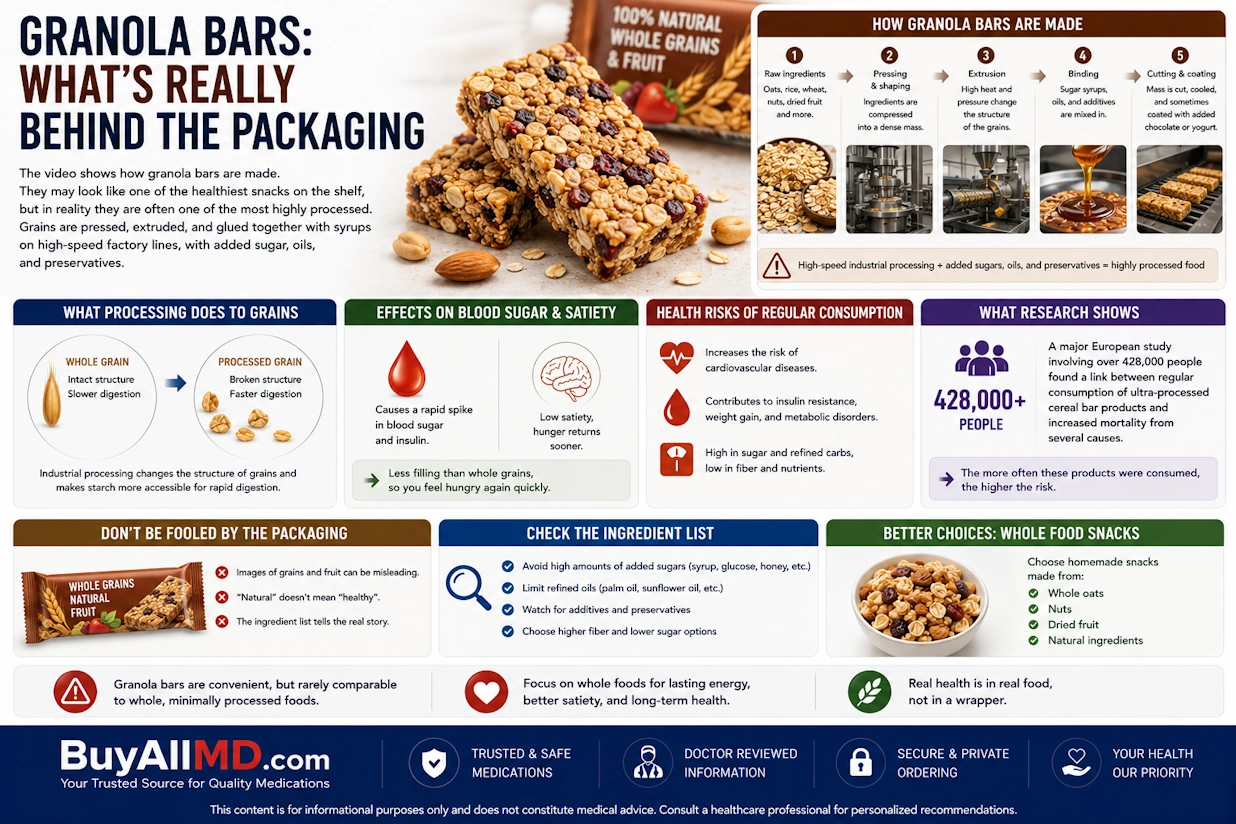
🥣 Granola bars are one of the most processed snacks on the shelf — often marketed as healthy while hiding high sugar, refined grains, and misleading health claims.
🥣 The Granola Bar Illusion — A “Healthy” Snack in Disguise
Granola bars are one of the most popular “healthy” snacks on supermarket shelves. But behind the packaging — with images of grains, fruit, and words like “natural,” “high-fiber,” and “whole grain” — lies a highly processed product.
The production process involves pressing, extruding, and binding grains with syrups on high-speed industrial lines — adding sugar, vegetable oils, and preservatives. What looks like a wholesome snack is often one of the most processed items in the aisle.
🏭
Ultra-Processed
Extruded, pressed, and bound with syrups
🍬
High Sugar
Often exceed 10g added sugar per serving
📊
Health Halo
Misleading labels like “natural” and “high-fiber”
💡 Key Insight: Granola bars have spent decades wrapped in a “health halo” — but the numbers on their labels rarely support the marketing claims.
🔧 How Granola Bars Are Made — The Processing Reality
The production of granola bars is a highly industrialized process:
1️⃣
Extrusion
Grains are subjected to high temperature, pressure, and shear forces — breaking down starch structure and making it more rapidly digestible.
2️⃣
Binding with Syrups
Extruded grains are bound together using sugar syrups, honey, or corn syrup — adding significant amounts of sugar.
3️⃣
Additives
Preservatives, artificial flavors, and oils are added for shelf stability, texture, and taste.
📌 Key Detail: Extrusion technology alters the structure of starch — making it more accessible for rapid digestion, which accelerates blood sugar spikes.
🩸 Blood Sugar and Insulin — A Rapid Spike
Research shows that industrial processing changes the structure of grains, making starch more accessible for rapid digestion. This leads to:
📈
Rapid Glucose Spike
Simple carbohydrates and refined grains are digested quickly, releasing glucose into the bloodstream rapidly.
💉
Insulin Surge
The pancreas releases insulin to manage the rapid glucose rise — insulin responses to granola bars vary widely.
😋
Energy Crash & Hunger
Rapid glucose drops can trigger increased hunger — making granola bars poorly satiating compared to whole grains.
⚠️ Key Finding: Granola bars with refined grains or added sugar can raise blood sugar quickly — often comparable to a candy bar.
⚠️ Health Risks — The Link to Chronic Disease
Regular consumption of ultra-processed foods like granola bars has been linked to serious health consequences:
❤️
Cardiovascular Disease
A large European study of over 428,000 people found a link between ultra-processed food consumption and increased mortality, particularly from cardiovascular disease.
🧠
Cognitive Decline
A study of over 10,000 people found that those getting 28% or more of calories from ultra-processed foods had a higher risk of dementia.
🧬
Cancer Risk
A study of 46,000 men found that those who ate the most ultra-processed foods had a 29% higher risk of colorectal cancer.
⚠️ Critical Finding: For every 10% increase in ultra-processed food consumption, the risk of all-cause mortality rises. In countries with high UPF consumption like the US and UK, a significant portion of premature deaths are attributed to UPF intake.
📋 Decoding the Label — What to Look For
The packaging often creates a “health halo” — but the nutrition label tells the real story:
| Marketing Claim | What It Means | What to Check |
|---|---|---|
| “High Protein” | Often contains only 3–5g protein — less than a handful of nuts | Aim for ≥10g protein per serving |
| “Natural” / “Organic” | Describes production, not nutrition — can still be high in sugar | Look beyond the claim — check calories, sugar, sodium |
| “Made with Whole Grains” | May contain only a small amount of whole grains | Look for “100% whole grain” or check ingredient list |
| “Good Source of Fiber” | Added isolated fiber may be present, but sugar can still be high | Aim for ≥4g fiber and <10g added sugar |
⚠️ Critical Warning: Many snack bars analyzed were found to be high in sugar and high in saturated fat — with many “high-protein” options failing to meet basic sugar guidelines.
✅ How to Choose a Better Granola Bar
Nutritionists recommend looking for the following in a granola bar:
🌾
≥4g Fiber
Fiber slows digestion and helps stabilize blood sugar.
💪
≥10g Protein
Protein and fat slow digestion and reduce blood sugar spikes.
🍬
<10g Added Sugar
Low added sugar for a more gradual rise in blood sugar.
💡 Practical Tip: The fix is not complicated — a handful of real nuts and a piece of fruit achieves what most granola bars promise, with none of the hidden costs. Reading the ingredients rather than the front of the package is where the truth lives.
❓ Frequently Asked Questions
Are granola bars actually healthy?
Many granola bars are ultra-processed and contain high amounts of added sugar — often comparable to candy bars. The marketing claims rarely match the nutrition label. Look for bars with ≥4g fiber, ≥10g protein, and ≤10g added sugar.
Why do granola bars spike blood sugar?
Industrial processing — especially extrusion — breaks down starch structure, making it more rapidly digestible. Combined with high added sugar and low fiber, this leads to rapid glucose spikes and insulin surges.
What are the health risks of eating granola bars regularly?
Regular consumption of ultra-processed foods like granola bars is linked to increased risk of cardiovascular disease, dementia, and certain cancers. The effects accumulate over time, even in healthy individuals.
How can I tell if a granola bar is healthy?
Ignore the front of the package — read the nutrition label. Look for ≥4g fiber, ≥10g protein, ≤10g added sugar, and ingredients you recognize. Whole grains should be listed first.
What’s a better alternative to granola bars?
A handful of real nuts and a piece of fruit — or homemade snacks made with whole oats, nuts, and dried fruit without added syrups or oils.
📚 References & Resources
- Prevention — Ultra-Processed Foods Explained
- Yahoo — The One “Healthy” Food Experts Say Isn’t Helping You
- Health — Granola Bars and Blood Sugar
- The Grocery Edit — UPFs and Premature Death
- Franke at Seaside — Food Label Misconceptions
- McMaster University — UPFs and Health
- ScienceDirect — Extrusion and Starch Digestibility
- EWG — Granola Bar Label Analysis
⚠️ Medical Disclaimer
This content is for informational and educational purposes only. The research findings discussed are based on scientific studies and do not constitute medical advice. Always consult a qualified healthcare professional for personalized health guidance, especially if you have concerns about your diet, blood sugar, or chronic disease risk.
© 2026 AusPharmX.com — Evidence-Based Nutrition & Public Health News
