
- Your cart is empty
- Continue Shopping
How Scientists Are “Listening” to Bacteria
-
Dr. Tina Sugandh
- Posted on
🔬 Nanotechnology • Microbiology • Antibiotic Resistance • Diagnostics
Scientists Can Now “Hear” Bacteria and Identify Their Species by Sound
📋 TU Delft • Graphene Membrane • Machine Learning • Flagella Motion • Antibiotic Sensitivity • 6 min read
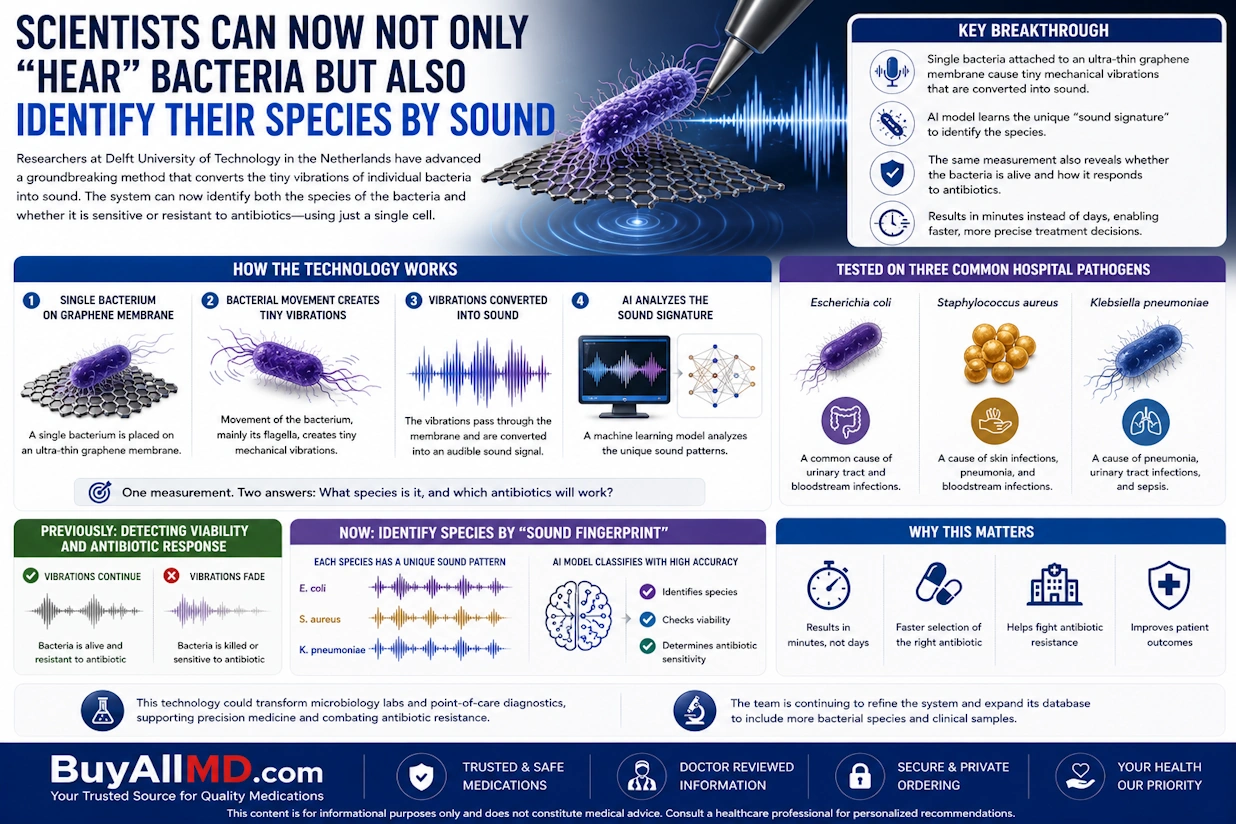
🔬 Researchers at TU Delft have developed a method to “hear” individual bacteria and identify their species by sound — while simultaneously testing antibiotic sensitivity.
🔬 The Discovery — Listening to Bacteria
In the Netherlands, scientists from Delft University of Technology (TU Delft) have advanced a method in which single bacteria attached to an ultra-thin graphene membrane cause tiny mechanical vibrations that can be converted into sound. Previously, the team showed that these vibrations stop when a bacterium is killed by an antibiotic and continue unchanged if it is resistant.
In their new work, the team went further — training a machine learning model to recognize not only bacterial viability but also the species based on each bacterium’s unique “sound signature.” The primary source of these vibrations is believed to be the movement of flagella — the tiny whip-like appendages bacteria use for movement.
🔊
“Hear” Bacteria
Vibrations converted to sound
🧬
Species ID
Unique sound signatures
💊
Antibiotic Sensitivity
Rapid resistance detection
💡 Key Finding: Combining both capabilities in a single measurement means the method can simultaneously determine the bacterial species and its sensitivity to a specific antibiotic — all from the vibrations of a single cell.
🔬 How the Technology Works
1️⃣
Bacteria on Graphene
Single bacteria are attached to an ultra-thin graphene membrane — a material just one atom thick.
2️⃣
Flagella Vibrations
The movement of flagella (bacterial “tails”) creates tiny mechanical vibrations that are converted into sound.
3️⃣
Machine Learning Analysis
An AI model analyzes the unique sound signature to identify species — and detects viability changes when antibiotics are introduced.
🦠 The Method Was Tested on Three Common Pathogens
The method was validated on three common hospital pathogens:
🧫
E. coli
Escherichia coli — a common cause of urinary tract infections, food poisoning, and hospital-acquired infections.
🧫
S. aureus
Staphylococcus aureus — a leading cause of skin infections, pneumonia, and MRSA-related complications.
🧫
Klebsiella
Klebsiella pneumoniae — a major cause of hospital-acquired pneumonia, bloodstream infections, and UTIs, often multidrug-resistant.
🏥 Clinical Implications — Faster, More Accurate Treatment
This technology could significantly accelerate the selection of effective treatments compared to classical methods, which typically require several days of waiting for results.
⚡
Rapid Diagnosis
Traditional bacterial culture and susceptibility testing can take 2–5 days. This method could deliver results in hours.
🎯
Targeted Therapy
Simultaneous species identification and antibiotic sensitivity testing enables precision antibiotic selection from the start.
🛡️
Reduced Resistance
Faster, more accurate diagnosis means less reliance on broad-spectrum antibiotics — a key strategy in combating antimicrobial resistance.
⚠️ Clinical Importance: Antimicrobial resistance (AMR) is one of the top global public health threats. This technology offers a potential tool for faster identification of drug-resistant infections, enabling more effective treatment and reducing the spread of resistant pathogens.
📊 Comparison — New Method vs Traditional Culture
| Feature | Graphene “Sound” Method | Traditional Culture |
|---|---|---|
| Time to result | Hours | 2–5 days |
| Species identification | Yes — via sound signature | Yes — via biochemical tests |
| Antibiotic sensitivity | Yes — simultaneous | Yes — requires additional culture |
| Requires cell culture | No — single cell analysis | Yes — requires colony growth |
🎵 The Sound of Bacteria — A New Diagnostic Frontier
The ability to “listen” to bacteria opens entirely new possibilities in diagnostics:
🔊
Real-Time Monitoring
Continuous monitoring of bacterial viability — the sound stops when the bacterium dies, providing instant feedback on antibiotic effectiveness.
🧬
Species-Specific Signatures
Each bacterial species produces a unique sound signature based on flagellar motion — allowing the AI to identify the pathogen with high accuracy.
💊
Resistance Detection
If the sound persists after antibiotic exposure, the bacterium is resistant — enabling rapid de-escalation to effective therapies.
❓ Frequently Asked Questions
What did the TU Delft study discover?
Researchers developed a method to “hear” individual bacteria attached to a graphene membrane. They trained a machine learning model to identify bacterial species by their unique sound signature — while simultaneously detecting antibiotic sensitivity.
How does the method identify bacterial species?
The movement of flagella — the tiny whip-like appendages bacteria use for movement — creates mechanical vibrations that are converted into sound. Each species produces a unique sound signature that machine learning can recognize.
Which bacteria were tested in the study?
The method was validated on three common hospital pathogens: E. coli (urinary tract infections), S. aureus (skin infections, MRSA), and Klebsiella (pneumonia, bloodstream infections).
How fast is this method compared to traditional culture?
Traditional bacterial culture and susceptibility testing can take 2–5 days. This method could deliver results in hours, potentially transforming the speed of diagnosis and treatment selection.
Is this technology ready for clinical use?
The method has been demonstrated in the laboratory and validated on three bacterial species. Further research and clinical validation would be needed before it could be deployed in hospital settings.
📚 References & Resources
- TU Delft — Official Website
- PubMed — Graphene Bacterial Detection Research
- WHO — Antimicrobial Resistance Fact Sheet
- CDC — Antimicrobial Resistance
- Nature Nanotechnology — Graphene Biosensing
⚠️ Medical Disclaimer
This content is for informational and educational purposes only. The research findings discussed are preliminary and based on laboratory studies. This technology has not yet been validated for clinical use and is not currently available as a diagnostic tool. This information does not constitute medical advice. Always consult a qualified healthcare professional for personalized health guidance, especially if you have concerns about infections, antibiotics, or antimicrobial resistance.
© 2026 BuyAllMD.com — Evidence-Based Microbiology & Diagnostics News
