
- Your cart is empty
- Continue Shopping
The Coffee Debate
-
Dr. Tina Sugandh
- Posted on
☕ Nutrition Science • Polyphenols • Inflammation • Food Chemistry
Scientists Explain What Really Boosts Coffee’s Anti-Inflammatory Effects — and What Doesn’t
📋 Chlorogenic Acid • Milk • Turmeric • Cinnamon • Cocoa • 6 min read
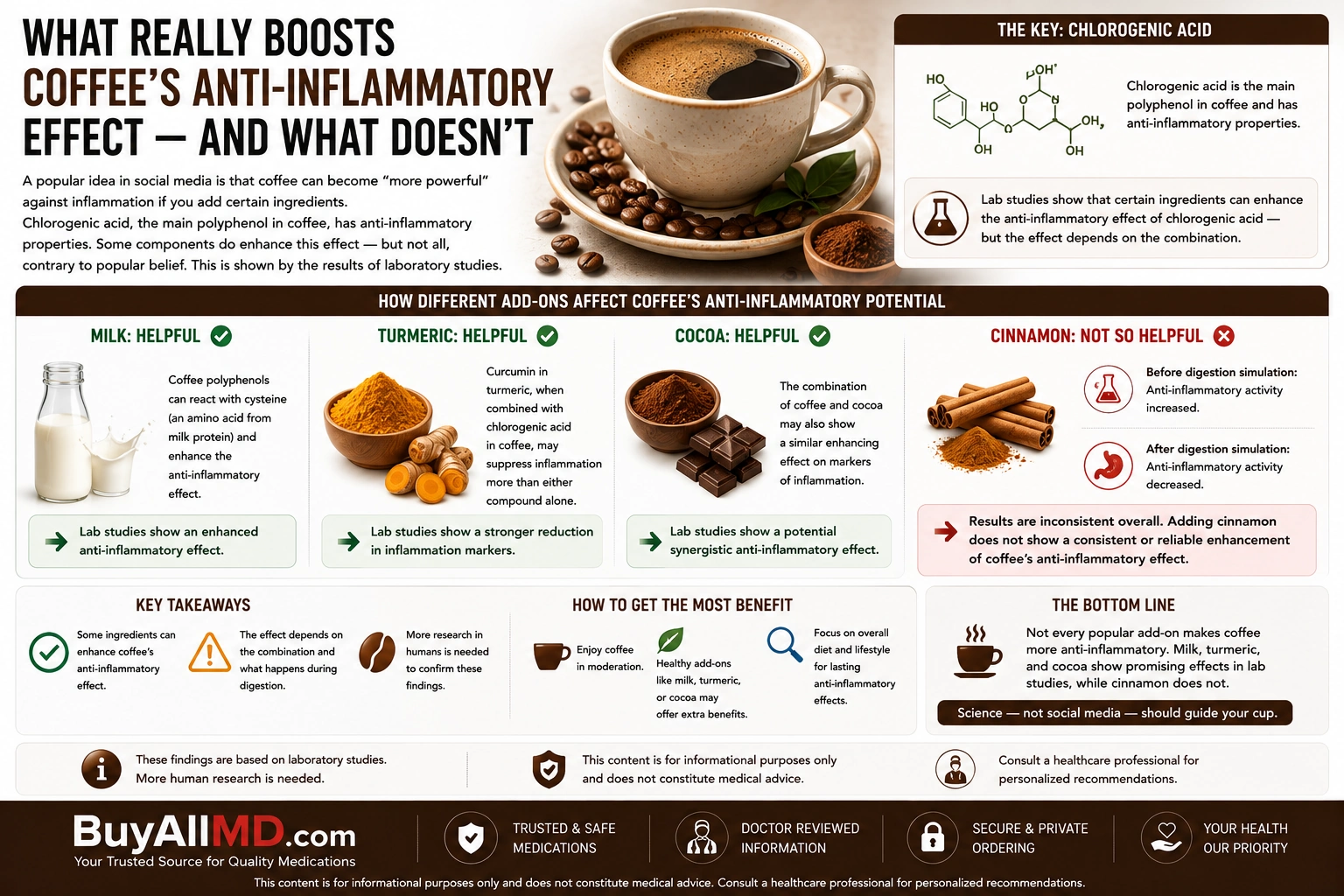
☕ Not all coffee additives are created equal — research shows milk, turmeric, and cocoa can boost the anti-inflammatory effects of coffee, while cinnamon’s benefits remain uncertain.
☕ The Coffee Debate — Can Additives Make It “Stronger”?
On social media, a popular idea has emerged: you can make coffee “more powerful” against inflammation by adding certain ingredients. Chlorogenic acid, the main polyphenol in coffee, does have anti-inflammatory properties. Some ingredients do indeed enhance this effect, but not all — contrary to widespread belief. This is shown by the results of laboratory studies .
Researchers have examined how various additives interact with coffee’s bioactive compounds, revealing a more nuanced picture than social media influencers often portray.
✅
Milk
Boosts anti-inflammatory effect
✅
Turmeric
Synergistic anti-inflammatory effect
✅
Cocoa
Enhanced effect on inflammation markers
❌
Cinnamon
Mixed results — no consistent benefit
💡 Key Insight: The anti-inflammatory potential of coffee comes primarily from chlorogenic acid — but certain additives can amplify this effect through synergistic interactions, while others may actually interfere.
🧬 Chlorogenic Acid — Coffee’s Main Anti-Inflammatory Compound
Chlorogenic acid (CGA) is the main polyphenol found in coffee. It is responsible for many of coffee’s health benefits, including:
🛡️
Anti-Inflammatory
CGA has been shown to reduce inflammatory markers and modulate immune responses.
🧬
Antioxidant
CGA is a potent antioxidant that neutralizes harmful free radicals.
🩸
Metabolic Support
CGA is associated with improved glucose and lipid metabolism.
✅ What Really Works — Additives That Boost Coffee’s Benefits
🥛
Milk
Coffee polyphenols, reacting with the amino acid cysteine in milk protein, can enhance the anti-inflammatory effect.
🧡
Turmeric
Curcumin, the active compound in turmeric, in combination with coffee’s chlorogenic acid, can suppress inflammation more strongly than either substance alone.
🍫
Cocoa
The combination of coffee and cocoa can also show a similar enhancing effect on inflammatory markers.
💡 Key Insight: Coffee polyphenols, when combined with other polyphenol-rich foods like turmeric and cocoa, create a synergistic effect that can amplify their anti-inflammatory activity.
❌ What Doesn’t Work — Cinnamon’s Mixed Results
Not all popular coffee additives work as expected. With cinnamon, for example, laboratory study results have been mixed and inconclusive:
📉
Antioxidant Activity
In laboratory studies, the antioxidant activity of the mixture weakened when cinnamon was added to coffee.
🔄
Inconsistent Anti-Inflammatory Results
Anti-inflammatory activity was enhanced before digestion simulation but weakened after it — showing no consistent benefit.
⚠️
No Sustained Benefit
Adding cinnamon did not show a consistent enhancement of the anti-inflammatory effect of coffee.
⚠️ Key Finding: The complex interactions between coffee polyphenols and cinnamon compounds are not straightforward — and the effect may depend on whether digestion is taken into account.
🔬 The Synergy Effect — Why Some Combinations Work
The mechanism behind these interactions is based on synergy — when compounds from different sources work together to produce an effect greater than the sum of their individual effects:
🧬
Polyphenol Interactions
Coffee polyphenols interact with milk proteins through cysteine to enhance anti-inflammatory activity.
🔄
Synergistic Anti-Inflammatory Action
Curcumin (turmeric) and chlorogenic acid (coffee) have been shown to suppress inflammation more strongly when combined.
🍫
Cocoa as a Booster
Combining coffee with cocoa shows enhanced effects on inflammation markers.
📊 Coffee Additives — What Works and What Doesn’t
| Additive | Effect on Inflammation | Mechanism | Evidence |
|---|---|---|---|
| Milk | ✅ Enhanced | Cysteine in milk protein reacts with coffee polyphenols | Laboratory studies show enhancement |
| Turmeric | ✅ Enhanced | Synergistic effect with chlorogenic acid | Inhibits inflammation more strongly |
| Cocoa | ✅ Enhanced | Polyphenol synergy | Enhanced effect on inflammation markers |
| Cinnamon | 🟡 Mixed | Complex interaction — may weaken antioxidant activity | No consistent enhancement, results vary |
❓ Frequently Asked Questions
Does adding milk to coffee reduce its health benefits?
Research suggests that milk may actually enhance the anti-inflammatory effect of coffee. Coffee polyphenols reacting with the amino acid cysteine in milk protein can boost the anti-inflammatory activity.
Is turmeric with coffee good for inflammation?
Yes. The combination of curcumin (from turmeric) and chlorogenic acid (from coffee) has been shown to suppress inflammation more strongly than either compound alone.
Does cinnamon in coffee help with inflammation?
The evidence is mixed and inconclusive. Laboratory studies showed inconsistent results — anti-inflammatory activity was enhanced before digestion simulation but weakened after it. No consistent benefit was demonstrated.
What is chlorogenic acid and why is it important?
Chlorogenic acid is the main polyphenol in coffee. It is responsible for many of coffee’s health benefits, including anti-inflammatory, antioxidant, and metabolic effects.
Can I make my coffee more anti-inflammatory?
Yes. Consider adding milk, turmeric, or cocoa — research suggests these ingredients can boost coffee’s anti-inflammatory effects. Avoid relying on cinnamon for this purpose, as the evidence is mixed.
📚 References & Resources
- PubMed — Coffee Polyphenols Research
- PubMed — Chlorogenic Acid Anti-Inflammatory
- PubMed — Curcumin and Chlorogenic Acid Synergy
- Healthline — Coffee and Inflammation
- NIH — Polyphenols and Inflammation
⚠️ Medical Disclaimer
This content is for informational and educational purposes only. The research findings discussed are based on laboratory studies and do not constitute medical advice. Coffee and its additives may have health benefits, but they are not a substitute for medical treatment. Always consult a qualified healthcare professional for personalized health guidance.
© 2026 AusPharmX.com — Evidence-Based Nutrition & Public Health News
