
- Your cart is empty
- Continue Shopping
Cats and Dogs May Support Health
-
Dr. Tina Sugandh
- Posted on
🐾 Healthy Aging • Pet Ownership • Cognitive Health • Cardiovascular Health
Study Review — Cats and Dogs May Support Health in Older Age
📋 NIA • Baltimore Longitudinal Study of Aging • Physical Activity • Cognitive Decline • 6 min read
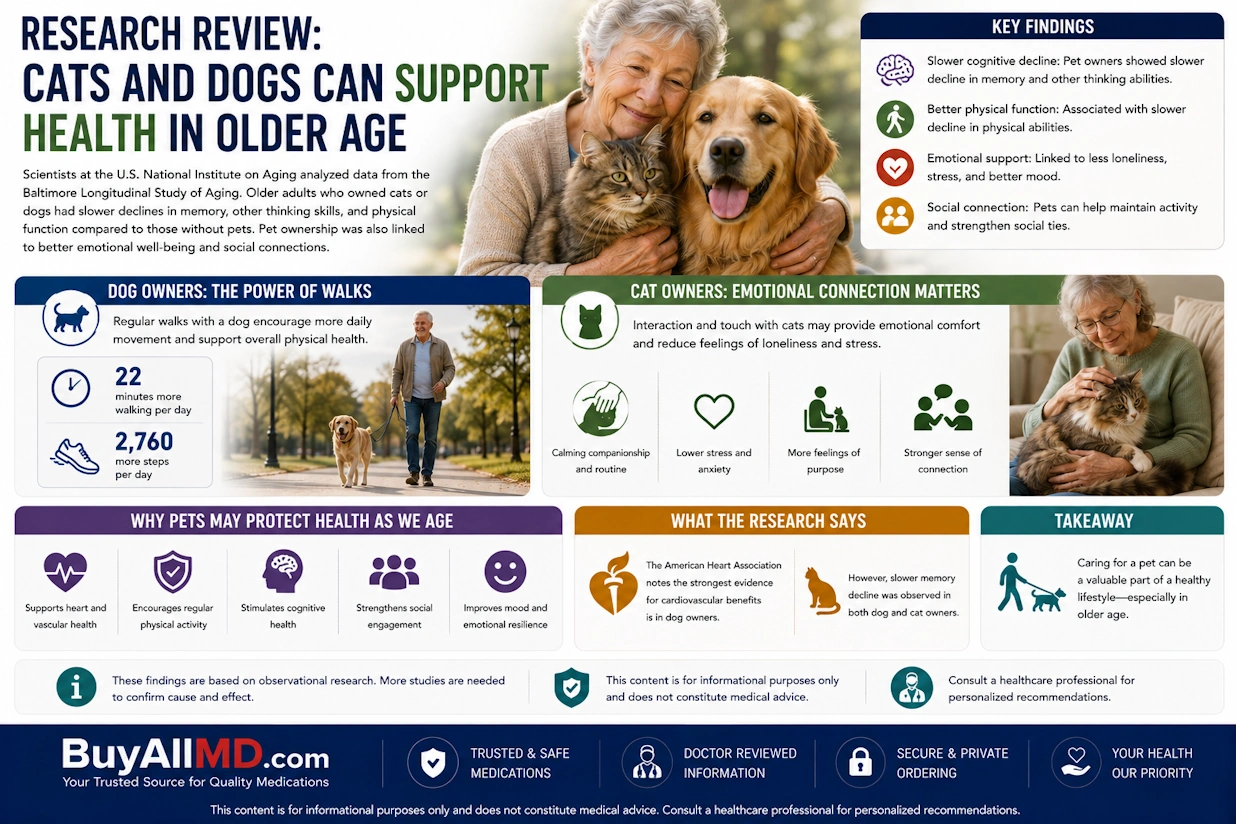
🐾 A review of research from the National Institute on Aging suggests that owning a cat or dog may help slow cognitive decline and support physical health in older adults.
🐾 The Discovery — Pets and Healthy Aging
In the United States, scientists from the National Institute on Aging (NIA) analyzed data from the Baltimore Longitudinal Study of Aging (BLSA) — one of the longest-running studies on aging in the world. They found that older adults who owned cats or dogs experienced slower declines in memory and other cognitive abilities compared to those without pets. Pet ownership was also linked to slower declines in physical function.
The review helps explain why pet ownership is associated with a lower risk of cardiovascular disease and more stable emotional well-being.
🧠
Slower Cognitive Decline
Memory and thinking preserved longer
🚶
Physical Activity
22 min more walking per day with dogs
❤️
Heart Health
Lower cardiovascular risk
💡 Key Finding: “We found that pet ownership was associated with slower decline in verbal memory and verbal fluency among older adults,” the researchers reported.
📊 The Baltimore Longitudinal Study — Key Findings
The researchers analyzed data from the Baltimore Longitudinal Study of Aging, which tracked participants over many years. The study included:
📋
Long-Term Tracking
One of the longest-running studies on aging in the world — providing robust data on how pet ownership affects health over time.
🧠
Cognitive Outcomes
Pet owners showed slower decline in verbal memory, verbal fluency, and other cognitive measures.
🚶
Physical Outcomes
Slower decline in physical function was also observed in pet owners.
💡 Key Data: The study found that older adults with pets had better cognitive function over time compared to those without pets, even after accounting for other factors.
🐶 Dogs vs Cats — Different Benefits, Same Positive Effect
Both dog and cat ownership showed benefits — but through different mechanisms:
🐕
Dog Owners — Physical Activity
Regular walks with dogs provide consistent physical activity. Dog owners walked an average of 22 minutes more per day and took 2,760 more steps than non-dog owners.
🐈
Cat Owners — Emotional Support
Interaction and tactile contact with cats may provide emotional support and be linked to lower levels of loneliness and stress.
📌 Key Note: The American Heart Association notes that the most compelling evidence for cardiovascular benefits is in dog owners — but slower memory decline was observed in both dog and cat owners.
🔬 How Pets Support Health — Multiple Pathways
The review suggests several mechanisms through which pet ownership supports health in older age:
🚶
Physical Activity
Dog walking encourages regular, moderate-intensity exercise — essential for cardiovascular and musculoskeletal health.
🤝
Social Connection
Pets can act as “social catalysts” — facilitating interactions with other people and reducing social isolation.
😌
Emotional Support
Tactile contact and companionship reduce stress, loneliness, and depression — all of which affect cognitive and physical health.
🧠
Cognitive Stimulation
Caring for a pet provides purpose, routine, and mental engagement — supporting cognitive reserve.
📊 Dogs vs Cats — Health Benefits Comparison
| Outcome | Dog Owners | Cat Owners |
|---|---|---|
| Physical Activity | ✅ Strong benefit (walks) | 🟡 Less direct |
| Emotional Support | ✅ Yes | ✅ Yes (touch, companionship) |
| Social Connection | ✅ Strong | 🟡 Moderate |
| Slower Cognitive Decline | ✅ Yes | ✅ Yes |
| Cardiovascular Risk | ✅ Reduced (AHA) | 🟡 Less evidence |
❤️ American Heart Association — Cardiovascular Benefits
The American Heart Association (AHA) notes that the most compelling evidence for cardiovascular benefits exists for dog owners. However, the review emphasizes that:
❤️
Cardiovascular Risk Reduction
Pet ownership is associated with lower blood pressure, cholesterol, and triglyceride levels.
🧠
Cognitive Protection
Slower cognitive decline was observed in both dog and cat owners — not just dog owners.
📌 Key Insight: The AHA suggests that pet ownership can be a useful part of a healthy lifestyle, especially in older age, but emphasizes that the evidence is strongest for dog owners who walk their dogs regularly.
❓ Frequently Asked Questions
Do pets really help with healthy aging?
Yes. Research from the National Institute on Aging found that older adults with pets experienced slower cognitive and physical decline compared to those without pets.
Are dogs or cats better for older adults?
Both provide benefits through different pathways. Dogs encourage physical activity through walks. Cats provide emotional support through companionship and touch. Both were linked to slower cognitive decline.
How do pets improve cognitive health?
Pets provide social connection, emotional support, routine, and purpose — all of which support cognitive reserve. Dog owners also benefit from regular physical activity, which is protective for brain health.
How much more active are dog owners?
Dog owners walk an average of 22 minutes more per day and take 2,760 more steps daily compared to non-dog owners.
What does the American Heart Association say about pets?
The AHA notes that the most compelling evidence for cardiovascular benefits is in dog owners, but acknowledges that pet ownership can be a useful part of a healthy lifestyle for older adults.
📚 References & Resources
- NIH — Pet Ownership and Cognitive Decline
- News-Medical — Pets and Cognitive Health
- Medscape — Pets and Aging
- AHA — Pet Ownership and Cardiovascular Risk
- PubMed — Pets and Healthy Aging
- WHO — Ageing and Health
⚠️ Medical Disclaimer
This content is for informational and educational purposes only. The research findings discussed are based on observational studies and do not constitute medical advice. While pet ownership may offer health benefits, it is not a substitute for medical care. Always consult a qualified healthcare professional for personalized health guidance, especially if you have concerns about aging, cognitive health, or cardiovascular disease.
© 2026 BuyAllMD.com — Evidence-Based Aging & Public Health News
