
- Your cart is empty
- Continue Shopping
Vitiligo Pill Shows Success in Patients
-
Dr. Tina Sugandh
- Posted on
🧬 Dermatology • Autoimmune Disease • Clinical Trials • Drug Development
Final Step Before Approval — Vitiligo Pill Shows Success in Patients
📋 Pfizer • JAK Inhibitor • Vitiligo • Clinical Trials • Repigmentation • 6 min read
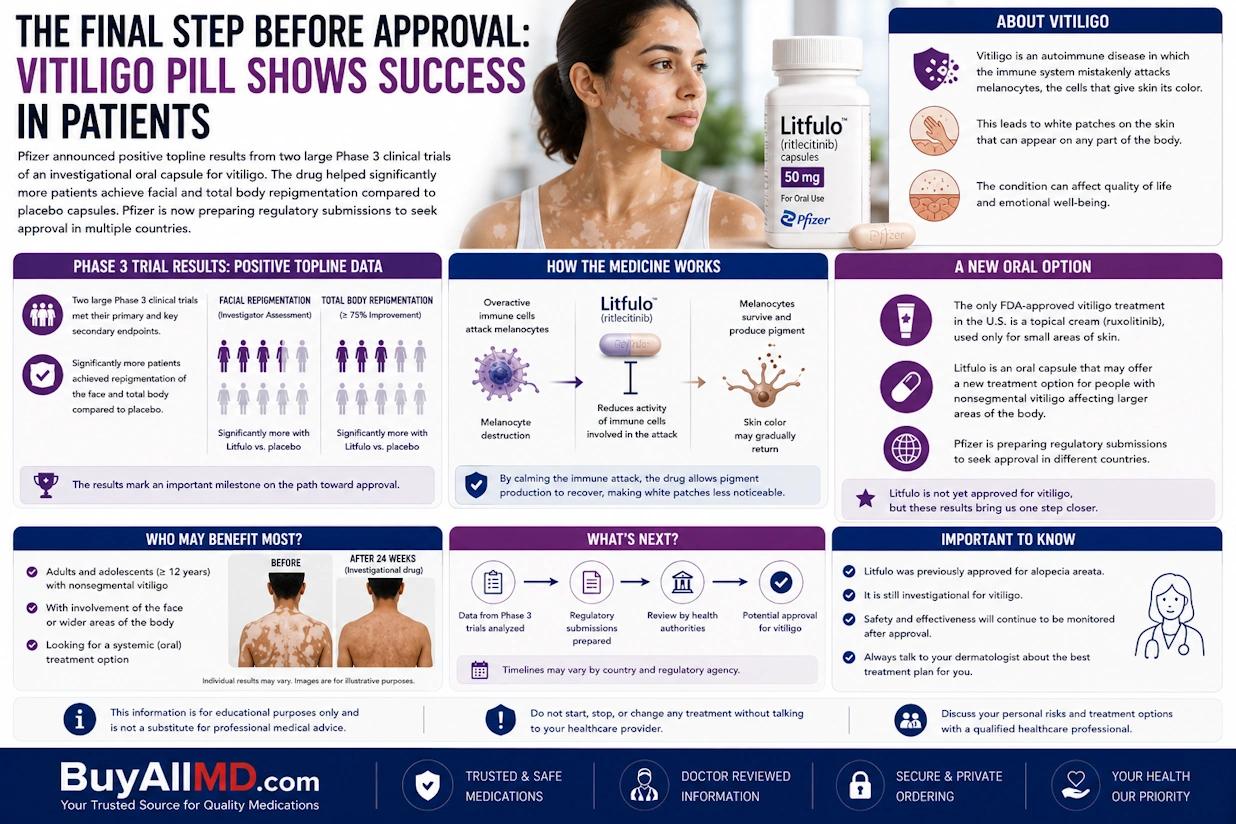
🧬 Pfizer’s investigational vitiligo pill has shown promising results in two large clinical trials, bringing patients one step closer to a new treatment option for widespread vitiligo.
🧬 The Discovery — A Pill That Restores Skin Color
In the United States, scientists at Pfizer have conducted two large clinical trials of an investigational capsule-based drug for the treatment of vitiligo. The medication helped a significantly greater number of patients restore skin color on the face and body compared to placebo. The company is now preparing documents to seek approval to use the drug for vitiligo treatment in various countries.
The data from the two Phase 3 trials, involving more than 1,500 patients across multiple countries, were presented at the American Academy of Dermatology (AAD) Annual Meeting .
🧪
Two Phase 3 Trials
1,500+ patients enrolled
🎯
JAK Inhibition
Targets immune cells attacking melanocytes
📋
Approval Pending
Regulatory submission in preparation
💡 Key Finding: The drug led to a clinically meaningful improvement in facial and total body repigmentation compared to placebo, as measured by the Vitiligo Area Scoring Index (VASI) .
🔬 How the Drug Works — Targeting the Immune Attack
Vitiligo is a disease in which the immune system mistakenly attacks the cells that give skin its color — melanocytes. This results in white patches appearing on the body. The investigational drug, a JAK inhibitor, works by reducing the activity of immune cells involved in this attack .
In vitiligo, immune cells called CD8+ T cells produce a signaling molecule called interferon-gamma (IFN-γ), which triggers a cascade of inflammatory signals that destroys melanocytes. By blocking the JAK pathway, the drug suppresses this inflammatory cascade, allowing melanocyte stem cells to repopulate the skin and gradually restore pigment .
🛡️
Blocks Immune Attack
Reduces activity of CD8+ T cells and suppresses IFN-γ signaling — stops melanocyte destruction .
🔄
Restores Pigment
Allows melanocyte stem cells to repopulate, gradually restoring color to white patches .
⏱️
Sustained Repigmentation
The effect was sustained in those who continued therapy after 52 weeks .
📌 Key Insight: “Thanks to the successful studies, the drug is approaching regulatory approval,” noted the authors, adding that the data suggest a favorable benefit-risk profile .
📊 Clinical Trial Results — Key Efficacy Data
The primary endpoint of both trials was the proportion of patients achieving ≥75% improvement in the Facial Vitiligo Area Scoring Index (F-VASI) at week 52. In both trials, the drug demonstrated statistically significant and clinically meaningful improvement .
| Endpoint | Drug (Week 52) | Placebo → Drug (Week 52) |
|---|---|---|
| F-VASI ≥75% | 40.9–42.5% | 27.5–38.4% |
| T-VASI ≥50% | 17.8–22.4% | 13.6–22.5% |
| F-VASI ≥90% | 21.4–25.0% | 13.3–20.5% |
💡 Key Data: “It is important to note that those who continued on the drug achieved sustained repigmentation over 52 weeks, whereas those who were switched from placebo had a similar treatment effect,” the authors noted .
⚖️ A New Option for Widespread Vitiligo
Currently, the only FDA-approved medication for vitiligo in the United States is a topical cream (ruxolitinib) approved for use in patients aged 12 years and older with non-segmental vitiligo. However, the cream is only suitable for small areas of skin and may be impractical for patients with widespread disease .
The investigational pill could become a new option for people with extensive vitiligo — where white patches cover large areas of the body. If approved, it would offer a systemic treatment for widespread disease .
🧴
Current: Topical Cream
Approved in the US for small areas — may be impractical for widespread vitiligo .
💊
New: Oral Pill
If approved, oral formulation would treat extensive vitiligo — a systemic option for widespread disease .
📌 Key Insight: Pfizer is preparing documents to submit for regulatory approval in various countries. The drug is not yet approved for vitiligo, but successful trials have brought it closer to registration .
❓ Frequently Asked Questions
What is vitiligo and what causes it?
Vitiligo is a chronic autoimmune disease in which the immune system attacks melanocytes — the cells that produce skin pigment. This leads to white patches on the skin .
What did the Pfizer trials show?
Two Phase 3 trials showed that the investigational pill led to clinically meaningful repigmentation on the face and body compared to placebo. Up to 42.5% of patients achieved ≥75% facial repigmentation at week 52 .
Is the Pfizer vitiligo pill already approved?
Not yet. The drug has shown success in clinical trials and Pfizer is preparing regulatory submissions. It is not yet approved for vitiligo treatment in any country .
How does the vitiligo pill work?
The drug is a JAK inhibitor that reduces the activity of immune cells involved in attacking melanocytes. By blocking the JAK-STAT pathway, it allows melanocyte stem cells to repopulate the skin and restore pigment .
How is this different from current vitiligo treatments?
Currently, the only FDA-approved treatment is a topical cream suitable for small areas. This investigational pill would be an oral systemic treatment for patients with widespread vitiligo .
📚 References & Resources
- Pfizer — Press Release
- Dermatology Times — Phase 3 Results
- Medscape — Pfizer Vitiligo Pill
- AAD — Vitiligo Overview
- NEJM — JAK Inhibitors in Vitiligo
⚠️ Medical Disclaimer
This content is for informational and educational purposes only. The investigational drug discussed is not yet approved for clinical use and is still in clinical development. This information does not constitute medical advice. Always consult a qualified healthcare professional for personalized health guidance, especially if you have concerns about vitiligo or other skin conditions.
© 2026 AusPharmX.com — Evidence-Based Dermatology & Drug Development News
