
- Your cart is empty
- Continue Shopping
Family History Affects Breast Cancer
-
Dr. Tina Sugandh
- Posted on
🧬 Oncology • Genetics • Breast Cancer • Public Health
Family History Affects Breast Cancer Risk Even With Negative BRCA Test, Study Finds
📋 Cedars-Sinai • BRCA1/BRCA2 • JAMA Network Open • Genetic Testing • Risk Assessment • 6 min read
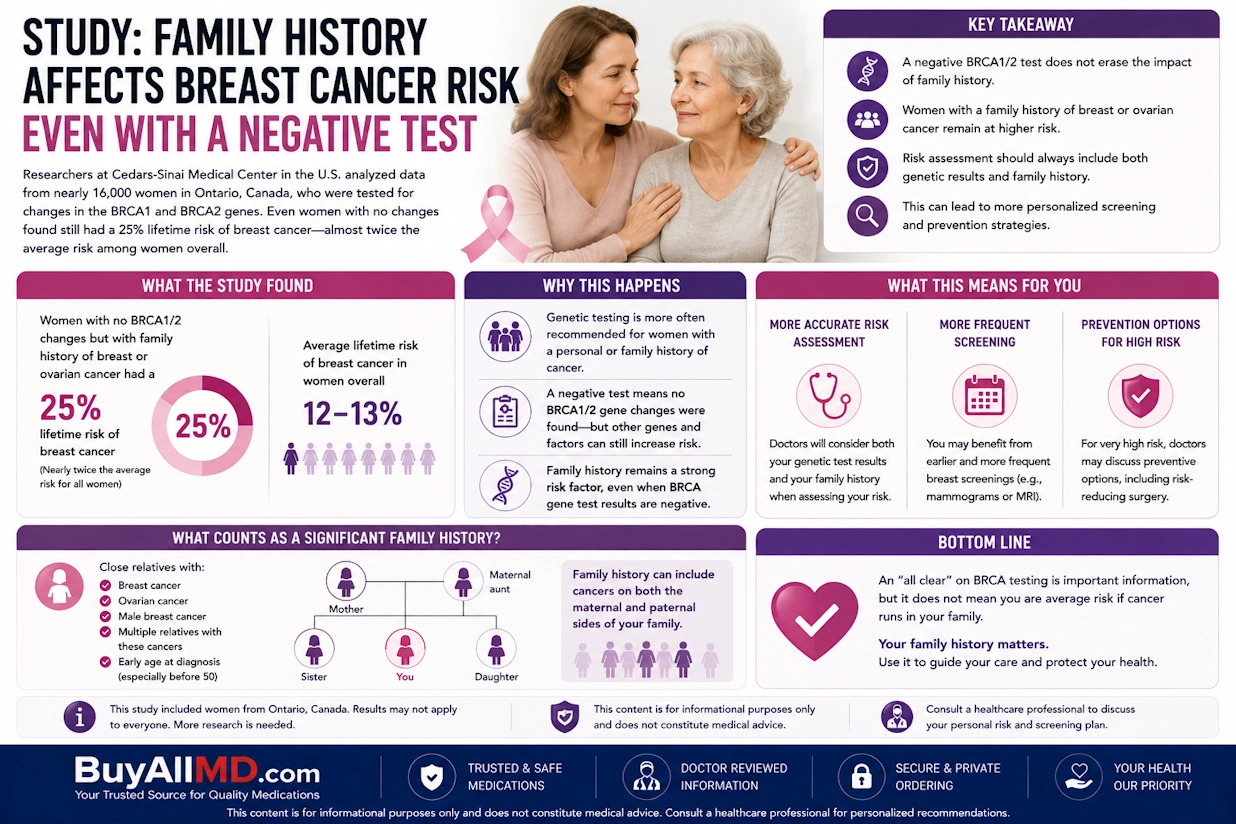
🧬 A negative BRCA test does not eliminate breast cancer risk — family history remains a critical factor, with lifetime risk still reaching 25% for women with strong family history.
🧬 The Discovery — Family History Matters Beyond BRCA Status
In the United States, scientists from Cedars-Sinai Health Sciences University analyzed data from nearly 16,000 women in Canada who underwent genetic testing for mutations in the BRCA1 and BRCA2 genes. The findings, published in JAMA Network Open, revealed that women who tested negative for these mutations still had a 25% lifetime risk of developing breast cancer — nearly double the average risk among women in the general population [citation:4][citation:5].
Women with a variant of uncertain significance (VUS) — a genetic change with unknown clinical implications — had an even higher lifetime risk of 30% [citation:4][citation:13].
📊
25% Lifetime Risk
Negative BRCA test with family history
🧬
16,000 Women
Study cohort from Ontario, Canada
📈
30% VUS Risk
Variants of uncertain significance
💡 Key Finding: “While most women who undergo genetic testing do not test positive for a cancer-risk-increasing BRCA mutation, they have generally been referred for testing because of strong personal or family cancer history,” said Dr. Fahima Dossa, lead author of the study [citation:4].
🔬 Why Does Risk Remain Elevated After a Negative Test?
The elevated risk among BRCA-negative women is largely explained by the selection bias inherent in genetic testing [citation:4][citation:13]:
👩⚕️
Testing Is Not Random
Women are referred for BRCA testing precisely because they already have risk factors — such as age, disease phenotype, and family history. In essence, those who are tested are already at higher risk than the general population [citation:13].
🧬
Family History Persists
A negative BRCA result does not erase the underlying genetic and familial factors that prompted testing. Strong family history remains an independent risk factor [citation:3][citation:14].
🔬
Other Genetic Factors
A negative BRCA test does not rule out other moderate-risk or low-penetrance genetic variants that may contribute to breast cancer risk [citation:7].
📊 Family History Stratifies Risk — Even Among BRCA-Negative Women
The study found that family history significantly influences breast cancer risk across all BRCA test result groups [citation:13]:
| BRCA Test Result | Lifetime Breast Cancer Risk | Risk by Family History |
|---|---|---|
| General Population | ~13% | Baseline [citation:4][citation:14] |
| Negative (Noninformative) | ~26% | 21% (0 affected relatives) → 43% (≥2 affected relatives) [citation:13] |
| Variant of Uncertain Significance (VUS) | ~31% | Higher than general population [citation:13] |
| BRCA1/2 Pathogenic Variant | 62–86% | 56% (0 affected) → 86% (≥2 affected relatives) [citation:13] |
| Predictive Negative | ~13% | Similar to general population [citation:13] |
📌 Key Insight: The only women in the study with breast cancer risk similar to the general population were those who had a known BRCA mutation in the family and tested negative for that specific mutation [citation:4][citation:13].
🩺 Clinical Implications — Guiding Prevention and Surveillance
These findings help physicians tailor surveillance and prevention strategies more precisely [citation:4]:
📋
Tailored Screening
A physician might recommend more frequent mammograms or breast MRI to a BRCA-positive patient in their 50s or 60s with no family history of breast cancer [citation:4].
🔬
Risk-Reducing Surgery
For a young BRCA patient with several cases of breast cancer in the family, preventive mastectomy may be discussed as an option [citation:4].
👩⚕️
Informed Counseling
“This study is a reminder to patients about the importance of having discussions with their doctors about genetic test results,” said Dr. Dossa. “We finally have some data to help inform those conversations” [citation:4].
💡 Key Takeaway: The study highlights that decisions around risk-reduction strategies should be individualized, considering both genetic status and family history [citation:13].
💡 What This Means for Women — A Balanced Perspective
✅
A Negative Test Is Not a “Free Pass”
A negative BRCA test should not be interpreted as complete elimination of risk. Family history must be evaluated alongside genetic results [citation:4][citation:13].
🛡️
Predictive Negative Testing Is Reassuring
Women who test negative for a specific BRCA mutation known to run in their family have a risk similar to the general population — this is reassuring [citation:13].
📊
Risk Models May Need Recalibration
Some risk models (such as BOADICEA and IBIS) may overpredict risk for women with negative BRCA results — caution is advised when using these models to guide risk management [citation:2][citation:11].
❓ Frequently Asked Questions
What did the Cedars-Sinai study find about BRCA-negative women?
The study found that women who tested negative for BRCA mutations still had a 25% lifetime risk of breast cancer if they had a family history of the disease — nearly double the average 13% risk in the general population [citation:4][citation:5].
Why do women with negative BRCA tests still have elevated risk?
Women are referred for BRCA testing precisely because they already have risk factors — including family history. A negative result does not erase the underlying familial risk factors that prompted testing [citation:4][citation:13].
What is a variant of uncertain significance (VUS)?
A VUS is a genetic change where little is known about its clinical implications. The study found that women with a VUS had a 30% lifetime risk of breast cancer [citation:4][citation:13].
What is a predictive negative test result?
A predictive negative result means a woman was tested for a specific BRCA mutation known to run in her family and did not carry it. These women had a risk similar to the general population (~13%) [citation:4][citation:13].
How should women with negative BRCA tests manage their breast cancer risk?
Decisions should be individualized based on family history. Women with strong family history may benefit from more frequent screening, while those with predictive negative results have risk similar to the general population. Always discuss options with your doctor [citation:4][citation:13].
📚 References & Resources
- Cedars-Sinai — Study News Release
- Medscape — Inconclusive BRCA Results and Cancer Risk
- EurekAlert! — Cedars-Sinai Study
- Michigan Medicine — Breast Cancer Risk Assessment
- PubMed — BRCA Risk Models
- Cedars-Sinai — Understanding Breast Cancer Risk
⚠️ Medical Disclaimer
This content is for informational and educational purposes only. The research findings discussed are based on scientific studies and do not constitute medical advice. If you have concerns about breast cancer risk, genetic testing, or family history, please consult a qualified healthcare professional for personalized guidance.
© 2026 AusPharmX.com — Evidence-Based Oncology & Public Health News
