
- Your cart is empty
- Continue Shopping
Scientists Use AI to Create Viruses
-
Dr. Tina Sugandh
- Posted on
🧬 AI & Synthetic Biology • Antimicrobial Resistance • Phage Therapy • Biotechnology
Scientists Use AI to Create Previously Non-Existent Viruses That Attack Bacteria
📋 Stanford University • Arc Institute • Generative AI • Bacteriophages • Antimicrobial Resistance • 6 min read
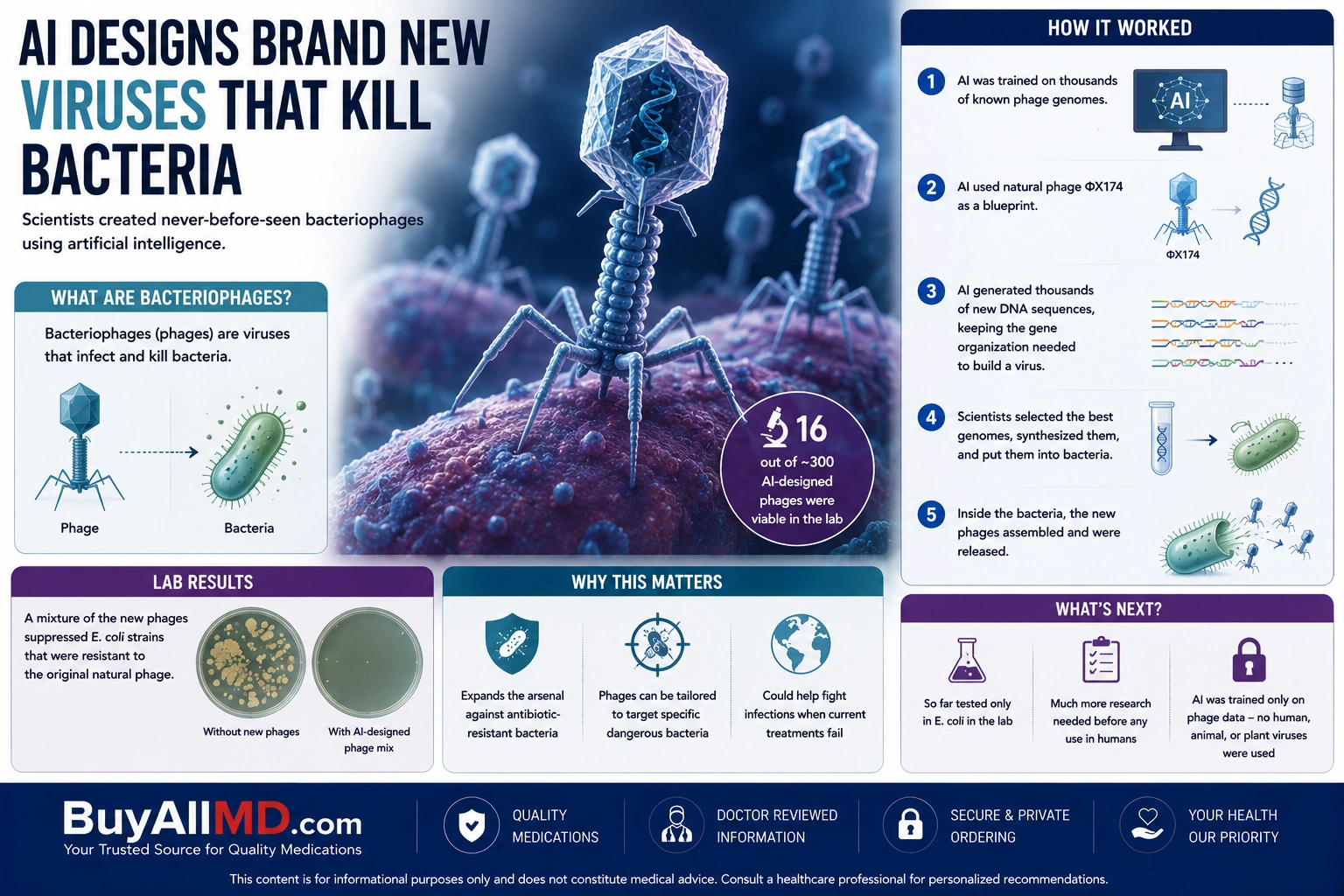
🧬 Researchers have used generative AI to design completely new bacteriophages — viruses that infect bacteria — opening new possibilities for treating antibiotic-resistant infections.
🧬 The Breakthrough — AI-Generated Bacteriophages
In the United States, scientists from Stanford University and the Arc Institute have used artificial intelligence to design complete genomes of previously non-existent bacteriophages — viruses that infect and kill bacteria. In laboratory experiments, 16 of nearly 300 synthesized variants were viable, and a mixture of them suppressed the growth of E. coli strains that were resistant to the original natural phage.
The work, published as a preprint on bioRxiv, represents a major step forward in using generative AI for synthetic biology and could offer new tools in the fight against antimicrobial resistance (AMR) .
🧬
Novel Phages
AI-designed, never before existed
🧪
16 Viable Phages
Out of ~300 synthesized
🦠
ΦX174 Guided
Natural phage used as reference
💡 Key Insight: “We can now start to think about a world where we can quickly and easily design new phages on demand for specific bacterial infections, potentially offering a powerful new tool in the fight against antibiotic resistance,” said lead researcher Dr. Sean Jungbluth .
🔬 How the AI Designed New Viruses
The researchers trained a generative AI model on the genomes of known bacteriophages and gave it a natural phage called ΦX174 as a reference point. The algorithm generated thousands of new DNA sequences while preserving the gene organization necessary for virus assembly.
1️⃣
AI Training
The model was trained on known bacteriophage genomes, learning the patterns and rules of viral DNA organization.
2️⃣
Sequence Generation
The AI generated thousands of novel DNA sequences, maintaining the gene organization required for a functional virus.
3️⃣
Synthesis & Testing
Selected genomes were synthesized and introduced into bacteria, where they assembled into new viral particles.
📌 Key Note: The researchers intentionally limited the training data to only phages that infect bacteria — they did not include genomes of viruses that infect humans, animals, or plants to reduce potential risks .
📊 Experimental Results — What the Lab Tests Showed
| Parameter | Result |
|---|---|
| Total Genomes Synthesized | ~300 |
| Viable Phages | 16 |
| Target Bacteria | E. coli (including antibiotic-resistant strains) |
| Phage Mix Effectiveness | Suppressed growth of E. coli strains resistant to natural phage ΦX174 |
🩺 Potential Applications — Fighting Antibiotic Resistance
In the future, this approach could expand the arsenal of phages available to fight bacterial infections, particularly when bacteria become resistant to known phages . The study is part of a broader effort to develop new tools to combat antimicrobial resistance (AMR), which is one of the leading global public health threats.
🦠
Phage Therapy
AI-designed phages could be used to treat bacterial infections that are resistant to conventional antibiotics.
🧬
Overcoming Resistance
Novel phages can be generated on demand when bacteria become resistant to existing phages.
🛡️
Personalized Medicine
AI could enable rapid, tailored phage design for individual patients with specific bacterial infections.
💡 Key Challenge: “The biggest challenge is the risk of bacteria developing resistance to these phages, just as they do to antibiotics. However, we can use this generative capability to create phages in a much faster way,” said Dr. Jungbluth .
🛡️ Safety and Limitations — A Long Way From Human Treatment
While the results are promising, the researchers emphasize that much more work remains before this approach can be used in humans:
🧪
Lab-Only Validation
The work has only been tested on E. coli in the laboratory — not in humans.
⏳
Years of Research Ahead
“We are years away from this being a clinical reality,” said Dr. Jungbluth.
🛡️
Safety Measures
The AI was trained only on phages that infect bacteria, excluding viruses of humans, animals, or plants to reduce risks.
⚠️ Important Note: For now, the work is a proof of concept, demonstrating that AI can generate functional, previously unknown phages . The researchers are working on improving the AI’s efficiency and exploring its potential for other bacterial pathogens .
❓ Frequently Asked Questions
What did the Stanford and Arc Institute study achieve?
Researchers used AI to generate complete genomes of previously non-existent bacteriophages. Of nearly 300 synthesized variants, 16 were viable and a mixture of them suppressed the growth of antibiotic-resistant E. coli.
How did the AI design new bacteriophages?
The AI was trained on known bacteriophage genomes and given the natural phage ΦX174 as a reference. It generated thousands of new DNA sequences while preserving the gene organization needed for virus assembly.
Could this help with antibiotic resistance?
Yes. This approach could allow rapid design of new phages when bacteria become resistant to known phages — offering a potential tool against antimicrobial resistance.
Is this treatment available to patients now?
No. The work is preliminary and laboratory-based. The researchers emphasize they are “years away” from clinical application. The phages have only been tested on E. coli in the lab.
What safety measures were taken?
The AI was trained only on phages that infect bacteria — researchers intentionally excluded genomes of viruses that infect humans, animals, or plants to reduce potential risks.
📚 References & Resources
- bioRxiv — Preprint Study
- Stanford University — News Release
- Arc Institute — Research Announcement
- Nature Biotechnology — Phage Therapy Review
- WHO — Antimicrobial Resistance Fact Sheet
⚠️ Medical Disclaimer
This content is for informational and educational purposes only. The research findings discussed are preliminary and based on laboratory studies — they have not yet been tested in humans and are not currently available as a treatment. This information does not constitute medical advice. Always consult a qualified healthcare professional for personalized health guidance, especially if you have concerns about infections or antibiotic resistance.
© 2026 BuyAllMD.com — Evidence-Based Biotechnology & Public Health News
