- Your cart is empty
- Continue Shopping


Price range: $4.00 through $20.00
✅ Active Ingredient Overview Table:
| 🔬 Active Ingredient (Generic Name): | Ceftriaxone Sodium |
|---|---|
| 💊 Indication: | Bacterial Infections (Sepsis, Meningitis, Pneumonia, Skin & Soft Tissue, Urinary) |
| 🇺🇸 US Brand Equivalent: | Rocephin |
| 🏭 Manufacturer: | Aristo Pharmaceuticals Pvt. Ltd (Founded: 1984) |
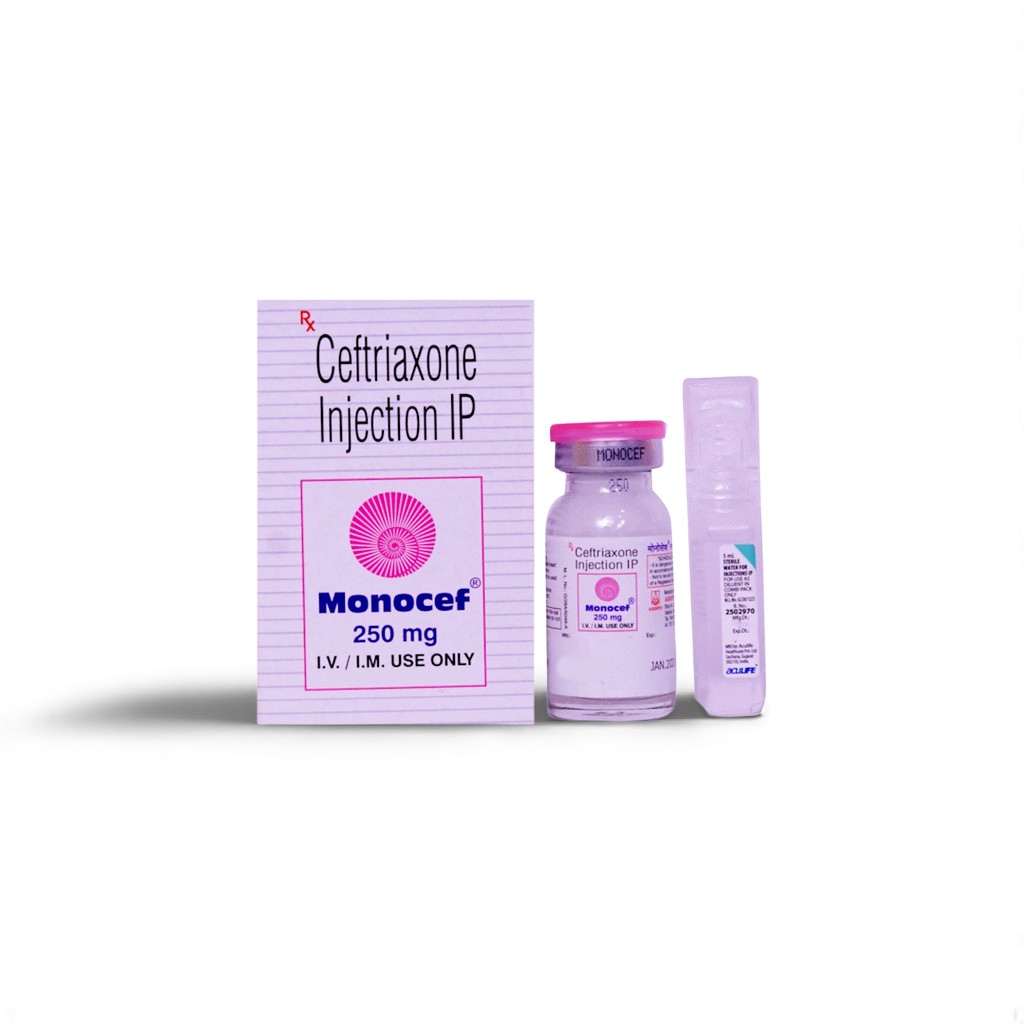
| 📦 Packaging: | 250 mg Ceftriaxone per 5 ml Vial |
| 🧪 Strength: | 250 mg (Reconstituted with Sterile Water for Injection) |
| 🚚 Delivery Time: | 6–15 days |
Monocef Injection contains Ceftriaxone, a third-generation cephalosporin antibiotic with broad-spectrum activity against Gram-positive and Gram-negative bacteria. It inhibits bacterial cell wall synthesis by binding to penicillin-binding proteins, leading to cell lysis and death. Monocef’s long half-life allows once- or twice-daily dosing, making it suitable for severe infections such as sepsis, meningitis, community-acquired pneumonia, and complicated urinary tract infections.
Ceftriaxone penetrates well into cerebrospinal fluid, bones, and other tissues, ensuring effective treatment of meningitis and osteomyelitis. Its stability against beta-lactamases makes it valuable against resistant strains.
| Attribute | Detail |
|---|---|
| Chemical Formula | C18H18N8O7S3•Na (as sodium salt) |
| Molecular Weight | 641.47 g/mol (Ceftriaxone sodium) |
| Mechanism of Action | Binds to penicillin-binding proteins → inhibits peptidoglycan cross-linking → bactericidal |
| Bioavailability | 100% (IV/IM administration) |
| Half-Life | ~8 hours in adults; prolonged in neonates and renal/hepatic impairment |
| Metabolism & Excretion | Excreted unchanged in urine (50–60%) and bile (40–50%); no dose adjustment in mild-to-moderate renal impairment; avoid combination with calcium-containing solutions in neonates |
| Condition | Dose & Administration |
|---|---|
| Community-Acquired Pneumonia (Adults) | 1–2 g IV/IM once daily or divided into 500 mg every 12 hours for 7–14 days based on severity and pathogen |
| Meningitis (Adults & Children ≥1 month) | 2 g IV every 12 hours (total 4 g/day) for 10–14 days; may adjust for neonates |
| Sepsis (Adults) | 2 g IV once daily; may increase to 2 g every 12 hours in severe cases; combine with appropriate coverage for possible Gram-positive pathogens (e.g., vancomycin) |
| Skin & Soft Tissue Infections (Adults) | 1–2 g IV/IM once daily or 500 mg every 12 hours for 7–10 days |
| Uncomplicated Urinary Tract Infections (Adults) | 1 g IV/IM once daily for 3 days |
| Gonorrhea (Adults) | 250 mg IM single dose plus single dose of azithromycin 1 g orally (dual therapy per CDC guidelines) |
| Meningitis (Neonates 0–28 days) | 20–50 mg/kg IV/IM once daily (dose varies by age group) |
Common Side Effects:
Less Common:
Serious (Rare):
Precautions:
Store Monocef vials at 20–25°C (68–77°F). Protect from light. Once reconstituted, use within 6 hours at room temperature or 24 hours if refrigerated (2–8°C). Discard unused portion accordingly. Keep out of reach of children.
Importing Monocef from India:
Ordering Monocef Injection from India may offer cost savings. Ensure compliance with local import regulations, maintain a valid prescription, and verify product authenticity via batch certificates to avoid counterfeit medications.
“Ceftriaxone’s long half-life and broad-spectrum coverage make Monocef Injection a cornerstone for empiric therapy in severe bacterial infections. Clinicians should remain vigilant for potential biliary sludging in pediatric patients and monitor liver function during prolonged therapy.”
| Active | Ceftriaxone |
|---|---|
| Injection/s | 1, 3, 6 |