- Your cart is empty
- Continue Shopping


Price range: $5.00 through $25.00
✅ Active Ingredient Overview Table:
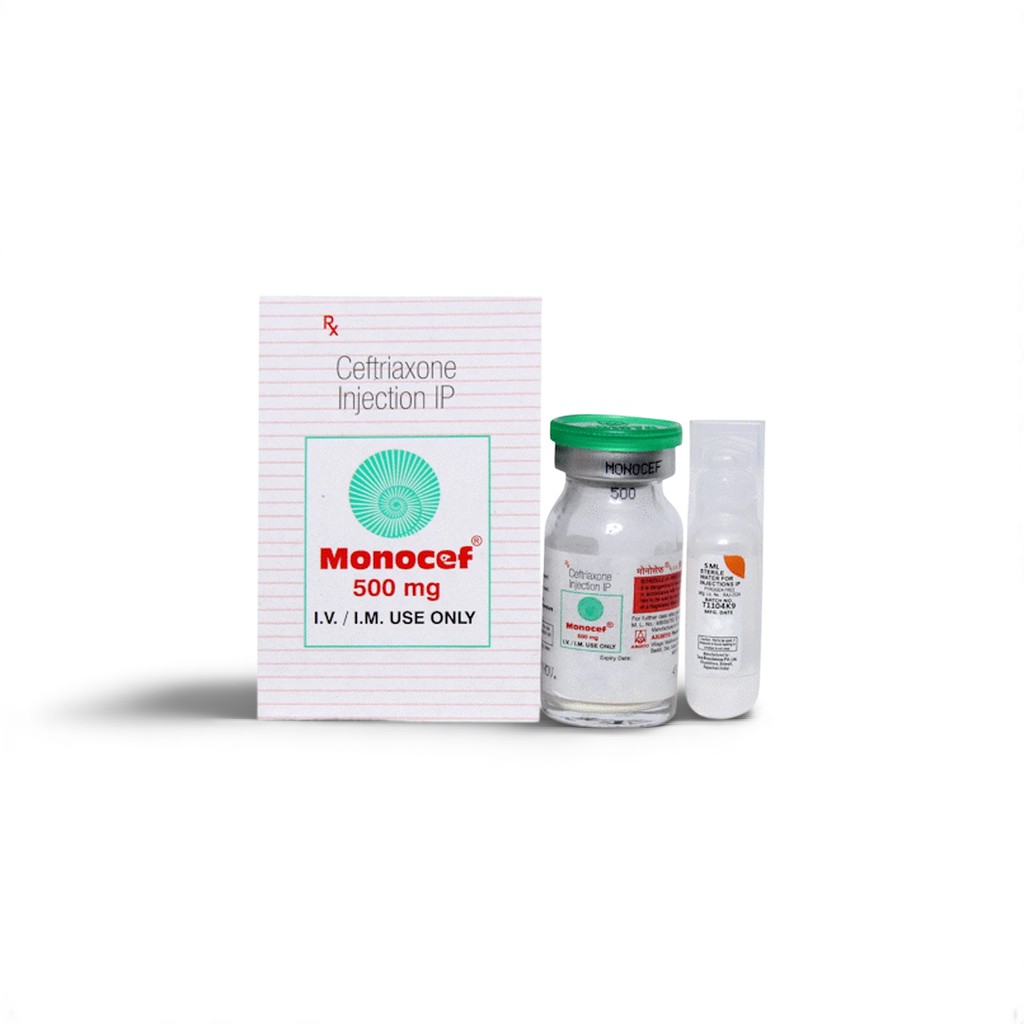
| 🔬 Active Ingredient (Generic Name): | Ceftriaxone Sodium |
|---|---|
| 💊 Indication: | Bacterial Infections (Sepsis, Meningitis, Pneumonia, Skin & Soft Tissue, Urinary) |
| 🇺🇸 US Brand Equivalent: | Rocephin |
| 🏭 Manufacturer: | Aristo Pharmaceuticals Pvt. Ltd (Founded: 1984) |
| 📦 Packaging: | 500 mg Ceftriaxone per 5 ml Vial |
| 🧪 Strength: | 500 mg (Reconstituted with Sterile Water for Injection) |
| 🚚 Delivery Time: | 6–15 days |
Monocef Injection 500 mg contains Ceftriaxone, a third-generation cephalosporin antibiotic renowned for its broad-spectrum activity against both Gram-positive and Gram-negative bacteria. As one of the most prescribed intravenous (IV) antibiotics worldwide, Ceftriaxone’s robust effectiveness stems from its ability to penetrate well into body tissues, including cerebrospinal fluid, making it a first-line agent for severe infections like bacterial meningitis, sepsis, and complicated pneumonia.
Moreover, Ceftriaxone exhibits high stability against most beta-lactamases, enzymes produced by resistant bacterial strains. Its long half-life (approximately 8 hours in adults) enables convenient once- or twice-daily dosing, which reduces nursing time and ensures consistent therapeutic levels. Monocef 500 mg is particularly valuable in hospital settings for treating severe infections, guiding empirical therapy in critically ill patients, and simplifying outpatient parenteral antibiotic therapy (OPAT).
When available for purchase in the US, UK, and Australia, clinicians and patients can leverage Monocef’s cost-effectiveness relative to branded equivalents. Ensuring a prescription and verifying authenticity through batch certificates are essential steps when sourcing Monocef 500 mg, whether domestically or via importation from India.
| Attribute | Detail |
|---|---|
| Chemical Formula | C18H18N8O7S3•Na (as sodium salt) |
| Molecular Weight | 641.47 g/mol (Ceftriaxone sodium) |
| Mechanism of Action | Binds to penicillin-binding proteins (PBPs) → inhibits peptidoglycan cross-linking → bactericidal |
| Bioavailability | 100% (IV/IM administration) |
| Half-Life | ~8 hours in adults; extended in neonates and in renal/hepatic impairment |
| Metabolism & Excretion | Excreted unchanged in urine (50–60%) and bile (40–50%); no dose adjustment needed for mild-to-moderate renal impairment; avoid calcium interactions in neonates |
| Condition | Dose & Administration |
|---|---|
| Community-Acquired Pneumonia (Adults) | 1–2 g IV once daily or 500 mg every 12 hours for 7–14 days based on severity and pathogen |
| Meningitis (Adults & Children ≥1 month) | 2 g IV every 12 hours (total 4 g/day) for 10–14 days; adjust for neonates |
| Sepsis (Adults) | 2 g IV once daily; may increase to 2 g every 12 hours in severe cases; combine with Gram-positive coverage (e.g., vancomycin) |
| Skin & Soft Tissue Infections (Adults) | 1–2 g IV once daily or 500 mg every 12 hours for 7–10 days |
| Uncomplicated Urinary Tract Infections (Adults) | 1 g IV once daily for 3 days |
| Gonorrhea (Adults) | 250 mg IM single dose plus single dose azithromycin 1 g orally (CDC dual therapy) |
| Meningitis (Neonates 0–28 days) | 50–75 mg/kg IV once daily (divided into two doses for neonates 0–14 days); see pediatric guidelines |
Common Side Effects:
Less Common:
Serious (Rare):
Precautions:
Store Monocef 500 mg vials at 20–25°C (68–77°F). Protect from light. Once reconstituted, use within 6 hours at room temperature or within 24 hours if refrigerated (2–8°C). Discard any unused portion accordingly. Keep out of reach of children.
Monocef 500 mg is available by prescription in various markets. When considering purchase, the following keywords can assist in locating reliable suppliers.
Importing from India:
Purchasing Monocef 500 mg Injection directly from India can significantly reduce costs. Ensure compliance with import regulations (FDA personal import scheme, UK MHRA guidelines, TGA permits), maintain a valid prescription, and verify product authenticity with batch certificates to avoid counterfeit antibiotics.
“Ceftriaxone’s long half-life and extensive tissue penetration make Monocef 500 mg Injection a cornerstone for empiric and definitive therapy in severe gram-negative and gram-positive infections. Clinicians should balance dosage with patient renal and hepatic function to optimize outcomes.”
| Active | Ceftriaxone |
|---|---|
| Injections/s | 1, 3, 6 |