
- Your cart is empty
- Continue Shopping
Columbia Human Embryo Base Editing: Facts vs Misinformation | 2026 Study
-
Dr. Tina Sugandh
- Posted on
🧬 Gene Editing • Human Embryos • Base Editing • Columbia University
Columbia Researchers Achieve Precise DNA Editing in Human Embryos — But “Designer Babies” Remain a Myth
📍 Columbia University • Nature Preprint • Base Editing Technology • 6 min read
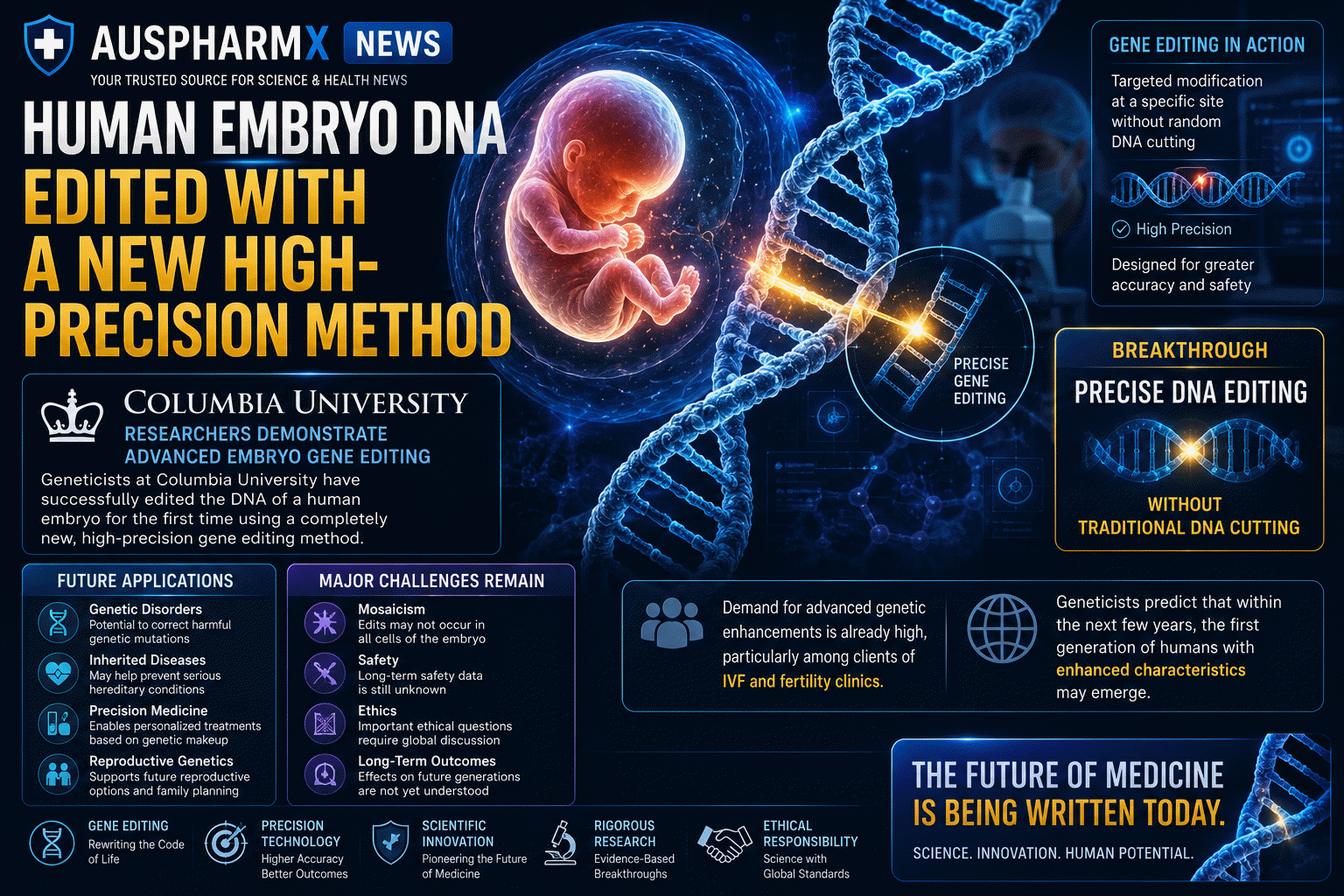
🧬 Columbia University researchers used adenine base editors (ABEs) to make precise single-letter DNA changes in donated research embryos — targeting genes linked to cholesterol (PCSK9) and sickle cell disease (HBB).
Researchers at Columbia University, led by geneticist Dieter Egli, have published a preprint demonstrating precise base editing in human embryos. However, contrary to alarming headlines, this research focuses on preventing serious genetic diseases — not creating “designer babies” with custom eye colors or enhanced intelligence. The technology remains strictly experimental and unapproved for clinical use.
📋 What Columbia Researchers Actually Did
The team used adenine base editing (ABE) — a more precise alternative to conventional CRISPR — to make single-letter DNA changes in donated human embryos. The embryos were surplus IVF embryos donated for research with informed consent. None were intended for pregnancy.
Target genes:
- PCSK9 — a gene where specific mutations lower LDL cholesterol and protect against heart disease (naturally occurring in some human populations)
- HBB — the beta-globin gene; specific mutations cause sickle cell disease and beta-thalassemia
The goal was to demonstrate safer, more precise editing — not to create “designer babies.”
⚠️ Important Clarifications — What This Is NOT:
- NOT the first time — human embryo editing was first reported in 2015
- NOT for “designer babies” — no credible scientist is editing embryos for eye color, hair color, or intelligence
- NOT creating a new species — genetically edited humans would still be Homo sapiens
- NOT approved for clinical use — research only, no pregnancy intended
- NOT legal in most countries — heritable genome editing is prohibited in the US, EU, UK, Australia, and many others
🔬 The Real Science: Base Editing vs. CRISPR
✂️ Conventional CRISPR-Cas9
Creates double-strand breaks (DSBs) in DNA. Prior human embryo editing attempts led to widespread chromosomal loss.
✏️ Adenine Base Editing (ABE)
Converts A•T to G•C directly — no double-strand break. The Egli lab’s approach did not cause detectable chromosomal abnormalities.
⚖️ Regulatory Reality: Heritable Genome Editing Is Illegal in Most Countries
Contrary to claims that “genetically modified humans will appear within 5 years,” heritable genome editing (editing embryos, sperm, or eggs) is prohibited in:
- United States — FDA cannot review or approve heritable editing applications (Congressional rider)
- European Union — prohibited under the Oviedo Convention and national laws
- United Kingdom — only allowed for research under HFEA license, never for pregnancy
- Australia — criminal offense to modify germline cells
- Canada — prohibited under Assisted Human Reproduction Act
The Columbia research was conducted on donated surplus IVF embryos with no intent to transfer for pregnancy, under strict ethical oversight.
⚠️ The He Jiankui Case (2018): Chinese scientist He Jiankui created the first gene-edited babies (using CRISPR) without ethical approval — leading to global condemnation, imprisonment, and strengthened regulations worldwide. This case serves as a cautionary tale, not a template for future practice.
💬 What Experts Actually Say
Dr. Dieter Egli (Columbia University, lead researcher): “This is basic research. We are not trying to create ‘designer babies.’ Our goal is to understand whether base editing could one day prevent serious genetic diseases — but that is many years away, if ever, and would require extensive ethical review and regulatory approval.”
International Commission on the Clinical Use of Human Germline Genome Editing (2020): “Heritable genome editing should only be considered for serious monogenic diseases, with rigorous safety and ethics review — and not for enhancement. Even then, it should only proceed after extensive public debate and regulatory approval.”
🔮 What This Research Actually Means for the Future
✅ What It Shows
- Base editing is more precise than CRISPR in embryos
- Chromosomal loss may be avoidable
- Potential future tool for preventing serious genetic diseases
❌ What It Does NOT Show
- No evidence for “designer babies” (eye color, intelligence)
- No clinical use anytime soon
- No change in legal or ethical landscape
- No “new species” — scientifically nonsensical
⚠️ Remaining Scientific Challenges
- Mosaicism: Not all cells in the embryo were edited
- Efficiency: The percentage of embryos with precise, homogeneous editing needs improvement
- Off-target effects: Comprehensive safety analysis still required
- Long-term safety unknown: No human born from edited embryos; long-term effects cannot be studied
✅ Key Facts
- Columbia research shows base editing precision in embryos
- Targeted PCSK9 (cholesterol) and HBB (sickle cell)
- Research only — no embryos transferred for pregnancy
- Heritable genome editing is illegal in most countries
- “Designer babies” remain science fiction
⚠️ What Alarming Headlines Get Wrong
- Not the “first time” — editing reported since 2015
- No “designer babies” — no intelligence or appearance genes
- No “new species” — scientifically inaccurate
- Not happening “within 5 years” — no legal pathway exists
🔬 Scientific References & External Resources
- National Academies — Heritable Genome Editing report (2020)
- FDA Statement on Human Genome Editing (2022)
- NHMRC — Human germline genome editing (Australia)
- HFEA — Embryo research regulations (UK)
⚠️ Fact-Checking Note: This article corrects widespread misinformation about human embryo editing circulating in sensationalist media. The Columbia University research is an important scientific advance in base editing precision, but it does NOT herald “designer babies” or a “new species.” Heritable genome editing remains illegal in most countries and is not approved for clinical use. This information is for educational purposes only.
© 2026 BuyAllMD.com — Evidence-Based Genetics Research News
