
- Your cart is empty
- Continue Shopping
Swallowable Sponge Test for Esophageal Cancer Risk
-
Dr. Tina Sugandh
- Posted on
🩺 Gastroenterology • Early Detection • Cancer Prevention
How a Capsule With a Sponge Helps Detect a Precancerous Condition of the Esophagus
📋 Cytosponge-TFF3 • Barrett’s Esophagus • Cambridge University • 6 min read
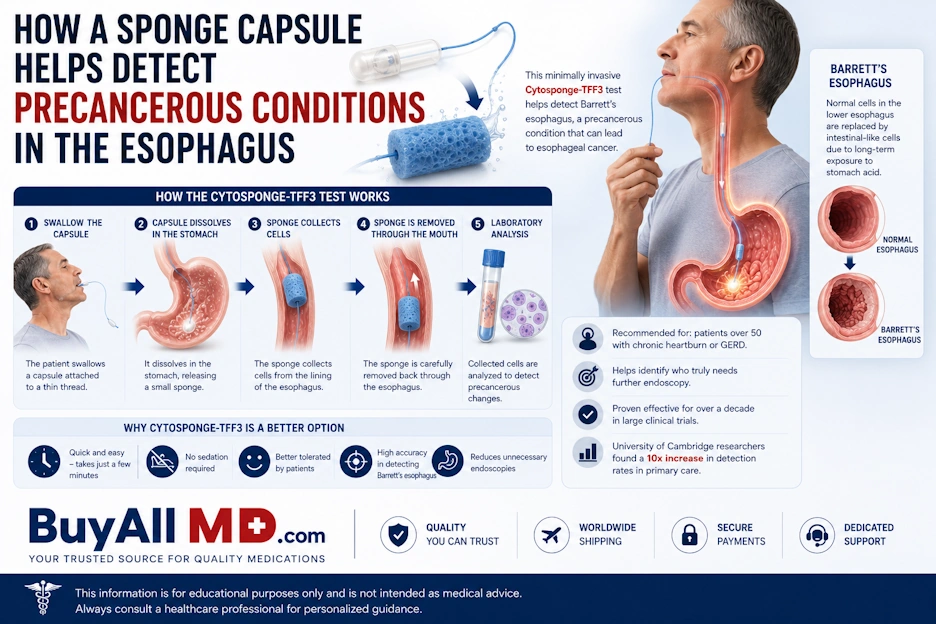
🧫 The animation shows how the Cytosponge-TFF3 test works — a swallowable capsule with a sponge that collects cells from the esophagus.
🩺 What Is Cytosponge-TFF3?
The medical animation demonstrates the principle of the Cytosponge-TFF3 test — a minimally invasive test for detecting Barrett’s esophagus, a precancerous condition of the esophagus.
The patient swallows a capsule attached to a thin thread. In the stomach, the capsule dissolves, releasing a small sponge, which is then gently withdrawn through the esophagus. As it is withdrawn, the sponge collects cells from the esophageal lining for laboratory analysis.
💊
Swallowable Easy to administer
🔬
Cell Collection Sponge collects esophageal cells
✅
10x Detection Compared to standard care
💡 Key Advantage: The test does not require sedation, takes only a few minutes, and is better tolerated by patients than traditional endoscopy.
🧬 What Is Barrett’s Esophagus?
Barrett’s esophagus is a precancerous condition in which the normal cells of the lower esophagus are gradually replaced by cells similar to those found in the intestine, due to long-term exposure to stomach acid.
The test is especially recommended for patients over 50 with chronic heartburn or gastroesophageal reflux. Test results help determine who actually requires further endoscopy.
📌 Key Point: Barrett’s esophagus affects approximately 10-15% of people with chronic GERD. Early detection can prevent progression to esophageal cancer.
⚙️ How Cytosponge-TFF3 Works
💊
1. Swallow the Capsule
The patient swallows a capsule attached to a thin thread, similar to swallowing a large pill.
🧽
2. Sponge Expands
In the stomach, the capsule dissolves, releasing a small sponge that expands.
🔬
3. Cell Collection
The sponge is gently withdrawn through the esophagus, collecting cells for analysis.
📊 Clinical Evidence — Cambridge University Study
Cytosponge-TFF3 has been in use for over a decade and has proven its effectiveness in large clinical studies.
According to Cambridge University researchers, using the test in primary care settings increased the detection of Barrett’s esophagus by approximately tenfold compared to standard care.
10x
Higher Detection Rate Compared to standard care
10+
Years of Use Proven track record
⏱️
Minutes Only Quick procedure time
💡 Key Finding: The test does not require sedation, takes only a few minutes, and is better tolerated by patients than traditional endoscopy.
🎯 Who Should Be Tested?
👴
Age 50+ Higher risk group
🔥
Chronic Heartburn Long-term GERD symptoms
🩺
Gastroesophageal Reflux Long-term acid exposure
🔗 Related Products — Anti-Cancer Medications
Early detection is key in cancer prevention. For patients diagnosed with conditions requiring treatment, our Anti-Cancer category offers a range of medications used in oncology care:
💊
Altraz (Anastrozole) Aromatase inhibitor
💊
Cytotam (Tamoxifen) SERM for breast cancer
💊
Fempro (Letrozole) Aromatase inhibitor
💊
Evermil (Everolimus) mTOR inhibitor
❓ Frequently Asked Questions
What is Barrett’s esophagus?
Barrett’s esophagus is a precancerous condition where normal cells in the lower esophagus are replaced by intestinal-like cells due to long-term acid exposure from GERD.
How does the Cytosponge test work?
The patient swallows a capsule attached to a thread. In the stomach, it dissolves, releasing a sponge. The sponge is gently withdrawn, collecting cells from the esophagus for laboratory analysis.
Is the test painful?
No. The test is well-tolerated, does not require sedation, and is significantly less invasive than traditional endoscopy.
Who should get tested?
Patients over 50 with chronic heartburn or gastroesophageal reflux are the primary candidates for this test.
How effective is the Cytosponge test?
Cambridge University researchers found that using the test in primary care increased detection of Barrett’s esophagus by approximately tenfold compared to standard care.
📚 References & Resources
- PubMed — Cytosponge Research
- NCI — Barrett’s Esophagus Information
- NHS — Barrett’s Esophagus Guide
- University of Cambridge — Research
⚠️ Medical Disclaimer
This content is for informational and educational purposes only. The Cytosponge test is a medical procedure that should be performed by qualified healthcare professionals. Always consult a gastroenterologist or your healthcare provider for personalized advice on screening and treatment.
© 2026 BuyAllMD.com — Evidence-Based Medical Technology & Health News
