
- Your cart is empty
- Continue Shopping
Handwriting Boosts Memory and Learning
-
Dr. Tina Sugandh
- Posted on
🧠 Neuroscience • Cognitive Health • Education • Aging
Study: The Habit of Writing by Hand Is Important at Any Age
📋 NTNU Norway • Brain Connectivity • Memory • Cognitive Aging • 6 min read
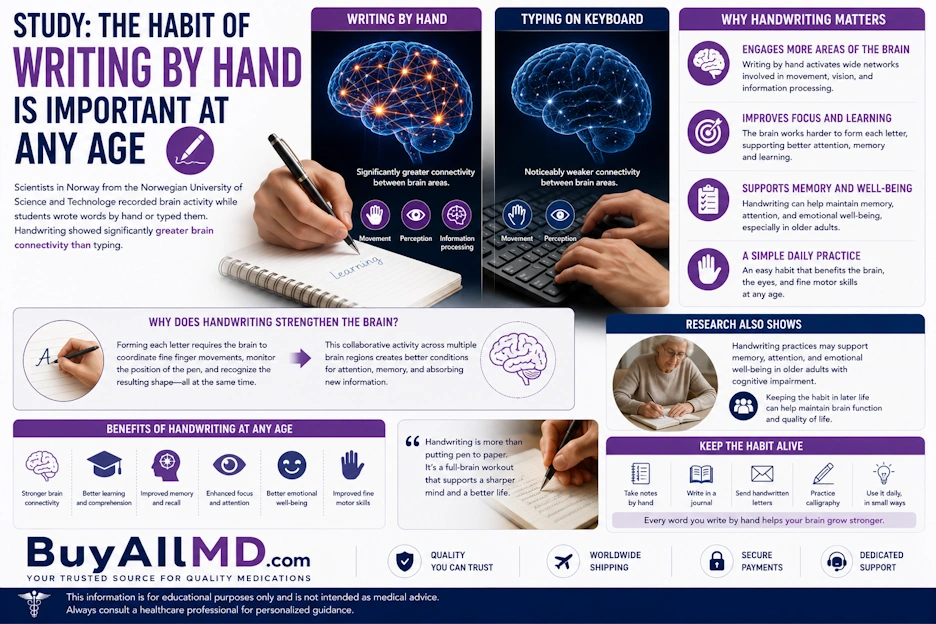
🧠 Norwegian researchers found that handwriting creates significantly greater brain connectivity than typing — making it a powerful tool for learning and cognitive health at any age.
🧠 The Discovery — Handwriting Engages the Brain Differently
In Norway, scientists from the Norwegian University of Science and Technology (NTNU) recorded brain activity in students while they wrote words by hand or typed them on a keyboard. The results were striking: during handwriting, researchers observed significantly greater connectivity between brain regions involved in movement, perception, and information processing. In contrast, typing showed notably weaker connectivity.
This is one of the first studies to directly compare the neural effects of handwriting and typing in real-time, using high-density EEG to measure brain activity. The findings challenge the growing trend of replacing handwriting with digital devices in education and daily life.
🧠
Greater Connectivity
Handwriting activates more brain regions
✍️
Fine Motor Skills
Precise finger movements engage the brain
📝
Memory & Learning
Handwritten notes improve retention
💡 Key Finding: The study provides neurophysiological evidence that handwriting creates more favorable conditions for attention, memory, and learning compared to typing.
🔬 Why Handwriting Engages the Brain More
The researchers explain that when we write by hand, the brain must simultaneously:
- Control precise finger movements — forming each letter requires different motor sequences
- Monitor the position of the pen — visual feedback guides the hand in real-time
- Recognize the resulting symbol — the brain checks each letter as it’s formed
- Integrate sensory information — tactile, visual, and proprioceptive signals are combined
This simultaneous, coordinated work of different brain areas creates stronger neural pathways and enhances cognitive processing. In contrast, typing is more automated and repetitive, requiring less cognitive engagement.
✍️
Handwriting
High cognitive engagement — activates motor, visual, and sensory networks simultaneously.
⌨️
Typing
Lower cognitive engagement — repetitive keystrokes require less brain coordination.
📊 Handwriting vs. Typing — Key Differences
| Factor | Handwriting | Typing |
|---|---|---|
| Brain Connectivity | High — widespread network activation | Low — limited network engagement |
| Motor Control | Precise, varied finger movements | Repetitive, uniform keystrokes |
| Memory Retention | Better — enhanced encoding and recall | Poorer — shallow processing |
| Learning Efficiency | Higher — promotes deeper understanding | Lower — encourages shallower processing |
| Speed | Slower — but more reflective | Faster — but more automatic |
📌 Practical Implication: For students and lifelong learners, taking notes by hand — rather than on a laptop — may lead to better understanding and retention of material.
👴 Cognitive Aging — Why Handwriting Matters for Seniors
The benefits of handwriting extend beyond the classroom. Results from other studies also show that writing practices can support memory, attention, and emotional well-being in older adults with cognitive impairments.
🧠
Memory Support
Handwriting engages memory networks, helping to maintain recall abilities in aging brains.
👀
Attention Maintenance
The focus required for handwriting strengthens attentional control in older adults.
😊
Emotional Well-Being
Journaling and expressive writing can improve mood and reduce stress in seniors.
💡 Key Takeaway: Handwriting is a simple, daily practice that simultaneously engages the brain, vision, and fine motor skills — making it an accessible tool for cognitive health across the lifespan.
📝 How to Incorporate Handwriting into Daily Life
Based on the research findings, here are some practical ways to make handwriting a regular part of your routine:
📓
Keep a Daily Journal
Write about your day, thoughts, or goals for 5–10 minutes each morning or evening.
📝
Take Notes by Hand
In meetings, classes, or when reading, write notes by hand instead of typing.
✉️
Write Letters
Send handwritten letters or cards to friends and family — it’s personal and brain-healthy.
🧩
Practice Calligraphy
The artistic side of handwriting adds creativity and mindfulness to the practice.
❓ Frequently Asked Questions
Is handwriting really better for learning than typing?
Yes. Research from NTNU shows that handwriting creates significantly greater brain connectivity than typing, which enhances attention, memory, and information processing — making it more effective for learning and retention.
Why does handwriting engage the brain more than typing?
Handwriting requires precise, varied finger movements, visual feedback, and real-time recognition of letters. This simultaneous activation of motor, visual, and sensory networks creates stronger neural pathways and deeper cognitive processing.
Can handwriting help seniors with memory problems?
Yes. Studies show that writing practices can support memory, attention, and emotional well-being in older adults with cognitive impairments. It’s a simple, accessible daily practice that engages multiple brain systems.
What did the NTNU study find about handwriting and brain connectivity?
Using high-density EEG, Norwegian researchers found that handwriting produced significantly greater connectivity between brain regions involved in movement, perception, and information processing compared to typing.
How can I incorporate more handwriting into my daily life?
Try keeping a daily journal, taking notes by hand, writing letters, or even practicing calligraphy. Just 5–10 minutes of handwriting daily can provide cognitive benefits.
📚 References & Resources
- NTNU — Norwegian University of Science and Technology
- PubMed — Handwriting and Brain Connectivity Research
- Frontiers in Psychology — Cognitive Benefits of Handwriting
- Alzheimer’s Association — Cognitive Health Tips
- WHO — Dementia Fact Sheet
⚠️ Medical Disclaimer
This content is for informational and educational purposes only. The research findings discussed are based on scientific studies and do not constitute medical advice. While handwriting is a beneficial daily practice for cognitive health, it is not a substitute for professional medical care. Always consult a qualified healthcare provider for personalized health advice, especially if you or a loved one are experiencing cognitive decline.
© 2026 BuyAllMD.com — Evidence-Based Neuroscience & Health Education
