
- Your cart is empty
- Continue Shopping
Lacunar Stroke Study
-
Dr. Tina Sugandh
- Posted on
🧠 Neuroscience • Stroke Research • Vascular Health
New Study Changes Understanding of Ischemic Stroke Causes
📋 University of Edinburgh • Lacunar Stroke • Microvascular Damage • 6 min read
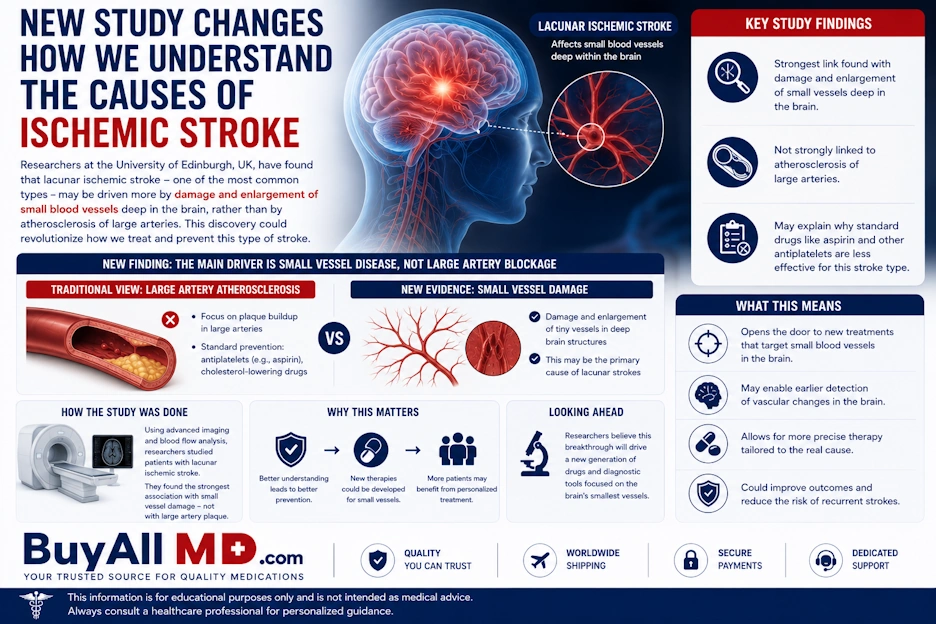
🧫 University of Edinburgh research reveals lacunar strokes may be caused by microvascular damage rather than large artery atherosclerosis.
🧠 The Discovery — Rethinking Stroke Causes
Scientists from the University of Edinburgh have discovered that a common type of stroke — lacunar ischemic stroke — may be linked not to large artery atherosclerosis, but to damage and dilation of small vessels deep within the brain. This finding changes the understanding of one of the most common subtypes of ischemic stroke.
Using advanced imaging techniques and blood flow analysis, researchers examined patients with this stroke type and found the strongest association was with damage to the small vessels supplying deep brain structures, rather than atherosclerosis of large arteries.
🧠
Paradigm Shift New understanding of stroke mechanism
🩸
Microvascular Focus Small vessel damage matters most
🔬
Advanced Imaging Modern techniques reveal new insights
💡 Key Finding: This discovery may explain why standard preventive medications like aspirin and other antiplatelet agents may be less effective for this specific stroke type.
🧬 Understanding Lacunar Ischemic Stroke
Lacunar strokes account for approximately 25% of all ischemic strokes. They occur when blood flow is blocked to the small penetrating arteries deep within the brain — areas responsible for critical functions like movement, coordination, and sensation.
Traditional understanding linked these strokes to large artery atherosclerosis. However, the Edinburgh study suggests that damage to the vessel walls themselves — rather than plaque buildup — may be the primary driver.
💊 Implications for Treatment and Prevention
Understanding this mechanism opens the door to:
🔬
Earlier Detection
Identify changes in small brain vessels earlier, before stroke occurs.
🎯
Personalized Therapy
Precisely match treatment to the specific stroke mechanism.
🛡️
New Prevention Approaches
Target small vessel health, not just large arteries.
💡 Future Vision: This approach could improve patient outcomes and reduce the risk of recurrent cerebrovascular events.
🔗 Related Products for Vascular and Cognitive Support
❓ Frequently Asked Questions
What is a lacunar ischemic stroke?
Lacunar strokes account for about 25% of all ischemic strokes. They occur in the small penetrating arteries deep within the brain, affecting movement, coordination, and sensation.
What did the University of Edinburgh study find?
Researchers found that lacunar strokes are linked to damage and dilation of small vessels deep in the brain, rather than large artery atherosclerosis. This challenges the traditional understanding of stroke mechanisms.
Why might aspirin be less effective for lacunar strokes?
Aspirin targets platelet aggregation in large arteries. If lacunar strokes are caused by small vessel damage rather than clot formation, antiplatelet agents may have limited effectiveness for this specific stroke type.
How could this discovery improve stroke prevention?
Understanding the microvascular mechanism could lead to earlier detection, more precise therapy selection, and new prevention approaches targeting small vessel health rather than just large arteries.
Who conducted this research?
The study was conducted by scientists from the University of Edinburgh in the United Kingdom using advanced imaging techniques and blood flow analysis.
📚 References & Resources
- PubMed — Lacunar Stroke Research
- University of Edinburgh — Research
- American Stroke Association — Stroke Information
- WHO — Stroke Fact Sheet
⚠️ Medical Disclaimer
This content is for informational and educational purposes only. The research findings discussed are based on scientific studies and do not constitute medical advice. Stroke is a medical emergency — if you or someone else experiences stroke symptoms, call emergency services immediately. Always consult a qualified healthcare professional for diagnosis, treatment, and prevention strategies.
© 2026 BuyAllMD.com — Evidence-Based Neuroscience & Public Health News
