
- Your cart is empty
- Continue Shopping
Rifaximin 200/400/550 mg – New Clinical Data, Microbiome Insights & Safety Alerts
-
Dr. Tina Sugandh
- Posted on
🧬 Gastroenterology • Gut Health • IBS-D • SIBO • Hepatic Encephalopathy
Rifaximin — The Gut-Selective Antibiotic Transforming GI Health
📋 Xifaxan Generic • IBS-D • SIBO • Hepatic Encephalopathy • Microbiome-Friendly Antibiotic • 7 min read
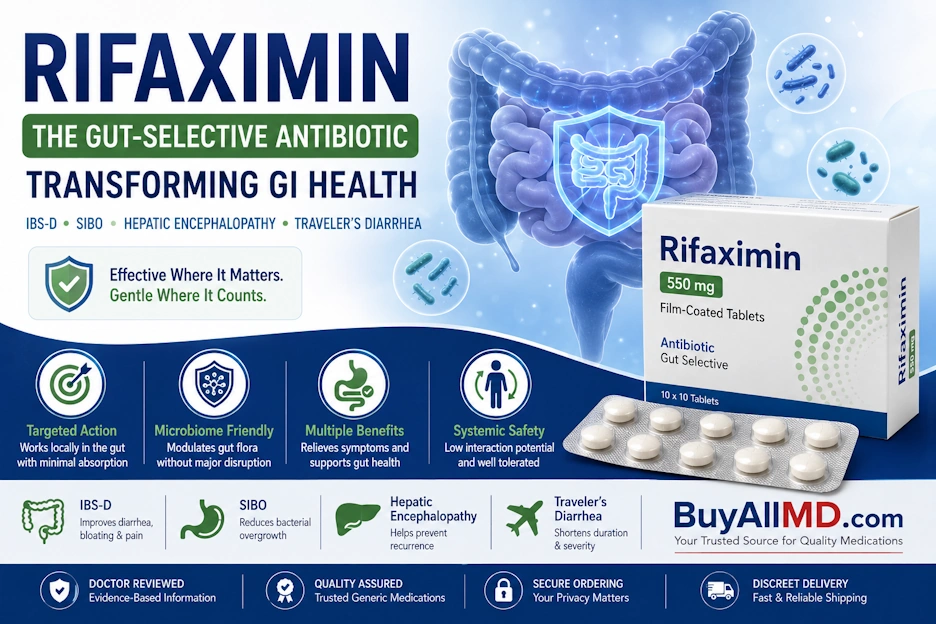
🧬 Rifaximin is a gut-selective, non-systemic antibiotic — transforming treatment for IBS-D, SIBO, and hepatic encephalopathy.
🧬 What Is Rifaximin?
Rifaximin, known globally as the generic alternative to Xifaxan, has become one of the most widely discussed gastrointestinal antibiotics in recent years. As a gut-targeted, non-systemic antimicrobial, it is used for IBS-D, traveler’s diarrhea, hepatic encephalopathy prevention, and emerging off-label roles in gut-microbiome therapy.
Rifaximin is unique among antibiotics because it works inside the gut with minimal absorption into the bloodstream — making it highly effective for gastrointestinal infections and inflammation without typical systemic antibiotic risks.
🧬
Gut-Selective
Minimal systemic absorption
🦠
Microbiome-Friendly
Modulates rather than destroys gut flora
💊
Multiple Indications
IBS-D, SIBO, HE, Traveler’s Diarrhea
💡 Key Insight: Rifaximin is often referred to as a “microbiome-friendly antibiotic” because it does not drastically disrupt the intestinal flora like conventional antibiotics.
🧾 Product Overview — Rifaximin (Generic Xifaxan)
| Property | Details |
|---|---|
| Brand | Generic Xifaxan (Rifaximin) |
| Strengths | 200 mg / 400 mg / 550 mg |
| Therapeutic Class | Gut-selective antimicrobial |
| Used For | IBS-D, Traveler’s Diarrhea, Hepatic Encephalopathy, SIBO |
| Action | Non-systemic, gut-localized antibiotic |
| Legal Status | Prescription-only in most regions |
📊 IBS-D and Microbiome Modulation — New Clinical Findings
Recent trials show that rifaximin offers significant improvement in IBS with diarrhea (IBS-D) symptoms, including:
🩸
Reduced Bloating
Significant improvement in abdominal bloating and discomfort.
🔄
Stable Stool Patterns
More consistent and predictable bowel movements.
😌
Improved Quality of Life
Enhanced daily functioning and well-being indices.
📌 Key Insight: Rifaximin does not drastically disrupt the microbiome like conventional antibiotics. Studies describe a “modulatory” effect that rebalances microbial populations without causing long-term dysbiosis.
🧠 Liver Disease & Brain Fog — Hepatic Encephalopathy Breakthroughs
In hepatology, rifaximin has become a major topic due to its proven ability to reduce hepatic encephalopathy (HE) episodes:
🧬
Reduces Ammonia-Producing Bacteria
Targets gut bacteria that produce ammonia — a key driver of HE symptoms.
🛡️
Lowers HE Recurrence
Proven to reduce the risk of recurrent HE episodes.
🧠
Improves Cognitive Clarity
Many patients experience improved mental clarity and cognitive function.
💡 Key Insight: Many clinicians argue rifaximin is now foundational therapy for chronic HE management, often used alongside lactulose.
🧬 Rifaximin & SIBO — A 2025 Key Focus Area
Small Intestinal Bacterial Overgrowth (SIBO) cases are increasing worldwide. Rifaximin is now considered one of the safest first-line treatments because:
🎯
Stays in the GI Tract
Minimal systemic absorption — targets SIBO directly.
🛡️
Low Resistance Risk
Lower risk of antibiotic resistance compared to systemic antibiotics.
🔄
Combination Therapy
Can be combined with neomycin for methane-dominant SIBO.
📌 Key Insight: GI doctors report better patient tolerance with rifaximin compared to multiple antibiotic combinations previously used.
💊 Dosing Snapshot (Informational Only)
| Indication | Typical Dose | Duration |
|---|---|---|
| IBS-D | 550 mg three times daily | 14 days |
| Traveler’s Diarrhea | 200 mg three times daily | 3 days |
| Hepatic Encephalopathy | 550 mg twice daily | Maintenance |
| SIBO | 550 mg three times daily | Varies by case |
⚠️ Important: Dosing must be guided by a licensed healthcare professional. Do not self-prescribe.
🛡️ Safety & Regulatory Highlights
Regulators reaffirm rifaximin’s strong safety profile, but issued updated guidance:
🤰
Pregnancy
Not recommended during pregnancy unless essential.
⚠️
Bowel Obstruction
Avoid in cases of significant bowel obstruction.
🚨
Allergic Reactions
Monitor for rare allergic reactions — rash, swelling, difficulty breathing.
⚠️ Warning: Counterfeit Xifaxan generics are increasing online. Buyers should rely on trusted, verified pharmacies only.
🔗 Related GI Health Products
👨⚕️ Doctor’s Expert Commentary
“Rifaximin is one of the most elegant tools we have in GI medicine today. Its gut-selective mechanism makes it extremely safe and surprisingly effective in IBS-D, hepatic encephalopathy maintenance, and SIBO. I emphasize to patients that rifaximin is not a ‘general antibiotic’ — it is a targeted therapy with a unique role in restoring gut balance rather than destroying it.”
— Dr. Michael R. Thorne, MD — Consultant Gastroenterologist
❓ Frequently Asked Questions
What is rifaximin used for?
Rifaximin is used for IBS-D, traveler’s diarrhea, hepatic encephalopathy, and SIBO. It is also being studied for other gut-microbiome-related conditions.
Is rifaximin safe for the microbiome?
Yes. Rifaximin is considered a “microbiome-friendly antibiotic” because it works locally in the gut and does not drastically disrupt the intestinal flora like systemic antibiotics.
How does rifaximin help with hepatic encephalopathy?
Rifaximin reduces ammonia-producing bacteria in the gut, lowering ammonia levels in the blood and reducing the risk of HE episodes. It is often used alongside lactulose.
What is the difference between rifaximin and Xifaxan?
Rifaximin is the generic name for the drug; Xifaxan is the brand name. Both contain the same active ingredient and are therapeutically equivalent. Generic versions are significantly more affordable.
Is rifaximin a prescription medication?
Yes. Rifaximin is a prescription-only medication in most regions. It should only be used under the supervision of a licensed healthcare professional.
📚 External Medical References
- AGA — IBS-D Clinical Guidelines
- Springer — Hepatic Encephalopathy Updates
- PMC — Microbiome Effects of Rifaximin
- EMA — Regulatory Information
- ESMO — GI Conference Findings
- FDA — Drug Information
⚠️ Medical Disclaimer
This content is for informational and educational purposes only and does not replace professional medical advice. Rifaximin is a prescription medication and must be used under the supervision of a licensed healthcare professional. Guidelines, approvals, and indications differ between countries. Always consult a qualified healthcare professional for personalized health guidance.
© 2026 BuyAllMD.com — Licensed Global Supplier • Discreet Packaging • Secure Payments
