
- Your cart is empty
- Continue Shopping
Cellular Rejuvenation Therapy Tested in Glaucoma Patients for First Time
-
Dr. Tina Sugandh
- Posted on
🧬 Cellular Rejuvenation • Epigenetic Reprogramming • Glaucoma • Life Biosciences
Cellular Rejuvenation Therapy Tested in Glaucoma Patients for First Time
📍 Life Biosciences (Boston) • First-in-human trial • Phase 1/2 • 6 min read
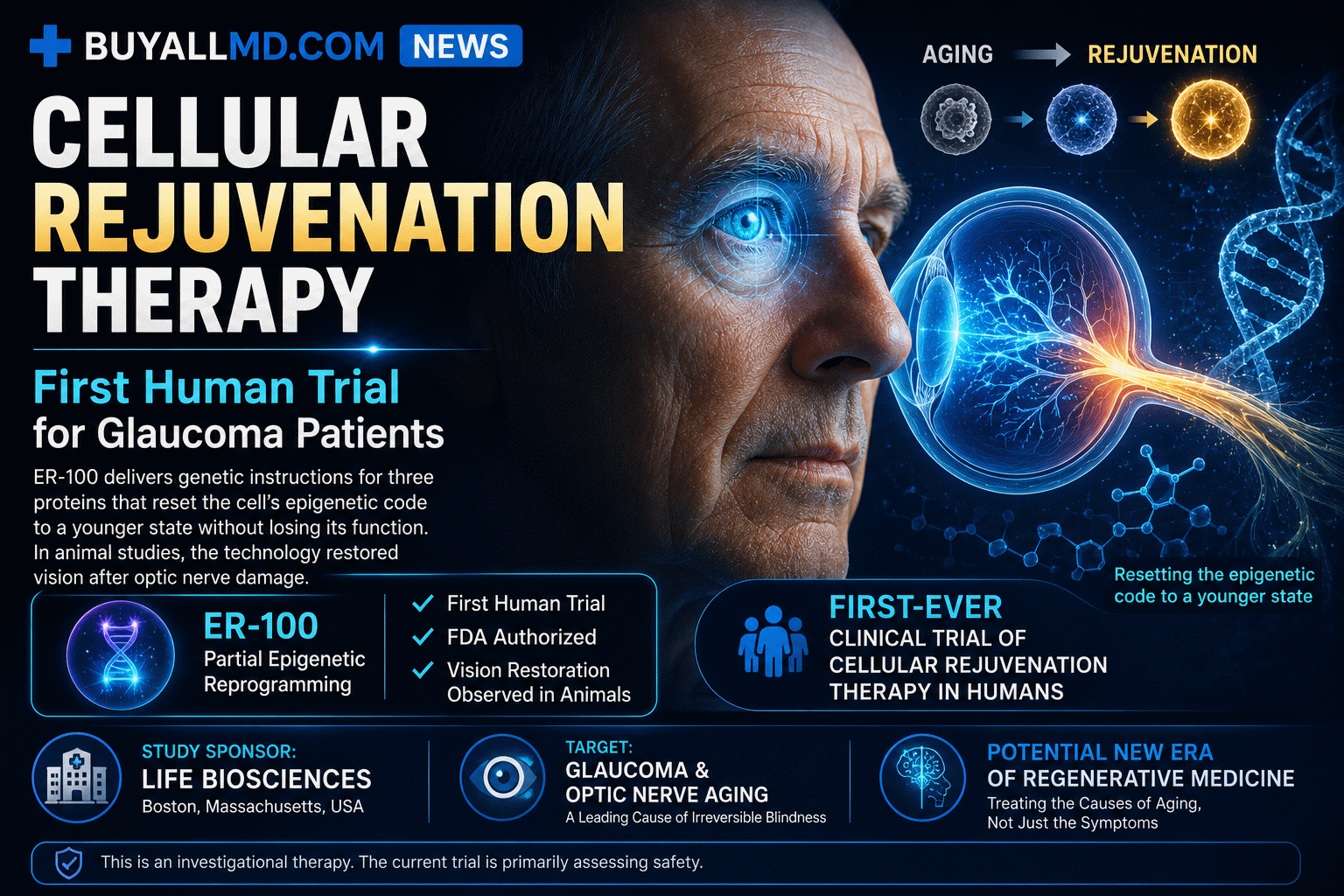
🧬 Life Biosciences’ ER-100 delivers genetic instructions for three Yamanaka factors (OSK) to partially reprogram cells to a younger epigenetic state — now in human trials for glaucoma.
Boston-based biotechnology company Life Biosciences announced that the first patient has received a dose of ER-100 in an FDA-approved clinical trial — the first-ever human trial of a cellular rejuvenation therapy. The treatment delivers genetic instructions for three proteins (OSK factors) that reset a cell’s epigenetic code to a younger state — a process called partial epigenetic reprogramming. ER-100 is being developed for glaucoma, a leading cause of irreversible blindness worldwide.
📋 The Clinical Trial: A Historic First
The Phase 1/2 trial is primarily focused on safety and tolerability in patients with glaucoma. If successful, later-phase trials will evaluate whether the treatment can restore vision or prevent further vision loss — something no existing glaucoma therapy can do.
ER-100 is delivered via an intravitreal injection (directly into the vitreous cavity of the eye), allowing the therapy to target retinal ganglion cells — the neurons whose death causes vision loss in glaucoma.
💡 Why this matters: Current glaucoma treatments only lower intraocular pressure (IOP) — they do not restore lost vision or regenerate damaged optic nerve cells. A therapy that could regenerate retinal ganglion cell axons or rejuvenate stressed cells would represent a revolutionary breakthrough.
🧬 How It Works: Partial Epigenetic Reprogramming
🔬 The Yamanaka Factors (OSK)
ER-100 delivers genetic instructions for three of the four Yamanaka factors (Oct4, Sox2, and Klf4 — “OSK”). These are the proteins that, when expressed together, can reprogram adult cells into induced pluripotent stem cells (iPSCs).
⏪ Partial (Not Full) Reprogramming
Crucially, the cells are not turned all the way back into stem cells (which would erase their identity). Instead, transient, partial expression of OSK resets epigenetic marks — reversing age-related changes — while preserving cell type and function.
🧬 Restoring Youthful Gene Expression
Aging cells accumulate epigenetic changes (DNA methylation patterns, histone modifications) that drive dysfunction. Partial reprogramming reverses these changes, restoring a more youthful gene expression profile without dedifferentiation.
🐭 Preclinical Data: Optic Nerve Regeneration and Vision Restoration
The ER-100 program is built on a substantial body of preclinical research, including landmark studies from David Sinclair’s laboratory at Harvard Medical School (co-founder of Life Biosciences). Key findings include:
🧬 Optic Nerve Regeneration (Mouse Models)
- Partial reprogramming (OSK) regenerated severed optic nerve axons in adult mice
- Restored vision after optic nerve crush injury
- Demonstrated reversal of age-related vision loss in aged mice
📖 Published in Nature (2020)
- OSK expression reverses epigenetic aging in retinal ganglion cells
- Restored youthful DNA methylation patterns
- No tumor formation or loss of cellular identity
👁️ Glaucoma: A Devastating, Irreversible Disease
Glaucoma is the leading cause of irreversible blindness worldwide, affecting an estimated 80 million people globally (projected to reach 111 million by 2040). Current treatments (eye drops, laser, surgery) only lower intraocular pressure (IOP) — they do not restore lost vision or regenerate damaged optic nerve cells.
The core problem in glaucoma: Progressive death of retinal ganglion cells (RGCs), whose axons form the optic nerve. Mammals cannot regenerate these axons. By the time vision loss is noticeable, significant damage has already occurred — and it is permanent.
💡 A therapy that could regenerate RGC axons or rejuvenate stressed RGCs would represent a revolutionary breakthrough — potentially restoring vision or halting progression even after significant damage.
💡 A Paradigm Shift: From Symptom Management to Cellular Rejuvenation
Current medicine largely treats symptoms of age-related diseases (lowering IOP in glaucoma, lowering cholesterol in heart disease, lowering glucose in diabetes). ER-100 represents a fundamentally different approach: targeting the cellular aging process itself.
If successful, this platform could be extended to other age-related diseases:
- Neurodegenerative diseases (Alzheimer’s, Parkinson’s, ALS) — rejuvenating neurons
- Sensorineural hearing loss — regenerating cochlear hair cells or auditory neurons
- Age-related macular degeneration (AMD) — rejuvenating retinal pigment epithelium
- Osteoarthritis — rejuvenating chondrocytes
⚠️ Safety Considerations and Key Challenges
The transition from animal models to human trials raises important safety questions:
- Teratoma risk: Full reprogramming (iPSC generation) carries cancer risk. Partial reprogramming aims to avoid this, but careful safety monitoring is essential.
- Delivery: ER-100 is delivered via an AAV (adeno-associated virus) vector — a platform already used in approved gene therapies (Luxturna, Zolgensma). However, durability and immune response must be evaluated.
- Off-target effects: Unintended reprogramming of non-target cells or systemic effects are concerns addressed by local (intravitreal) delivery.
The Phase 1/2 trial is designed to assess these safety parameters first, with efficacy as a secondary outcome.
✅ Key Takeaways
- First-in-human clinical trial of cellular rejuvenation therapy (ER-100)
- Partial epigenetic reprogramming using OSK factors (Oct4, Sox2, Klf4)
- Target: glaucoma — leading cause of irreversible blindness
- Preclinical studies show optic nerve regeneration and vision restoration in mice
- Phase 1/2 trial focused on safety; potential paradigm shift for age-related diseases
⚠️ Important Caveats
- Phase 1/2 trial — safety data only at this stage
- Human efficacy not yet demonstrated
- Long-term safety risks unknown (teratoma, off-target effects)
- AAV delivery may have immunogenicity concerns
- Not approved for clinical use; investigational only
🔬 Scientific References & External Resources
- Life Biosciences — Developer of ER-100
- Lu Y, Brommer B, et al. “Reprogramming to recover youthful epigenetic information and restore vision.” Nature. 2020;588(7836):124-129. — Landmark study demonstrating OSK-mediated vision restoration. PubMed link
- PubMed — Partial reprogramming glaucoma research
- ClinicalTrials.gov — Search “ER-100 glaucoma” for updates
- National Eye Institute (NEI) — Glaucoma
- David Sinclair Lab (Harvard Medical School) — Research on epigenetic aging and reprogramming
⚠️ Medical & Safety Disclaimer: This article summarizes a clinical trial announcement and preclinical research. ER-100 is an investigational therapy that has not been approved by the FDA or any other regulatory authority for the treatment of glaucoma or any other condition. The safety and efficacy of ER-100 have not been established in humans. Patients with glaucoma should continue current standard-of-care treatments (IOP-lowering medications, laser, or surgery) as prescribed by their ophthalmologist. Do not seek or attempt to access unapproved gene therapies. This information is for educational and research purposes only and does not constitute medical advice.
© 2026 BuyAllMD.com — Evidence-Based Biotechnology & Medical Research News
