
- Your cart is empty
- Continue Shopping
Taurine: Why Your Body Needs This
-
Dr. Tina Sugandh
- Posted on
🧬 Nutrition Science • Amino Acids • Taurine • China Medical University
Taurine: Why Your Body Needs This Amino Acid
📍 China Medical University (Shenyang) • Comprehensive Review • 5 min read
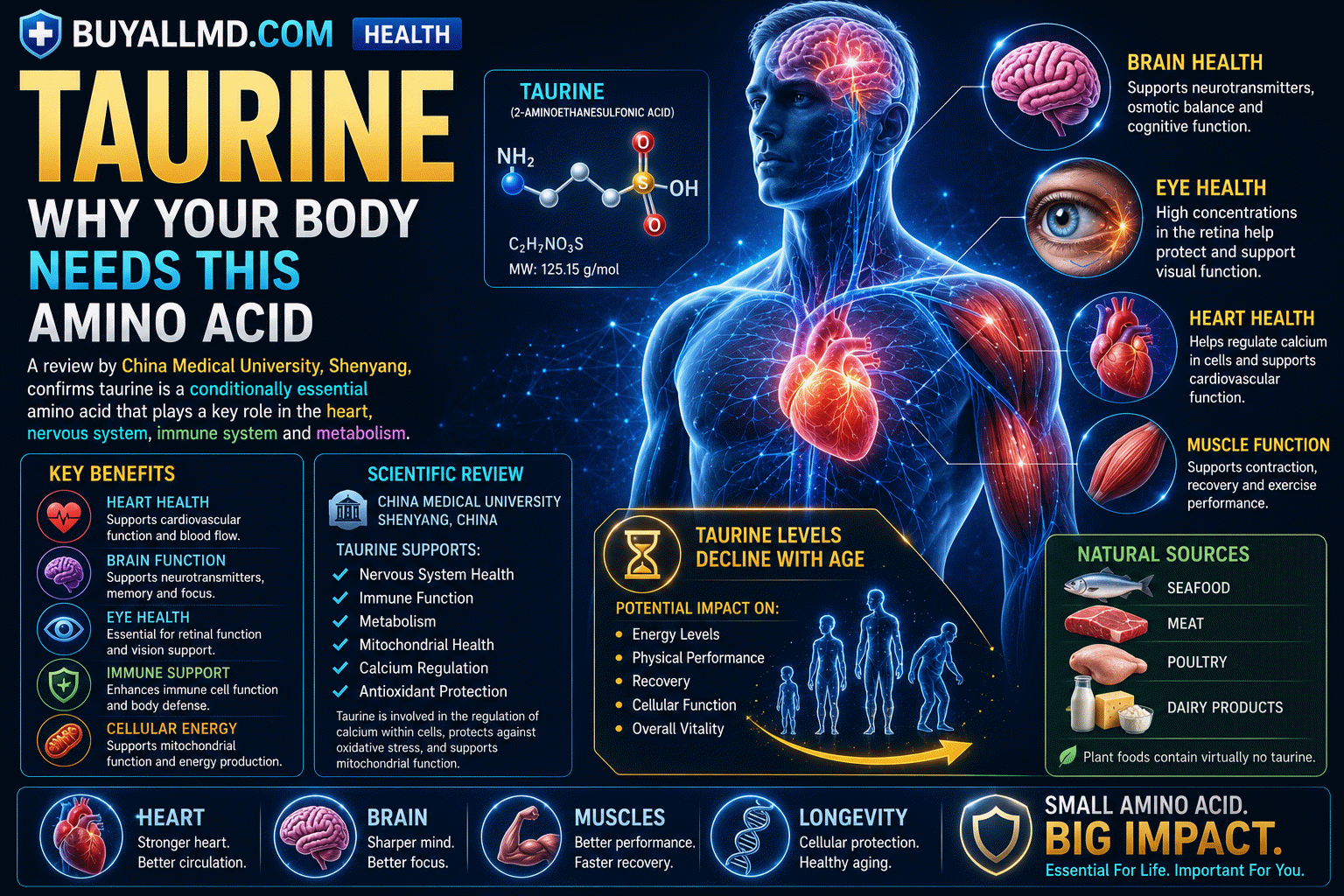
🧬 Taurine is found in high concentrations in the heart, brain, retina, and muscles — playing vital roles in calcium regulation, oxidative stress protection, and mitochondrial function.
Scientists at China Medical University in Shenyang have published a comprehensive review of taurine’s properties and potential for human health. The results show that taurine is a conditionally essential amino acid — produced by the body and obtained from food — that plays important roles in heart function, the nervous system, immunity, and metabolism. With age, taurine levels decline, which researchers link to the deterioration of several physiological functions.
🔬 What Is Taurine? A Unique Amino Acid
Taurine (2-aminoethanesulfonic acid) is a sulfur-containing amino acid found in high concentrations in animal tissues. Unlike most other amino acids, taurine is not incorporated into proteins — instead, it exists as a free amino acid in cells, where it performs critical regulatory functions.
It is considered conditionally essential because while the human body can produce small amounts (primarily in the liver), certain populations — including infants, vegetarians, and individuals with metabolic disorders — may require dietary sources to maintain adequate levels.
💡 Key fact: Taurine is found in particularly high concentrations in energy drinks (often 1000 mg per serving) — but it occurs naturally in meat, seafood, and dairy products long before it became a popular supplement ingredient.
📍 Where Taurine Is Found in the Body
Taurine is present in high concentrations in several key organs and tissues:
❤️
Heart
🧠
Brain
👁️
Retina
💪
Skeletal Muscle
⚙️ Key Functions of Taurine in the Body
🔬 Calcium Regulation
Taurine helps regulate calcium movement within cells — critical for heart contraction, nerve signal transmission, and muscle function. It modulates calcium handling in cardiac cells, contributing to normal heart rhythm.
🛡️ Antioxidant Protection
Taurine protects cells from oxidative stress by neutralizing reactive oxygen species (ROS) and reducing inflammation. It also stabilizes cell membranes and protects mitochondria from damage.
⚡ Mitochondrial Support
Taurine is essential for proper mitochondrial function — the energy-producing powerhouses of cells. It helps maintain mitochondrial structure and efficiency, supporting overall cellular energy production.
🧠 Neurotransmitter Modulation
In the nervous system, taurine acts as an inhibitory neurotransmitter, helping to calm overactive neurons. It also supports synaptic plasticity and protects against excitotoxicity.
📉 Taurine Declines With Age — Implications for Healthy Aging
Research shows that taurine levels decline significantly with age in humans and animals. This decline has been linked to age-related deterioration of several physiological functions:
Cardiovascular function — decreased heart contractility, increased stiffness
Muscle mass and strength — sarcopenia (age-related muscle loss)
Metabolic health — insulin resistance, glucose intolerance
Neurological function — cognitive decline, neuroinflammation
The review authors suggest that maintaining taurine levels through diet or supplementation may support healthy aging — though more clinical research is needed to establish causation and optimal dosing.
🍽️ Dietary Sources of Taurine
Taurine is found almost exclusively in animal-based foods. Plant foods contain negligible amounts:
🦪
Shellfish(scallops, mussels, clams)
🐟
Fish(tuna, salmon, sardines)
🍗
Poultry(dark meat, turkey)
🥛
Dairy(milk, cheese, yogurt)
Important note for vegetarians and vegans: Since plant foods contain virtually no taurine, and the body’s production may be limited, supplementation could be considered — though clinical evidence for this population is limited.
❤️ Potential Health Benefits of Taurine
- Cardiovascular health: May help lower blood pressure, improve heart function, and reduce cholesterol levels
- Metabolic health: Improves insulin sensitivity, supports glucose regulation, and may reduce risk of type 2 diabetes
- Neurological protection: Neuroprotective effects in conditions like epilepsy, stroke, and neurodegenerative diseases
- Eye health: Essential for retinal health — taurine deficiency causes photoreceptor degeneration
- Exercise performance: May reduce muscle fatigue, improve recovery, and protect against exercise-induced oxidative stress
- Anti-aging potential: Emerging research on taurine as a “geroprotector” — slowing age-related decline
⚠️ Safety and Recommendations
Taurine has an excellent safety profile. Studies using doses up to 3-6 grams per day have shown no significant adverse effects in healthy adults. The European Food Safety Authority (EFSA) considers taurine safe at typical supplement doses.
However, the researchers emphasize:
- Taurine is not a replacement for medical treatment of any disease
- Most evidence comes from observational studies and animal models — more human randomized controlled trials are needed
- Individuals with chronic diseases should consult a physician before starting taurine supplementation
- Pregnant or breastfeeding women should consult their healthcare provider
✅ Key Takeaways
- Taurine is a conditionally essential amino acid found in heart, brain, retina, and muscles
- Regulates calcium, protects against oxidative stress, supports mitochondria
- Levels decline with age — linked to deterioration of physiological functions
- Found in seafood, meat, poultry, dairy — virtually absent from plants
- Being studied as a potential factor in healthy aging
⚠️ Important Caveats
- Consult a doctor before taking supplements, especially with chronic diseases
- More human clinical trials needed to confirm benefits
- Not a substitute for medical treatment
- Vegetarians/vegans may have lower levels — supplementation may be considered
🔬 Scientific References & External Resources
- China Medical University (Shenyang) — Lead institution for this review
- PubMed — Taurine health research
- PubMed — Taurine and aging
- PubMed — Taurine cardiovascular benefits
- Wikipedia — Taurine
⚠️ Medical & Safety Disclaimer: This article summarizes a scientific review from China Medical University and is provided for educational purposes only. Taurine is generally recognized as safe, but dietary supplements are not intended to diagnose, treat, cure, or prevent any disease. Individual results vary. Always consult a healthcare professional before starting any new supplement regimen, especially if you have underlying medical conditions, are pregnant or breastfeeding, or are taking medication. This information does not constitute medical advice.
