
- Your cart is empty
- Continue Shopping
Mitochondria Found to Be Directly Connected to Cell Nucleus
-
Dr. Tina Sugandh
- Posted on
🔬 Cell Biology • Mitochondria • University of Arizona
Study: Mitochondria Found to Be Directly Connected to the Cell Nucleus
📍 University of Arizona • Fundamental Cell Biology Discovery • 5 min read
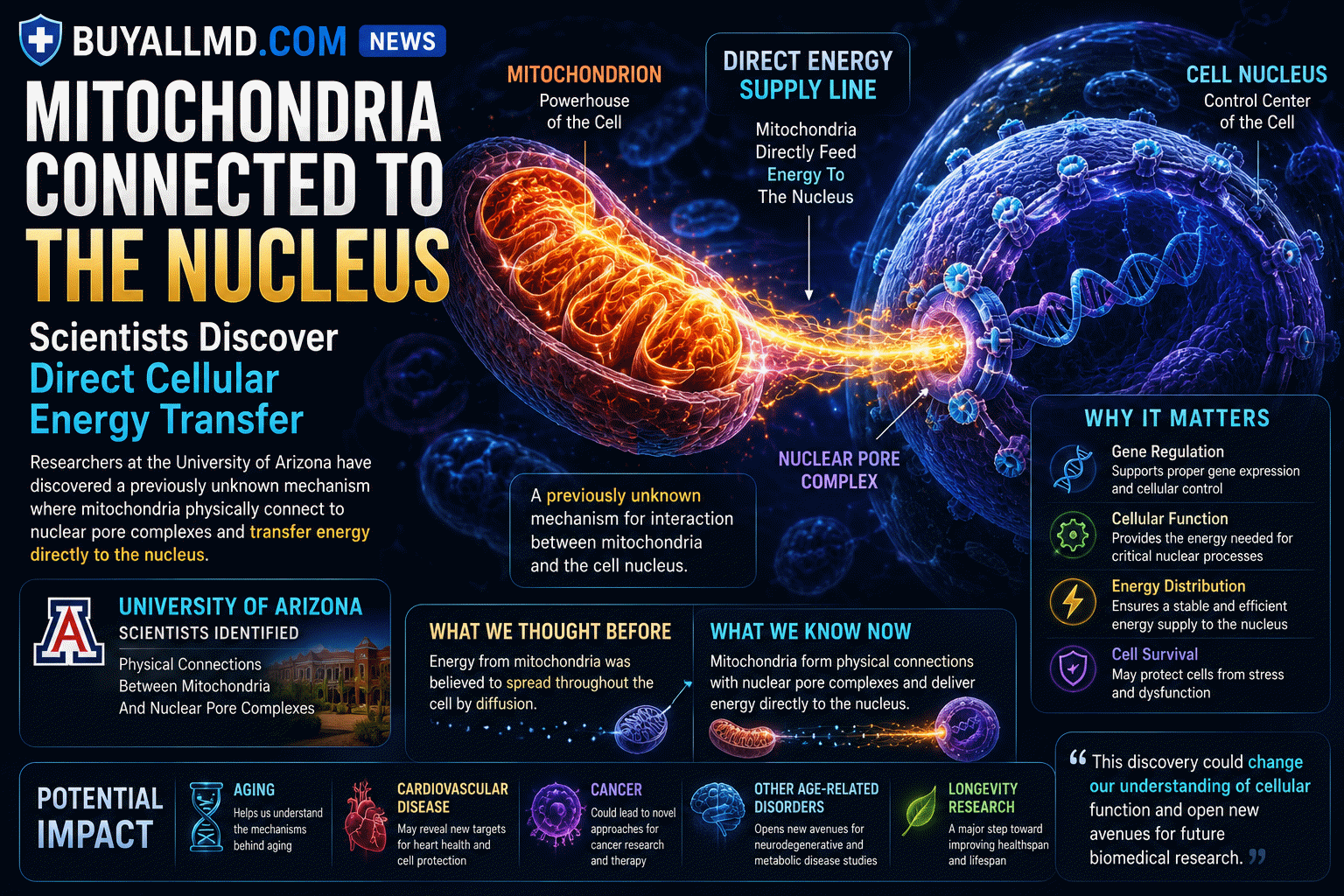
🔬 Mitochondria (green) were found to physically connect to nuclear pore complexes — creating a dedicated energy supply line directly to the cell nucleus.
Scientists at the University of Arizona have discovered a previously unknown mechanism of interaction between mitochondria and the cell nucleus. The research shows that mitochondria physically connect to nuclear pore complexes and transfer energy directly to the nucleus — challenging the long-held belief that energy distribution within cells occurs solely by diffusion.
🔬 The Discovery: A Dedicated Energy Supply Line to the Nucleus
Until now, scientists believed that the energy (ATP) produced by mitochondria was distributed throughout the cell by diffusion — essentially floating randomly until reaching where it was needed. However, the University of Arizona researchers discovered what they describe as a “dedicated energy supply line” that delivers energy directly to the cell nucleus.
The nucleus controls gene expression and many key cellular processes, making stable, reliable energy supply particularly important for its function. This direct physical connection between mitochondria and nuclear pore complexes represents a paradigm shift in our understanding of cellular bioenergetics.
💡 Key insight: Rather than energy being distributed randomly through diffusion, mitochondria have evolved a direct physical connection to the nucleus — ensuring the nucleus has priority access to the energy it needs to control cell function and gene expression.
⚙️ The Mechanism: Mitochondria-Nuclear Pore Connection
The study revealed that mitochondria form physical tethering connections with nuclear pore complexes — the gateways that control molecular traffic in and out of the nucleus. These connections allow mitochondria to:
- Directly transfer ATP (cellular energy currency) to nuclear pore complexes
- Supply energy for nuclear functions including gene transcription, DNA repair, and RNA processing
- Coordinate energy production with nuclear demand — potentially allowing real-time adjustment of energy supply based on nuclear activity
This discovery reveals that cellular energy distribution is not random but is instead spatially organized and regulated — with the nucleus receiving priority energy delivery through dedicated infrastructure.
❓ Why This Matters: Implications for Health and Disease
The authors believe this discovery could fundamentally change our understanding of cell biology and may help explain mechanisms underlying aging, cardiovascular disease, cancer, and other age-related disorders.
🕰️
AgingMitochondrial dysfunction may directly impair nuclear energy supply
❤️
CardiovascularHeart cell energy distribution may depend on this connection
🧬
CancerDisrupted mitochondrial-nuclear communication may drive disease
⚡
Metabolic DiseaseEnergy distribution defects may underlie many conditions
🔬 Fundamental Research with Broad Implications
This research is primarily fundamental (basic) science — it advances our understanding of how cells work at the most basic level. However, such fundamental discoveries often open entirely new directions for biomedical research.
Potential future research directions include:
- Investigating whether mitochondrial-nuclear connections are disrupted in aging and disease
- Developing therapies to restore or enhance these connections in conditions where they are damaged
- Understanding how nuclear energy demand signals to nearby mitochondria
- Exploring whether other organelles also have dedicated energy supply lines
📌 Historical context: For decades, textbooks have taught that ATP (energy) diffuses randomly throughout the cell. This discovery challenges that paradigm, suggesting instead that cells have organized energy distribution infrastructure — analogous to a power grid rather than a random distribution network.
✅ Key Takeaways
- Mitochondria physically connect to nuclear pore complexes
- They transfer energy directly to the nucleus — not just by diffusion
- Discovery challenges decades-old understanding of cellular energy distribution
- May help explain aging, cardiovascular disease, cancer, and metabolic disorders
- Fundamental research opens new directions for biomedical science
⚠️ Important Caveats
- Fundamental research — clinical applications not yet developed
- Further studies needed to confirm mechanisms in human cells
- Disease relevance is still theoretical at this stage
- No treatments based on this discovery exist yet
🔬 Scientific References & External Resources
- University of Arizona — Lead research institution
- PubMed — Mitochondria-nucleus communication research
- PubMed — ATP delivery to nucleus
- Wikipedia — Nuclear pore complexes
⚠️ Scientific Disclaimer: This article summarizes fundamental cell biology research from the University of Arizona. The discovery is at an early, basic science stage. Clinical applications, if any, are years away. This information is for educational purposes only and does not constitute medical advice.
© 2026 BuyAllMD.com — Evidence-Based Cell Biology & Research News
